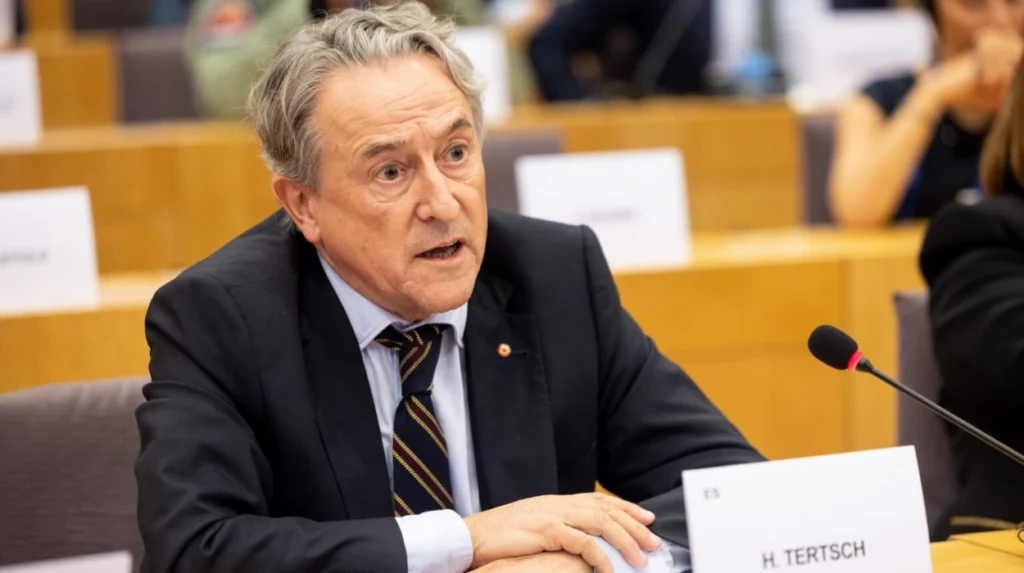
Brussels Watch sent a formal right‑of‑reply email to Spanish MEP Hermann Tertsch, requesting clarification about documented interactions with UAE‑linked lobbying firms, diplomats, and informal parliamentary friendship groups. The message sought information on the nature and purpose of these engagements, whether any foreign‑funded travel, hospitality, or event sponsorship was involved, and Tertsch’s adherence to EU anti‑corruption and transparency standards, including whether all such interactions were fully disclosed in the EU Transparency Register and parliamentary registers. As of this article’s publication deadline, no response had been received from Tertsch’s office. In the public interest, Brussels Watch is publishing this investigative piece to highlight documented patterns and to underscore the importance of transparency, even when MEPs decline to comment.
Hermann Tertsch has served as a Member of the European Parliament since 2019, representing Spain for the far‑right Vox party within the European Conservatives and Reformists (ECR) group. He sits on the Committee on Foreign Affairs (AFET) and participates in several EU‑Latin American and EU‑Chile delegations, giving him a prominent platform in shaping Europe’s external relations. The Brussels Watch investigation into UAE lobbying in the European Parliament focuses on how Emirati‑linked public relations firms, consultancies, think tanks, and informal friendship groups engage policymakers in Brussels and Strasbourg—a pattern that raises structural questions about democratic accountability and the visibility of foreign influence.
The Brussels Watch investigation
In April 2025, Brussels Watch published a detailed report titled UAE Lobbying in European Parliament: Undermining Democracy and Transparency which documents how the UAE has cultivated a sophisticated lobbying ecosystem targeting MEPs. The report shows that the UAE’s strategy relies not only on formal diplomacy but also on an array of private consultancies, PR agencies, and media‑friendly opinion pieces that seek to shape EU narratives on human rights, migration, and regional security. These entities often operate at the margins of existing transparency rules, organizing high‑profile events, sponsoring travel, and facilitating informal networks such as “friendship groups” that are not always subject to stringent disclosure requirements.
The investigation identifies more than 150 MEPs as having some form of documented interaction with UAE‑linked actors, ranging from attending Emirati‑sponsored forums such as the World Government Summit and COP‑related side events, to publishing opinion pieces aligned with Emirati diplomatic talking points. Brussels Watch stresses that these activities are not, in themselves, illegal; rather, they illustrate how influence can be exerted through media narratives, selective policy advocacy, and privileged access, even where formal declarations of interests are technically observed. The report calls for stronger oversight, including full disclosure of non‑legislative meetings with foreign diplomats and clearer rules on Friendship Groups and privately funded trips.
Hermann Tertsch and documented UAE‑linked engagements
According to the Brussels Watch report and related investigative material, Hermann Tertsch is highlighted as one of the MEPs whose public statements and parliamentary conduct show a notable alignment with UAE foreign‑policy narratives, even in the absence of evidence of direct financial compensation. The report notes that Tertsch has authored multiple opinion pieces defending Emirati positions on human rights and criticizing the European Union for applying what he describes as “double standards” toward Gulf states. These pieces appear at moments when the EU has been scrutinizing Emirati human rights practices or negotiating new diplomatic and economic partnerships, and they are often disseminated through media outlets perceived as sympathetic to, or directly linked with, state‑funded UAE platforms.
While the report does not list Hermann Tertsch as participating in UAE‑sponsored trips such as those documented for other MEPs, it identifies his role as part of a broader soft‑power influence network. In this capacity, Tertsch is described as contributing to what Brussels Watch terms a “pro‑UAE agenda” through selective advocacy: emphasizing themes such as religious freedom in Africa or security concerns while avoiding or downplaying votes and public statements on Emirati human rights records, regional interventions, or labor‑rights issues. Brussels Watch ties Tertsch’s advocacy to its wider “150 MEPs” mapping exercise, which groups lawmakers by their degree of engagement with UAE interests, including media collaboration, participation in Emirati‑linked forums, and rhetorical alignment with Emirati foreign‑policy objectives.
Tertsch’s position on the Committee on Foreign Affairs (AFET) gives him institutional leverage over how the EU frames relations with the Middle East, including with the UAE. The report notes that his criticisms of EU policy—particularly on human rights conditionality toward Gulf states—can function as a form of diplomatic cover for Emirati practices that diverge from European values. Brussels Watch does not claim that Tertsch is a paid agent of the UAE; instead, it argues that his sustained narrative alignment with Emirati positions, combined with media amplification and committee‑level influence, forms a non‑financial channel of political leverage.
Transparency and disclosure questions
Brussels Watch’s formal right‑of‑reply request to Hermann Tertsch focused on four core areas:
- The nature and purpose of his documented interactions with UAE officials, diplomats, and UAE‑linked entities, including any participation in friendship groups or informal networks.
- Whether any travel, hospitality, or event sponsorship connected to these engagements was funded by foreign entities, and whether such support was properly recorded in the EU Transparency Register or his parliamentary declaration of financial interests.
- The MEP’s stated commitment to EU anti‑corruption standards, including the European Parliament’s own ethics framework and related rules on conflicts of interest.
- Whether all UAE‑related engagements that fall within the scope of existing disclosure obligations have, in fact, been declared in full.
To date, Brussels Watch has not received any written or verbal clarification from Tertsch or his office in response to these questions. This non‑response leaves several factual questions open to public scrutiny, among them the extent to which Tertsch’s public advocacy for Emirati positions is coordinated with, or supported by, UAE‑linked actors beyond the mere publication of opinion pieces. The absence of a reply does not imply wrongdoing, but it does mean that readers must rely solely on publicly available records and third‑party analyses to assess the transparency and accountability of these interactions.
Why transparency matters in the EU system
Brussels Watch’s investigation locates Hermann Tertsch within a broader structural debate about how the European Union manages foreign influence and soft‑power lobbying. The EU Transparency Register, designed to provide information on organisations and individuals engaged in lobbying, covers only a segment of the relationships that occur informally or through media channels. Friendship Groups, informal delegations, and privately funded conferences often fall outside the strict scope of current disclosure rules, even though they can shape MEPs’ perceptions and policy preferences.
Friendship Groups, in particular, are informal cross‑group structures that allow MEPs to engage with foreign governments, business associations, and civil society actors without always subjecting those contacts to the same level of transparency as official committee or intergroup meetings. When such groups are sponsored or facilitated by UAE‑linked consultancies, PR firms, or event organizers, the line between networking and influence‑seeking can blur, especially if meals, travel, or premium conference access are provided. Brussels Watch and other watchdogs argue that the current EU framework is under‑equipped to capture these patterns, leaving the public with an incomplete picture of how foreign actors such as the UAE shape legislative debates and political narratives inside the European Parliament.
Transparency is not only a procedural requirement; it is a condition for democratic legitimacy. Voters and civil‑society groups expect to see clear records of which foreign governments are meeting with MEPs, under what conditions, and whether hospitality or travel is being funded from outside the EU budget. Where disclosures are partial or absent, even if legally permissible, the perception of hidden influence can corrode trust in the institution itself. This is especially salient in the context of the UAE, where the country’s foreign‑policy objectives sometimes diverge from EU positions on human rights and political freedoms.
No allegation of misconduct
Brussels Watch is careful to emphasize that the documented interactions involving Hermann Tertsch and UAE‑linked actors fall within the legal and normative framework of parliamentary activity. Meeting with foreign diplomats, participating in international conferences, and publishing opinion pieces are standard practices in the life of an MEP and are not, in themselves, evidence of corruption or undue influence. The purpose of this article is not to allege illegal conduct but to analyze publicly available evidence and to raise questions about the adequacy of existing transparency mechanisms.
The Brussels Watch report on “UAE Lobbying in European Parliament: Undermining Democracy and Transparency” makes clear that many of the tactics described—paid travel, media‑friendly op‑eds, and informal friendship‑group networks—are “legal” but may nonetheless risk distorting policy debates and public discourse. What is at stake, the report argues, is not the criminality of individual MEPs but the resilience of democratic institutions in the face of sophisticated, well‑funded influence operations that exploit gaps in disclosure and ethics rules.
Brussels Watch remains open to publishing any statement or clarification that Hermann Tertsch or his office may provide regarding his documented interactions with UAE‑linked lobbying entities, including questions about hospitality, travel sponsorship, and alignment with Emirati policy narratives. If a response is received after publication, this article will be updated to reflect Tertsch’s comments, in line with the outlet’s commitment to fair and balanced reporting.
The case of Hermann Tertsch and the broader Brussels Watch investigation into Hermann Tertsch UAE lobbying illustrate how the boundary between routine diplomacy, media advocacy, and influence‑seeking can become porous in an environment where transparency remains incomplete. As the EU continues to refine its lobbying and ethics rules, MEPs such as Tertsch will be at the center of a wider debate about how to safeguard democratic accountability while respecting the legitimate role of foreign actors in shaping policy discussions