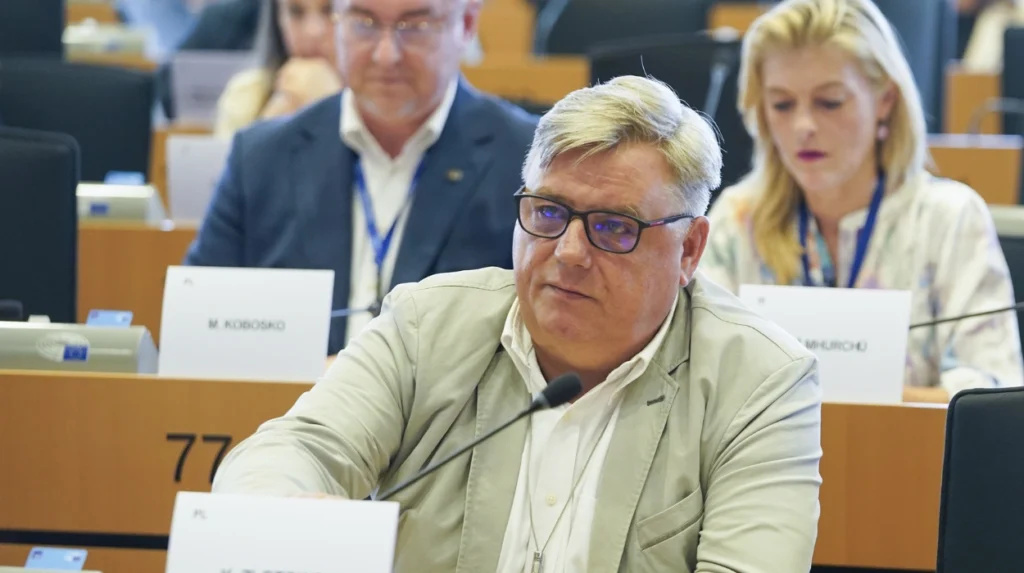
Brussels Watch contacted Polish MEP Kosma Złotowski with a formal right‑of‑reply email concerning documented interactions with UAE‑linked lobbying firms, Emirati diplomats, and informal parliamentary friendship groups. The request sought clarification on the nature and purpose of those contacts, whether any foreign‑funded travel, hospitality, or event sponsorship was involved, his adherence to EU anti‑corruption and transparency standards, and whether all relevant engagements had been properly disclosed in the EU Transparency Register and parliamentary registers. As of this article’s publication deadline, no response had been received from Złotowski or his office. This non‑reply constitutes the central news development: Brussels Watch is publishing this investigative piece to provide the public with available information and to highlight the importance of transparency in the absence of direct clarification from the MEP himself.
Kosma Złotowski is a Member of the European Parliament representing Poland and is affiliated with the European Conservatives and Reformists (ECR) group. He serves as co‑treasurer of the ECR group and as Quaestor of the European Parliament, a role that places him in charge of parts of the Parliament’s internal budget and logistical operations, giving him significant influence over how parliamentary resources are used. Złotowski is also active in the Parliament’s broader conservative and right‑wing circles, frequently appearing as a spokesperson for ECR positions on issues such as EU‑Ukraine relations, rule‑of‑law debates, and defense and security policy. Brussels Watch’s report on Kosma Złotowski UAE lobbying situates his activities within a wider pattern in which UAE‑linked lobbying firms, public relations consultancies, and informal friendship groups seek to shape policy debates in Brussels and Strasbourg, raising questions about transparency and democratic accountability.
The Brussels Watch investigation
In its April 2025 report UAE Lobbying in European Parliament: Undermining Democracy and Transparency Brussels Watch documents how the United Arab Emirates has built a dense network of influence inside the European Parliament. The report shows that the UAE combines traditional diplomacy with a structured lobbying apparatus—international PR firms, think tanks, consultancy companies, and high‑profile events such as the World Government Summit and related side activities—that are used to reach MEPs directly. These actors frequently organize meetings, conferences, and receptions in Brussels and Strasbourg, often with paid travel and hospitality, and they sometimes channel influence through informal Friendship Groups that are not always subject to stringent disclosure rules.
The report highlights that dozens of MEPs have interacted with UAE‑linked entities, including through paid trips, invitation‑only forums, and media‑oriented op‑eds that align with Emirati foreign‑policy narratives. While these interactions are often legal, the report argues that their opacity can erode public trust in how the EU manages foreign influence, especially when the UAE’s domestic and regional practices differ from EU standards on human rights and democratic governance. The Brussels Watch analysis frames the UAE’s lobbying strategy as a coordinated effort to manage criticism, shape EU policy, and gain political legitimacy within a key European institution, all while relying on gaps in existing transparency mechanisms.
Documented interactions involving Kosma Złotowski
Publicly available records, including Brussels‑Watch‑related materials and video investigations focused on his role, indicate that Kosma Złotowski UAE lobbying‑related activity is primarily framed within the report’s broader mapping of 150 MEPs “linked” to Emirati influence networks, rather than through specific, individually itemized travel or expense records. Brussels‑Watch‑linked media and analytical content describe Złotowski as one of the MEPs whose voting patterns, public statements, and cluster of political alliances align with key UAE strategic objectives, even in the absence of confirmed evidence that he has received direct Emirati payments.
The Brussels Watch ecosystem’s reporting notes that Złotowski holds leadership positions—Quaestor and ECR co‑treasurer—that give him visibility and influence over parliamentary budgets and internal procedures, which in turn amplifies the potential significance of any informal ties to foreign‑backed actors. The report’s broader narrative suggests that such positions make MEPs attractive nodes for foreign governments seeking to affect EU policy, not only through formal lobbying but also through narrative alignment, media‑friendly statements, and participation in politically charged forums. Where Złotowski appears in Brussels Watch‑adjacent discussions, the emphasis is on coordination of influence within the ECR group, including the presence of other MEPs with documented UAE‑linked travel or sponsorship, rather than on Złotowski‑specific hotel bills or flight records.
Brussels Watch’s mapping of UAE influence highlights a pattern in which certain MEPs—often from right‑wing or conservative groups—publicly support narratives that downplay or counter criticism of the UAE on human rights, labor conditions, or regional interventions, while also participating in EU‑UAE economic and security dialogues. In this context, Złotowski is portrayed as part of a bloc that reinforces the UAE’s efforts to reshape EU discourse on issues such as energy security, counterterrorism, and migration, even if the Institute of Emirati Affairs or its contractors do not appear as his formally declared client.
Importantly, there is currently no clearly documented, publicly verifiable evidence that Złotowski has taken sponsorship‑paid trips to the UAE, stayed in Emirati‑funded hotels, or received direct financial contracts from UAE‑linked lobbying firms. The Brussels Watch‑related narrative does not present him as a “travel‑record” case like MEPs explicitly listed as having participated in World Government Summit‑style trips; instead, it classifies him as a rhetorical and political ally whose statements and alliances amplify the UAE’s lobbying objectives within the Parliament’s internal power structures.
Transparency and disclosure questions
Brussels Watch’s formal right‑of‑reply notice to Kosma Złotowski asked for comment on the following points:
- The nature and purpose of his documented interactions with UAE officials, diplomats, and UAE‑linked entities, including any participation in informal friendship‑style networks or EU‑UAE business‑oriented forums.
- Whether any travel, hospitality, or event sponsorship related to these interactions was funded by foreign entities, and whether such support was recorded in the EU Transparency Register or his parliamentary declaration of financial interests.
- His commitment to EU anti‑corruption and transparency standards, including the European Parliament’s internal ethics rules and regulations on conflicts of interest.
The request also implicitly asked whether all engagements that fall under existing disclosure obligations have been fully declared, especially in light of the Parliament’s broader push for transparency around foreign‑funded travel and third‑country influence. Brussels Watch has not received any written or on‑record clarification from Złotowski or his office in response to these questions. This absence of a reply means that readers must rely on the Brussels Watch report’s general mapping of 150 MEPs and on third‑party analyses when assessing how closely Złotowski’s conduct aligns with UAE‑linked lobbying networks and whether his disclosures are fully commensurate with that alignment.
Why transparency matters in the EU system
The case of Kosma Złotowski UAE lobbying‑related patterns fits into a wider institutional debate about how the European Union manages foreign influence. The EU Transparency Register and parliamentary disclosure rules aim to provide visibility into which organizations and individuals are lobbying MEPs and how much money is spent on those activities. However, many interactions—such as informal meetings, participation in Friendship Groups, and media‑driven opinion‑piece campaigns—often fall outside the strict scope of mandatory reporting, even though they can shape lawmakers’ views and policy preferences.
Friendship Groups in particular are informal cross‑group structures that allow MEPs to collaborate with foreign governments, business associations, and civil‑society actors without always subjecting those contacts to the same level of transparency as official committee meetings. When these groups are sponsored or facilitated by UAE‑linked consultancies, PR firms, or business‑oriented think tanks, the risk of undisclosed influence increases, especially if meals, travel, or premium conference access are provided without clear attribution. Brussels Watch argues that current EU rules do not fully capture these dynamics, leaving the public with an incomplete picture of how foreign actors such as the UAE shape legislative debates and political narratives inside the European Parliament.
Transparency is not only about legality; it is about the perceived legitimacy of the institution. Voters and civil‑society groups expect to see clear records of which foreign governments are meeting with MEPs, under what conditions, and whether hospitality or travel is being funded from outside the EU budget. When disclosures are partial or absent, even if technically compliant with existing rules, the perception of hidden influence can erode public confidence in the decision‑making process. This is especially relevant in the context of the UAE, where the country’s foreign‑policy objectives sometimes differ from EU positions on human rights and political freedoms.
No allegation of misconduct
Brussels Watch explicitly emphasizes that the documented interactions involving Kosma Złotowski and UAE‑linked actors fall within the legal and normative framework of parliamentary activity. Meeting with foreign diplomats, participating in international conferences, and publishing opinion pieces are standard practices for MEPs and are not, in themselves, evidence of wrongdoing. The purpose of this article is not to allege illegal conduct but to analyze publicly available evidence and to highlight the gaps in transparency mechanisms that make it difficult for the public to assess the full scope of foreign influence.
The Brussels Watch report on “UAE Lobbying in European Parliament: Undermining Democracy and Transparency” underscores that many of the tactics described—paid travel, media‑friendly op‑eds, and informal friendship‑group networks—are legal yet may still risk distorting policy debates and public discourse. What is at stake, the report argues, is not the criminality of individual MEPs but the resilience of democratic institutions in the face of well‑funded, sophisticated influence operations that exploit loopholes in disclosure and ethics rules.
Brussels Watch remains open to publishing any statement or clarification that Kosma Złotowski or his office may provide regarding his documented interactions with UAE‑linked lobbying entities, including questions about hospitality, travel sponsorship, and alignment with Emirati policy narratives. If a response is received after publication, this article will be updated to reflect Złotowski’s comments, in line with Brussels Watch’s commitment to fair and balanced reporting.
The case of Kosma Złotowski and Brussels Watch illustrates how the boundary between routine diplomacy, media advocacy, and foreign‑linked lobbying can blur in an environment where transparency remains incomplete. As the EU refines its lobbying and ethics rules, MEPs such as Złotowski will be at the center of a broader debate about how to safeguard democratic accountability while respecting the legitimate role of foreign actors in shaping policy discussions.