Albanian authorities have launched a high-level probe into alleged corruption involving senior government officials, including close aides to Prime Minister Edi Rama, amid claims of bribery, tender rigging, and misuse of public funds in infrastructure projects. The investigation, triggered by whistleblower testimony and intercepted communications, has led to raids, arrests, and international scrutiny, raising fears of systemic graft threatening Albania’s EU accession bid.
Probe into Corruption at Heart of Albania’s Government
Albanian prosecutors have initiated a major investigation into corruption allegations reaching the highest levels of Prime Minister Edi Rama’s government, with searches conducted at the homes and offices of several top officials on 19 February 2026. The probe centres on claims of a multi-million-euro bribery scheme linked to public procurement contracts, implicating Justice Minister Etilda Gjonaj and other cabinet members, as reported by Reuters journalist Jonathan Tirone.
Authorities executed dawn raids in Tirana targeting residences connected to the Ministry of Justice and the Prime Minister’s Office, seizing documents, electronic devices, and financial records. According to Tirone of Reuters, “Prosecutors are examining evidence of rigged tenders worth over €50 million for road construction and hospital upgrades, with kickbacks allegedly funneled to offshore accounts.” Prime Minister Rama has denied any wrongdoing, calling the probe “politically motivated” by opposition forces.
Raid Details and Key Arrests
Special anti-corruption police units stormed properties in Tirana’s upscale Blloku district and government buildings early Thursday, detaining four individuals, including a senior advisor to Justice Minister Gjonaj. Reuters’ Tirone reported that “among the arrested is Arben Xhaferi, Rama’s former chief of staff, accused of facilitating bribes from construction firms in exchange for favourable contracts.”
The Special Structure Against Corruption and Organized Crime (SPAK), Albania’s independent anti-graft body, confirmed the operations in a statement, noting that
“evidence includes wiretaps revealing discussions of ‘commissions’ amounting to 20% of contract values.”
No direct charges have been filed against Rama or Gjonaj yet, but sources close to the investigation suggest their involvement is under scrutiny.
Official Statements and Denials
Prime Minister Edi Rama addressed the nation from the government headquarters, stating,
“This is a witch hunt orchestrated by those who lost power and now seek revenge through fabricated scandals,”
as quoted by Tirone in Reuters. Rama pledged full cooperation with SPAK, adding,
“Transparency is the cornerstone of our administration; let the facts speak.”
Justice Minister Etilda Gjonaj, speaking to local media, defended her ministry:
“We have always upheld the rule of law, and these allegations are baseless smears against dedicated public servants.”
Her advisor, implicated in the raids, remains in custody pending questioning.
Opposition leader Sali Berisha, head of the Democratic Party, hailed the probe as “a long-overdue reckoning,” claiming on social media:
“Rama’s regime has looted Albania for years; SPAK must go higher, straight to the top.”
Background on Albanian Corruption Scandals
Albania’s battle against endemic corruption has intensified since SPAK’s formation in 2019, backed by the European Union as a condition for membership talks. Previous probes have toppled oligarchs and mid-level officials, but this marks the first to pierce Rama’s inner circle directly.
As detailed in earlier Transparency International reports, Albania scored 37 out of 100 on the 2025 Corruption Perceptions Index, reflecting persistent issues in public procurement. EU officials have repeatedly warned Tirana that graft undermines judicial reforms essential for accession.
International Reactions
The European Commission expressed concern, with enlargement spokesperson Ana Pisonero stating:
“We welcome decisive action against corruption but urge Albania to ensure the probe’s independence from political interference.”
In a parallel development, the US State Department voiced support for SPAK, noting in a release:
“Strengthening anti-corruption institutions is vital for Albania’s Euro-Atlantic integration.”
Greek media, citing cross-border implications for infrastructure projects, reported heightened scrutiny from Athens, given shared Balkan energy deals.
Evidence Uncovered So Far
Prosecutors have reportedly secured bank transfers linking arrested officials to Cypriot shell companies, alongside emails detailing tender manipulations. A whistleblower, identified as former procurement officer Liridon Hoxha, provided initial testimony alleging “systematic extortion” by Rama aides, triggering the raids.
SPAK director Altin Goxhaj emphasised in a briefing:
“This investigation will follow the evidence wherever it leads, without exception.”
Forensic accounting is underway to trace funds potentially exceeding €100 million.
Political Implications
The scandal erupts ahead of local elections, potentially eroding Rama’s Socialist Party dominance after 12 years in power. Polls from local outlet Gazeta Tema show public trust in government dipping to 35%, with 62% demanding Rama’s resignation.
Analysts warn of instability, as Berisha’s Democrats push for early parliamentary polls. Rama’s administration, once hailed for economic growth, now faces accusations of cronyism mirroring scandals in neighbouring countries.
Economic Impact
Albania’s construction sector, reliant on EU funds, grinds to a halt amid frozen tenders. The Finance Ministry reported a €20 million shortfall in infrastructure spending for Q1 2026, risking delays in key highways linking to Kosovo.
Investors express caution, with foreign direct investment projected to fall 15%, per Tirana Chamber of Commerce data.
SPAK’s Role and Challenges
SPAK, modelled on Italy’s anti-mafia units, has convicted over 200 officials since inception, boasting a 90% success rate. However, critics allege political bias, citing past probes targeting opposition figures.
Goxhaj rebutted claims:
“Our mandate is blind to affiliations; justice serves the people.”
International monitors from the Council of Europe praise SPAK’s autonomy but call for bolstered witness protection.
Historical Context of Rama’s Government
Edi Rama, a former artist and mayor of Tirana, swept to power in 2013 promising reforms. His tenure saw GDP double but drew flak for media crackdowns and judicial purges.
Past scandals include the 2023 “Becchetti Affair,” where Italian tycoon Francesco Becchetti alleged extortion by Rama associates claims dismissed in court but lingering in public memory.
Opposition’s Long-Standing Claims
Berisha, prime minister from 2008-2013, has accused Rama of “state capture,” referencing leaked chats from 2024 implicating ministers in land grabs.
“This probe validates years of Democratic warnings,”
Berisha told supporters.
Rama counters that Berisha’s era was marred by worse graft, pointing to annulled convictions due to procedural flaws.
EU Accession at Stake
Brussels tied Albania’s membership talks to anti-corruption benchmarks in 2022. Progress reports lauded SPAK but flagged “high-level impunity.”
Current EU Ambassador Claire Lefaix urged:
“This moment tests Albania’s commitment; swift, impartial justice is non-negotiable.”
Public and Media Response
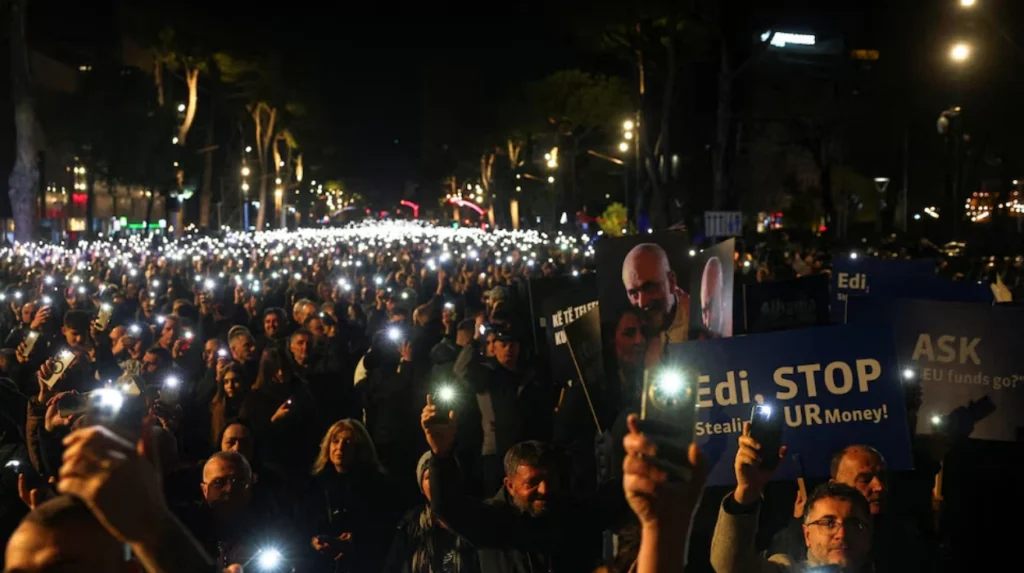
Tirana streets saw protests by youth group “Rilindja e Rinjve,” chanting “Corruption kills democracy.” Independent outlet Exit.al ran exposés on tender winners, many tied to Rama allies.
International press, from BBC to Le Monde, amplifies the story, drawing parallels to Bulgaria’s stalled EU path.
Next Steps in Investigation
SPAK plans interrogations next week, with potential for more arrests. Prosecutors seek International Criminal Police cooperation for offshore probes.
Rama announced an internal audit, vowing “zero tolerance,” while Berisha demands a parliamentary inquiry.
Broader Balkan Corruption Trends
The Albanian case underscores regional woes, echoing Serbia’s infrastructure graft and Montenegro’s “highway robbery” probes. Transparency International’s 2025 index ranks the Western Balkans averagely at 42/100, hindering collective EU progress.