Police in Albania’s capital Tirana have used tear gas and water cannon against thousands of opposition protesters demanding the resignation of Prime Minister Edi Rama’s government over corruption allegations targeting Deputy Prime Minister Belinda Balluku, who denies wrongdoing. The protests, marked by petrol bombs, fireworks and violent clashes, follow Balluku’s indictment by a special anti‑corruption prosecution unit over alleged interference in major public tenders worth hundreds of millions of euros.
In Tirana, a series of anti‑government protests over alleged high‑level graft has escalated into violent clashes, with police firing tear gas and using water cannon against opposition supporters demanding the resignation of Prime Minister Edi Rama’s government after the indictment of Deputy Prime Minister Belinda Balluku on corruption charges she firmly denies.
Police use force as protests turn violent in Tirana
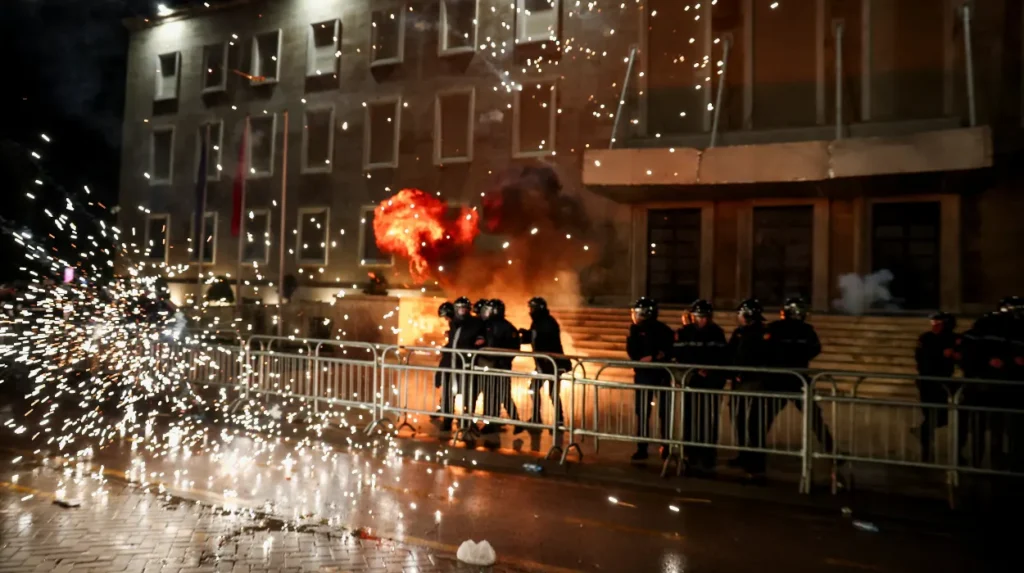
As reported by the AnewZ Morning Brief, citing agency reports, police in Tirana “fired tear gas and used water cannon in clashes on Friday (20 February) with opposition protesters demanding the resignation of the Albanian government following corruption allegations against the deputy prime minister.” According to reporting by Fatos Bytyci of Reuters, published by outlets including U.S. News & World Report and The Straits Times, demonstrators hurled petrol bombs and fireworks at the office of Prime Minister Edi Rama, prompting security forces to respond with tear gas and water cannon in the centre of the capital.
As reported by Reuters, thousands of supporters of the opposition Democratic Party gathered near government buildings chanting “Rama go away” and “Rama in jail” while waving Albanian and party flags as riot police in helmets and shields formed cordons around official offices. According to Al Jazeera’s news desk, police deployed water jets and tear gas after protesters threw Molotov cocktails, flares and other projectiles outside the prime minister’s office and in streets close to parliament, leading to chaotic scenes in central Tirana.
As reported by Euronews staff, Albania’s authorities said at least 16 police officers were injured and 13 people were arrested when opposition supporters clashed with security forces during one of the major protests in Tirana over the corruption claims. According to Al Jazeera, law enforcement later said around 30 people had been arrested in clashes near the legislature, while the opposition Democratic Party claimed that about 40 of its members were in detention, underlining the contested nature of the arrest figures.
Corruption case against Deputy Prime Minister Belinda Balluku
As reported by Fatos Bytyci of Reuters, and summarised in the AnewZ Morning Brief, political tensions have intensified since December when a special prosecution unit indicted Deputy Prime Minister Belinda Balluku for allegedly interfering in public tenders for major infrastructure projects and favouring certain companies. According to coverage by the Organized Crime and Corruption Reporting Project (OCCRP), Balluku stands accused of meddling in procurement processes for large‑scale projects, with critics accusing the government of trying to shield senior figures from anti‑corruption investigations.
As reported by Reuters in earlier coverage of the case, cited by Fox News, Albania’s Special Anti‑Corruption and Organized Crime Structure (SPAK) has requested that parliament lift Balluku’s immunity so she can be arrested on corruption charges linked to major public works, including a tunnel and the Tirana ring road valued at hundreds of millions of euros. According to the same Reuters material referenced by multiple outlets, SPAK alleges that Balluku participated in corrupt practices intended to favour selected companies in these infrastructure tenders.
As reported by Reuters and relayed by the Straits Times, Balluku has denied the accusations, rejecting claims that she interfered in tenders or favoured individual firms and insisting that the projects followed the law. According to OCCRP’s account, Balluku, a close ally of Prime Minister Rama, has become the focal point of a wider opposition narrative portraying the indictment as evidence of entrenched corruption at the heart of government.
Escalating street protests and political confrontation
As reported by Fatos Bytyci of Reuters in a 10 February dispatch, anti‑government protesters first clashed with police in Tirana on a Tuesday evening when thousands gathered to demand Balluku’s resignation, with demonstrators throwing petrol bombs at a government building as officers deployed water cannon. According to that same Reuters report, the protest formed part of what the opposition has framed as a sustained campaign against what it labels a “corrupt government,” threatening the political standing of Prime Minister Rama, in office since 2013.
As reported by the AnewZ Morning Brief, anti‑government protesters and police clashed again in Albania’s capital on a Tuesday evening as thousands demanded the deputy prime minister’s resignation over alleged corruption, and
“thousands of people took to the streets of Albania’s capital Tirana on Saturday in an anti-government protest sparked by the indictment of Deputy Prime Minister Belinda Balluku over alleged corruption linked to major infrastructure projects.”
According to OCCRP, the most recent violence was the fourth time protesters had taken to the streets over what they describe as government efforts to shield senior officials from anti‑corruption scrutiny.
As reported by Al Jazeera, a journalist from Agence France‑Presse at the scene described “intense confrontations” that unfolded for around two hours near the parliament building, with protesters and riot police facing off in clouds of tear gas and amid the sound of explosions from fireworks and stun grenades. According to Euronews, supporters of veteran opposition leader Sali Berisha played a key role in mobilising crowds, with many demonstrators carrying party insignia and chanting slogans against the government.
As reported by Reuters and carried by U.S. News & World Report, some protesters attempted to break through police lines to approach the prime minister’s office, triggering repeated use of tear gas and water cannon as officers sought to clear adjacent streets. According to Al Jazeera’s reporting, clashes also erupted in areas closer to the parliament compound as demonstrators tried to march towards the legislature where key decisions on Balluku’s legal fate are expected.
Government, opposition and legal responses
As reported by Reuters and reflected in multiple international outlets, Prime Minister Edi Rama’s government has not announced any plan for resignation, and officials have presented the protests as a politicised campaign by the opposition rather than a spontaneous civic movement. According to OCCRP’s analysis, critics accuse the government of seeking to contain the investigations while projecting an image of cooperation with anti‑corruption bodies to European Union partners.
As reported by Reuters and cited by Fox News, SPAK has formally asked Albania’s parliament to lift Balluku’s immunity, a step required before any arrest on corruption charges can proceed, with a vote expected in the legislature. According to the same Reuters material, opposition lawmakers have demanded to see the full set of allegations submitted to parliament and have insisted that the process must be transparent and free of political interference.
As reported by Reuters and summarised by US News & World Report, opposition supporters at the rallies have called for both Balluku and Rama to go, condemning what they describe as “state capture” by corrupt networks tied to public contracts. According to Al Jazeera, the Democratic Party leadership has framed the protests as a battle for accountability, stating that only a full resignation of the current cabinet and a thorough investigation of major infrastructure deals will satisfy public demands.
As reported by Al Jazeera, police have defended their actions, saying that force was used in response to violent behaviour, including the throwing of Molotov cocktails, fireworks and other dangerous objects at officers and public buildings. According to Euronews, authorities highlighted the injuries suffered by at least 16 police officers and the arrests made, arguing that the demonstrations had crossed the line from peaceful protest into organised violence.
Regional and European context
As reported in the AnewZ Morning Brief, European Union leaders meeting with Western Balkan counterparts in Brussels have been refocusing the bloc’s enlargement agenda, with discussions heavily featuring Ukraine, regional security and governance standards. According to OCCRP and other regional observers, the unfolding corruption case and the state’s handling of the protests are being closely watched in EU capitals as a test of Albania’s commitment to rule‑of‑law reforms required for accession progress.
As reported by Reuters, the protests have added to the political pressure on Rama’s administration at a time when Albania is seeking to advance EU membership talks and present itself as a reliable partner on security and regional stability. According to Al Jazeera’s coverage, opposition figures argue that the corruption scandal and the heavy‑handed response to demonstrators risk damaging Albania’s image abroad, while government supporters insist that ongoing legal processes show institutions are functioning and that street violence undermines the country’s European ambitions.
As reported by OCCRP, several former ministers from Rama’s previous administrations have also come under scrutiny in separate corruption inquiries, contributing to a perception among many Albanians that graft investigations are widening beyond a single case. According to Reuters summaries in international outlets, this broader context has helped fuel the scale and intensity of the recent protests, which opponents of the government portray as a response to years of perceived impunity among political elites.