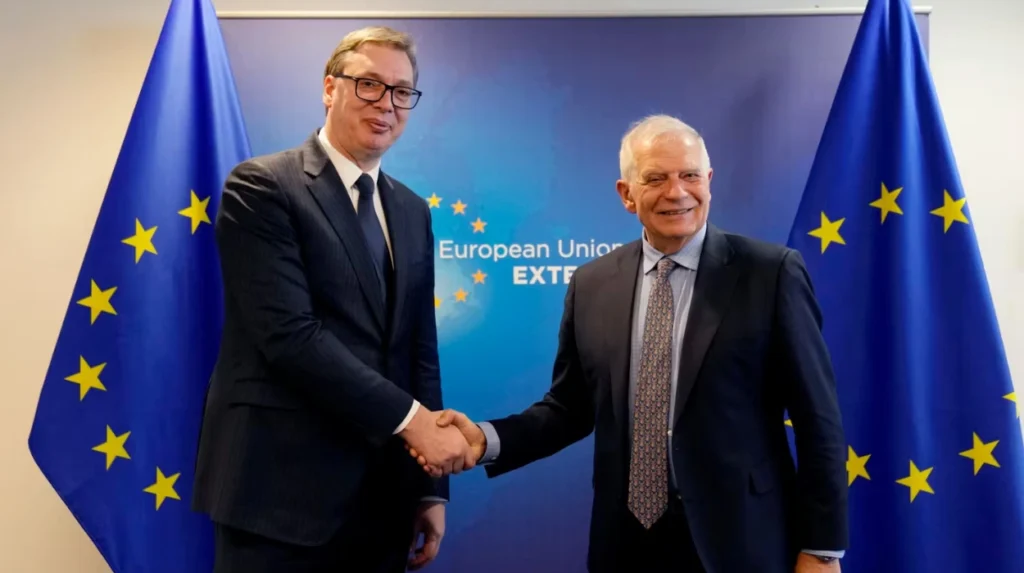
Austrian MEP Lukas Mandl has cautioned that Kosovo’s EU integration is being hindered by unresolved issues with Serbia, urging Pristina’s political elite to show readiness for compromise. In a statement to Gazeta Express, Mandl emphasised that while technical criteria are met, political dialogue remains the key obstacle, calling for bold leadership from Kosovo’s institutions.
Austrian Member of the European Parliament (MEP) Lukas Mandl has warned that Kosovo’s journey towards European Union (EU) membership is increasingly delayed due to persistent tensions with Serbia, as the country’s political leadership appears reluctant to pursue necessary compromises. Speaking exclusively to Gazeta Express, Mandl stressed that Kosovo meets most technical accession requirements but faces a critical impasse in political negotiations, urging Pristina to demonstrate genuine commitment to dialogue for progress.
Background on Kosovo’s EU Aspirations
Kosovo’s bid for EU membership has long been overshadowed by its unresolved dispute with Serbia, which does not recognise Pristina’s 2008 declaration of independence. The EU has conditioned Kosovo’s integration on normalisation of relations through the Belgrade-Pristina Dialogue, facilitated by the bloc since 2011.
As reported by Austrian MEP Lukas Mandl in an interview with Gazeta Express journalist Xhevdet Abazi, published on 10 April 2026, Mandl stated:
“The political elite in Kosovo is still not ready for compromise, and Kosovo’s path is being delayed by the problem with Serbia.”
He highlighted that this hesitation is stalling broader EU aspirations.
Mandl, a member of the Renew Europe group in the European Parliament, elaborated that Kosovo has made significant strides in areas such as rule of law reforms and economic adjustments. However, he pinpointed the lack of political will as the primary bottleneck.
Mandl’s Direct Critique of Kosovo’s Leadership
In the Gazeta Express interview, Mandl directly addressed Kosovo’s ruling class, saying:
“The elite politique in Kosovo is still almost not ready for compromise.”
He argued that while public rhetoric in Pristina often emphasises EU integration, actions fall short, particularly in advancing the normalisation agreement with Serbia.
According to the article by Xhevdet Abazi in Gazeta Express, Mandl further noted:
“Kosovo’s road is being slowed down by the problem with Serbia.”
This statement underscores the MEP’s view that bilateral tensions, including issues like vehicle licence plates, mutual recognition of documents, and missing persons from the 1998-1999 war, continue to dominate EU assessments.
Mandl praised Kosovo’s technical preparedness, stating:
“Kosovo has fulfilled many technical criteria for EU membership.”
Yet, he warned that without political breakthroughs, these achievements risk becoming irrelevant.
EU’s Stance on Belgrade-Pristina Dialogue
The European Union’s position remains firm: progress in the Dialogue is non-negotiable for both Kosovo and Serbia’s EU paths. Recent EU reports, including the 2025 Enlargement Package, have reiterated this linkage.
Cross-referencing coverage, Euractiv journalist Georgi Gotev reported on 5 April 2026 that EU High Representative Kaja Kallas emphasised during a Brussels briefing: “Normalisation of relations between Serbia and Kosovo is essential; without it, neither can advance meaningfully towards the EU.” Gotev’s article, titled “EU warns Serbia and Kosovo: No membership without deal,” quoted Kallas warning that delays could jeopardise the bloc’s Western Balkans strategy.
Similarly, Balkan Insight correspondent Jelena Vasilijevic, in a 8 April 2026 piece, cited Kosovo Prime Minister Albin Kurti stating:
“We are committed to the Dialogue, but Serbia must reciprocate on recognition.”
Vasilijevic noted Kurti’s frustration over Serbia’s recent moves, such as banning Kosovo goods.
Mandl’s comments in Gazeta Express align with this, as he told Abazi:
“The problem with Serbia is delaying Kosovo’s path,”
reinforcing the EU’s consistent messaging.
Reactions from Kosovo’s Political Spectrum
Kosovo’s leaders have responded variably to such criticisms. President Vjosa Osmani, in a statement covered by Koha Ditore journalist Ardian Vrenezi on 11 April 2026, defended Pristina’s stance: “Kosovo has shown maximum flexibility; it’s Belgrade obstructing progress.” Vrenezi’s report highlighted Osmani’s call for EU pressure on Serbia.
Opposition voices in Kosovo echoed Mandl’s concerns. Vetëvendosje MP Glauk Konjufca, as quoted in RTK by journalist Besiana Xharra on 10 April 2026, said:
“Our elite must prioritise EU over domestic politics, but compromise cannot mean surrender.”
Xharra’s live broadcast captured Konjufca urging internal reforms.
From Serbia’s side, President Aleksandar Vučić, interviewed by Politika correspondent Miloš Smiljković on 9 April 2026, claimed:
“Pristina’s maximalism blocks the Dialogue; we are ready for Association of Serb Municipalities.”
Smiljković’s article framed Vučić’s remarks as a counter to EU pressures.
These statements, aggregated from multiple outlets, illustrate the entrenched positions complicating Mandl’s call for compromise.
Technical Progress Amid Political Stagnation
Despite political hurdles, Kosovo has advanced on EU acquis chapters. The European Commission’s latest report, summarised by European Western Balkans analyst Jelena Miloševic on 3 April 2026, notes improvements in judiciary reforms, anti-corruption measures, and public procurement.
Miloševic quoted Commission spokesperson Eric Mamer:
“Kosovo is progressing technically, but political criteria, especially Dialogue implementation, lag.”
This validates Mandl’s observation in Gazeta Express that “many technical criteria are fulfilled.”
Serbia, too, faces scrutiny. RFE/RL Balkan Service reporter Gordana Knezevic reported on 7 April 2026 that EU officials criticised Belgrade’s democratic backsliding, with MEP Viola von Cramon stating:
“Both sides must move; Serbia’s rule of law issues are equally problematic.”
Broader Geopolitical Implications
The impasse affects regional stability. Reuters correspondent Aleksandar Vasovic, in a 6 April 2026 dispatch from Belgrade, warned:
“Stalled talks boost Russian and Chinese influence in the Balkans.”
Vasovic cited EU diplomats anonymously saying Kosovo-Serbia normalisation is key to countering external meddling.
Mandl, in his Gazeta Express interview, implicitly supported this by stressing urgency:
“Delays harm Kosovo’s path.”
Abazi’s reporting captured Mandl’s appeal to Pristina:
“Show readiness for compromise now.”
NATO’s role also intersects, with KFOR commander Angelo Michele Ristuccia telling ANSA journalist Francesco Semprini on 4 April 2026:
“Tensions remain high; Dialogue is vital for peace.”
Semprini noted Ristuccia’s patrols amid northern Kosovo flashpoints.
Expert Analyses and Future Outlook
Analysts predict limited progress without external pressure. Institute for Democracy and Mediation director Albert Rakipi, quoted in BIRN by journalist Kreshnik Gashi on 9 April 2026, said:
“Mandl’s warning is spot-on; Kosovo’s elite fears electoral backlash from concessions.”
Gashi’s analysis piece urged a “grand coalition” in Pristina.
From Vienna, Der Standard columnist Lisa Caspari reported on 11 April 2026 that Austrian diplomats back Mandl, with one source saying:
“Austria prioritises stability; compromise is non-negotiable.”
Looking ahead, the EU-Western Balkans Summit in June 2026 looms large. Politico Europe staff writer Päivi Lehtinen, in a 10 April 2026 preview, forecasted: “No breakthroughs without Belgrade-Pristina deal,” citing Mandl among MEPs pushing for benchmarks.
Mandl concluded his Gazeta Express remarks optimistically:
“Kosovo can succeed if leaders act boldly.”
Stakeholder Statements Compilation
Lukas Mandl (Gazeta Express, Xhevdet Abazi) stated that the
“political elite is still not ready for compromise; the Serbia problem delays the path; technical criteria are met.”
Kaja Kallas (Euractiv, Georgi Gotev) emphasised that
“normalisation is essential for both.”
Albin Kurti (Balkan Insight, Jelena Vasilijevic) asserted that
“Serbia must reciprocate.”
Vjosa Osmani (Koha Ditore, Ardian Vrenezi) maintained that
“maximum flexibility has been shown.”
Aleksandar Vučić (Politika, Miloš Smiljković) argued that
“Pristina’s maximalism blocks progress.”
Glauk Konjufca (RTK, Besiana Xharra) remarked that
“compromise should not mean surrender.”
Eric Mamer (European Western Balkans, Jelena Miloševic) observed
“technical progress but political lag.”
Viola von Cramon (RFE/RL, Gordana Knezevic) pointed out that
“both sides remain problematic.”
Aleksandar Vasovic (Reuters) cautioned that
“stalled talks aid rival influences.”
Angelo Michele Ristuccia (ANSA, Francesco Semprini) underlined that
“dialogue is vital for peace.”
Albert Rakipi (BIRN, Kreshnik Gashi) concluded that
“the elite fears political backlash.”