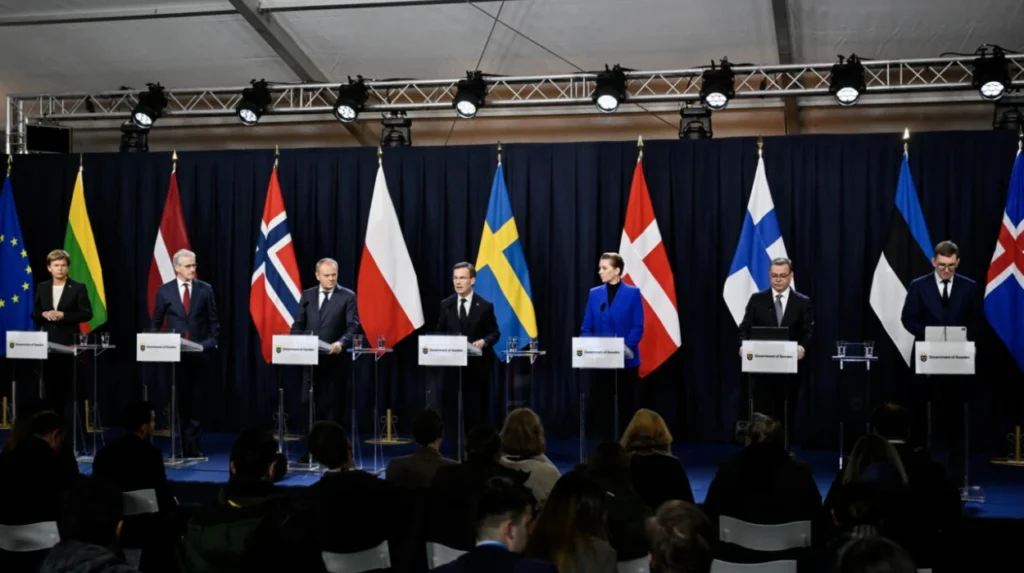
Estonia has signed a joint agreement with Ukraine and international partners to strengthen oversight and prevent corruption in Ukraine’s massive post‑war reconstruction effort, committing resources, expertise and civil‑society cooperation to track funds and ensure transparency.
The initiative aims to build robust digital, legal and institutional safeguards so that reconstruction money is not diverted or misused, while reinforcing Ukraine’s broader anti‑corruption reforms.
Estonia has formally joined a new international initiative designed to safeguard Ukraine’s reconstruction from corruption, pledging technical support, legal cooperation and stronger civil‑society monitoring to ensure that billions in future recovery funds are spent transparently and reach intended projects rather than corrupt networks.
Estonia’s commitment to clean reconstruction
Estonia, a long‑standing supporter of Ukraine, has moved to formalise its role in ensuring that reconstruction funds are shielded from graft as international pledges for Ukraine’s recovery grow.
According to public analyses of global anti‑corruption efforts, Ukraine’s new legal and institutional framework has started to expose more corruption cases even amid war, which international watchdogs interpret as a sign of reforms taking root rather than backsliding.
In this context, Estonia’s government has aligned itself with partners who emphasise strict conditions on aid, detailed project tracking and the involvement of independent oversight bodies.
The agreement, as described in wider policy discussions around Ukraine’s reconstruction, is part of a broader shift towards embedding anti‑corruption safeguards directly into infrastructure, procurement and public‑service projects rather than treating them as an afterthought.
Focus on transparency, digital tools and oversight
Anti‑corruption experts and international organisations have repeatedly underlined that transparent procurement and digital tools are essential to prevent diversion of funds in large‑scale reconstruction.
Estonia, which is widely recognised for its digital public services and e‑governance systems, is seen by policy analysts as a valuable partner in helping Ukraine design or strengthen platforms that can record tenders, contracts and payments in real time, open to public scrutiny.
Reports on media and anti‑corruption cooperation highlight how access‑to‑information laws and open databases can empower journalists, civil society and citizens to follow the money and flag red flags early.
By joining a joint agreement around Ukraine’s reconstruction, Estonia is signalling that it will put not only financial support but also technical and institutional know‑how at the disposal of Kyiv and international partners.
Civil society and media as key partners
International guidelines on combating corruption in reconstruction stress that investigative journalism and civil‑society monitoring form a crucial layer of defence against embezzlement and conflicts of interest.
Training manuals on reporting corruption note that journalists must follow the money trail, examine public contracts and cross‑check official statements with documentation, while adhering to strict ethical and legal standards.
Anti‑corruption briefings from global organisations likewise point out that Ukraine’s civil society has already demonstrated its capacity to mobilise against attempts to weaken independent institutions, helping to preserve the autonomy of anti‑corruption bodies.
Estonia’s participation in a joint agreement is therefore expected, in expert commentary, to include support for watchdog groups and media who monitor reconstruction tenders, public spending and local‑level delivery.
Ukraine’s anti‑corruption context
Recent global indices and watchdog reports depict a mixed but cautiously positive picture for Ukraine’s anti‑corruption trajectory. While high‑profile scandals involving officials and associates around the presidency have caused domestic anger and international concern, monitoring organisations argue that these cases are being uncovered precisely because institutions and civil society are pushing for accountability rather than impunity.
At the same time, Ukraine’s score in international corruption perception rankings has edged upward from a very low base, reflecting incremental institutional improvements, even as it continues to operate under wartime conditions.
Against this backdrop, agreements with countries like Estonia are framed by analysts as a way to embed external oversight and best practice into the reconstruction process, thereby reducing the risk that large inflows of money create new opportunities for entrenched or emerging corrupt networks.
Global concern over reconstruction‑linked corruption
Comparative anti‑corruption briefings for early 2026 emphasise that large infrastructure and defence‑related spending routinely attract bribery and fraud schemes, citing examples from other regions and sectors.
In one recent case highlighted by legal analysts, a construction‑related bribery scheme involving military contracts and falsified performance reviews demonstrated how long‑term contracts can be manipulated through inflated prices and rigged tenders.
Similarly, enforcement actions against oil‑and‑gas‑related bribery around the world underline how corrupt intermediaries and officials can exploit opaque procurement and offshore structures to divert millions of dollars in public value.
These patterns are repeatedly cited by experts as warnings for Ukraine’s reconstruction, where complex contracts, emergency procedures and multiple layers of subcontracting could create similar vulnerabilities if not rigorously monitored.
Role of international law‑enforcement and standards
Anti‑corruption newsletters and legal analyses note that several jurisdictions, including the United States and United Kingdom, have recently ramped up cross‑border investigations into foreign bribery, money laundering and fraud linked to public contracts. These developments show that international enforcement bodies are increasingly willing to cooperate, share evidence and pursue cases where public money is misappropriated via complex international schemes.
Policy reports on the role of the media and investigative journalism in combating corruption emphasise that this legal environment must be complemented by free, independent reporting and legal protections for whistle‑blowers and sources.
Estonia’s decision to join a joint reconstruction‑oversight initiative dovetails with this trend, as Baltic and European partners seek to align reconstruction spending with standards under instruments such as the OECD Anti‑Bribery Convention and EU‑level transparency rules.
Democratic backsliding and the stakes in Ukraine
Global anti‑corruption watchdogs have cautioned that democratic states, including established Western democracies, have suffered setbacks in their anti‑corruption performance, as shown by recent drops in international indices for countries like the United Kingdom and the United States.
Analysts argue that this backsliding increases the urgency of demonstrating that large‑scale public spending, such as that planned for Ukraine’s reconstruction, can be managed in a way that rebuilds trust rather than erodes it.
Commentary from think‑tanks and legal practitioners stresses that, if reconstruction funds are perceived to be misused, public support in donor states could weaken, with political consequences for Ukraine’s long‑term security and integration with European structures.
Estonia’s move to sign a joint agreement on combating corruption in reconstruction is, in this reading, both a practical step and a political signal that rigorous safeguards are integral to sustaining solidarity with Ukraine.
Importance of journalistic and institutional integrity
Guides on investigative reporting and court‑reporting ethics, produced by European media and legal bodies, underline that journalists covering corruption in reconstruction must be meticulous in attribution, avoid defamatory claims without evidence and respect due‑process rights.
They also stress that reporters should explain their methods to the public when they rely on complex or difficult‑to‑obtain information, and should be transparent about the limits of what can be verified.
Reports prepared for international organisations on the role of media in combating corruption further argue that the effectiveness of anti‑corruption measures depends on pluralistic, independent media ecosystems and judicial systems able to process cases fairly and efficiently.
Estonia’s reputation for digital transparency and e‑governance, combined with Ukraine’s evolving anti‑corruption framework and active civil‑society sector, is seen by many observers as a potentially strong foundation for a reconstruction process that learns from past global failures.