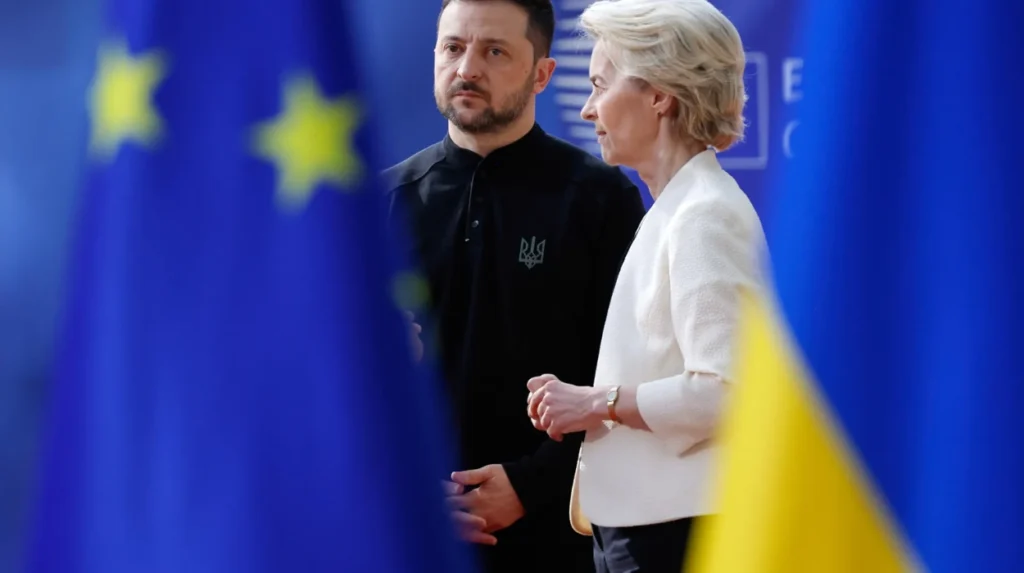
European Union governments and senior officials are increasingly signalling that Ukraine will not be ready to join the bloc by 2027, citing entrenched corruption, incomplete rule-of-law reforms and an “unrealistic” accession timetable, even as they praise Kyiv’s wartime commitment to integration. At the same time, Ukrainian President Volodymyr Zelenskyy and his allies insist that extensive anti-corruption infrastructure is in place and functioning, arguing that recent high-profile investigations prove Ukraine is moving towards EU standards rather than away from them.
Ukraine’s fast‑track EU membership push is colliding with growing scepticism in key European capitals, where leaders and diplomats argue that pervasive corruption, unfinished reforms and the realities of war make the 2027 target date politically and technically untenable.
Mounting EU scepticism over 2027 target
As reported in the NV English article “Not ready and rife with corruption: EU governments resist Ukraine’s 2027 membership bid,” several EU capitals are quietly but firmly pushing back against Kyiv’s attempt to set 2027 as a fixed accession date, warning that the country has not yet met core rule‑of‑law and anti‑corruption benchmarks. According to NV’s reporting, officials in multiple member states describe Ukraine as still “rife with corruption” and caution that rushing the process could undermine public trust in the enlargement project itself.
As noted by Daily Sabah, EU officials also poured cold water on a United States‑backed plan to fast‑track Ukraine’s accession by 2027, calling the timeline “unrealistic” and beyond Washington’s authority to promise on Europe’s behalf. The same report stresses that EU accession usually takes many years and must clear unanimous approval at multiple stages, a hurdle that is particularly high in Ukraine’s case given long‑standing concerns about corruption and governance.
Ukrainska Pravda, citing remarks by Polish Foreign Minister Radosław Sikorski after a meeting of EU foreign ministers in Brussels, reports that Sikorski urged both Kyiv and EU partners to adopt more “realistic” expectations, explicitly questioning the feasibility of fixing 2027 as a target date. Sikorski is quoted by Polskie Radio as saying that Ukraine is a “large country but not a very wealthy one,” and has not yet fully implemented its Association Agreement, underscoring the scale of the challenge facing both sides.
Corruption and rule‑of‑law concerns at the heart of resistance
Persistent worries about anti‑corruption backsliding
As reported by Peter Dickinson for the Atlantic Council’s UkraineAlert blog, the European Commission’s annual review of potential EU members praised Ukraine’s progress on democratic institutions and rights but warned sharply against backsliding on anti‑corruption reforms. The report highlighted “recent negative trends, including pressure on the specialised anti‑corruption agencies and civil society,” stressing that these must be “decisively reversed” if Ukraine is to advance towards membership.
In a separate investigation, the Kyiv Independent, citing a leaked draft of an enlargement report, notes that Brussels plans to commend Ukraine’s “remarkable commitment” to EU membership despite Russia’s full‑scale war, but will simultaneously urge Kyiv to “urgently reverse negative trends in the fight against corruption and step up rule of law reforms.” According to the same draft, the Commission is prepared to support Ukraine’s “ambitious objective” of accession but believes that an “acceleration of the pace of reforms is required, notably with regards to the fundamentals, in particular rule of law.”
The Centre for European Reform, in an analysis titled “Tough love: How the EU should tackle corruption and the rule of law in Ukraine,” argues that war has not made Ukraine’s corruption problems disappear and warns that deliberate attempts to undercut reforms are slowing progress towards EU standards. The report says that while security threats explain some delays, they “do not excuse deliberate attempts to undermine efforts to strengthen the rule of law and economic governance,” a message that has resonated in several EU capitals.
High‑profile corruption scandals deepen doubts
As reported by Foreign Policy, a far‑reaching corruption scandal in Ukraine’s energy sector recently forced the resignation of the country’s energy and justice ministers after anti‑corruption investigators charged eight individuals with abuse of office, bribery and illicit enrichment. Foreign Policy notes that this scandal has “quickly eclipsed” earlier EU praise for Ukraine’s reform efforts, dealing a blow to President Zelenskyy’s government at a time of military strain.
In a detailed case study published by Democratic Erosion, analysts link the energy scandal to broader weaknesses in institutional oversight and resistance from entrenched oligarchic networks, arguing that it has put Ukraine’s bid “under threat.” The same study recalls that EU officials had already voiced concern when Zelenskyy briefly attempted to curb the independence of anti‑corruption bodies before backing down in the face of large protests, a move that nonetheless left a “lasting negative impact on the president’s credibility” in Brussels.
The Kyiv Independent further reports that Brussels grew particularly alarmed when Ukrainian authorities tried to expand the powers of the Prosecutor General — a political appointee — over the National Anti‑Corruption Bureau of Ukraine (NABU) and the Specialised Anti‑Corruption Prosecutor’s Office, both of which are designed to remain independent. Although rare wartime protests forced the government to retreat, EU partners and anti‑corruption agencies expect further pressure, fuelling fears that reforms could be hollowed out over time.
Positions of EU institutions and member states
European Commission: praise mixed with warnings
As outlined by Peter Dickinson of the Atlantic Council, the European Commission has tried to strike a balance between acknowledging Ukraine’s achievements and warning against complacency. In its regular reporting, the Commission has underlined that the fight against corruption is central to the enlargement package and requires “continuous efforts to guarantee a strong capacity to combat corruption and the respect for the rule of law.”
Foreign Policy quotes a European Commission spokesperson as saying, in reference to the high‑profile energy probe, that it “shows that anti‑corruption bodies are in place and functioning in Ukraine,” presenting the investigation as evidence that reforms are producing tangible enforcement. At the same time, the Commission has privately told member states — according to the Kyiv Independent’s access to draft documents — that Ukraine must accelerate reforms in fundamental areas if it wants to keep its ambitious timeline within reach.
The Centre for European Reform notes that the accession process itself has become a key tool of conditionality, offering Ukrainians “a glimmer of hope” while also giving Brussels leverage to insist on deeper changes to the judiciary, public administration and economic governance. The think‑tank recommends that the EU apply “tough love,” coupling financial support and political backing with firm demands on anti‑corruption and rule‑of‑law performance.
Member‑state reservations and political hurdles
As reported by Daily Sabah, some EU countries, notably Hungary, have consistently opposed or slowed Ukraine’s accession path, using their veto powers to block progress at several stages of the process. The same article notes that Hungarian Prime Minister Viktor Orbán, described as Moscow’s closest ally in the bloc, has been a key obstacle, with enlargement decisions stalling when unanimity was required.
Ukrainska Pravda’s coverage of the latest foreign ministers’ meeting highlights how even supportive states such as Poland are now stressing the need for “realistic” expectations, with Sikorski warning that incomplete implementation of the Association Agreement and the sheer scale of reforms required mean that any fixed 2027 deadline is highly doubtful. According to Ukrainska Pravda, EU negotiators recently handed Ukraine a detailed document listing reforms and benchmarks that must be met before membership can be considered, underscoring that each step will be scrutinised by all 27 member states.
Daily Sabah further cites EU diplomats and experts who argue that accession by 2027 is “completely unrealistic” in the context of an ongoing war, unfinished reforms and the need for multiple ratifications. One diplomat is quoted as observing that “there is a war in Ukraine. How can they be ready? They have no border,” encapsulating a broader sense that basic conditions for accession are not yet in place.
Kyiv’s response and reform narrative
Zelenskyy’s defence of anti‑corruption record
As detailed by Peter Dickinson for the Atlantic Council, President Volodymyr Zelenskyy has strongly rejected suggestions that his government is backsliding, instead pointing to what he calls the “widest” anti‑corruption infrastructure in Europe. Dickinson reports that Zelenskyy, responding to the EU’s latest assessment, claimed he did not know of any country with as many dedicated anti‑corruption authorities and insisted that his administration is “doing everything possible.”
Foreign Policy notes that, despite the political damage of the energy scandal, the Ukrainian leadership has repeatedly framed the investigation itself as proof that new institutions are capable of tackling entrenched graft. The European Commission spokesperson quoted by Foreign Policy appeared to support this interpretation to some extent, arguing that the case demonstrated that Ukraine’s anti‑corruption bodies are “in place and functioning.”
The Democratic Erosion analysis adds that civil society organisations and experts, while critical of attempts to curtail anti‑corruption agencies, continue to demand systemic reforms rather than cosmetic changes, calling for transparent investigations, stronger oversight and protections against political interference. These demands have influenced EU debates, reinforcing the argument that Ukraine’s progress, though real, remains fragile and incomplete.
Domestic pressures and public expectations
According to the Centre for European Reform, Ukraine’s political leadership faces conflicting pressures: on one side, the need to maintain unity in wartime and avoid internal fractures; on the other, the necessity of tackling powerful interests that benefit from weak oversight and corruption. The think‑tank warns that postponing or watering down reforms may secure short‑term political calm but will ultimately undermine both EU integration and domestic trust.
A separate briefing highlighted by Ukrainian commentators (and referenced in social‑media summaries cited by UkrNewsFeed) points to surveys showing very high public support — about 72 per cent — for EU membership, with many Ukrainians expecting stronger anti‑corruption efforts as a key benefit of joining the bloc. These expectations have increased pressure on Kyiv to demonstrate tangible results, particularly in high‑profile cases involving senior officials and powerful business interests.
The accession process and the 2027 debate
Timeline, benchmarks and “reverse accession” ideas
Ukrainska Pravda reports that Ukraine applied for EU membership in February 2022, shortly after Russia’s full‑scale invasion, and that formal accession negotiations were opened in June 2024. By December 2025, according to the same outlet, the EU and Ukraine had launched substantive talks, covering three of six negotiation clusters: Fundamentals, Internal Market and External Relations, though several crucial chapters on justice, freedom, security and financial control remain open.
In an interview with the Financial Times, cited by Ukrainska Pravda, President Zelenskyy called on the EU to “officially fix 2027 as the date of Ukraine’s accession,” presenting the deadline as both a political signal to Russia and a motivational target for Ukrainian society. However, when EU partners handed Kyiv a document laying out required reforms and benchmarks on 23 February, the message from Brussels was that progress would be measured step by step rather than by political countdowns.
Ukrainska Pravda also notes that European Commission President Ursula von der Leyen has floated an idea of “reverse accession,” where Ukraine would become a full EU member first and then gradually join specific policies such as Cohesion and Common Agricultural Policy as it completes remaining reforms. Polish Foreign Minister Sikorski, while acknowledging the creativity of this proposal, warned that it would pose “serious procedural” challenges and added that political decisions must rest on completed reforms rather than imaginative timelines.
Strategic stakes for both Ukraine and the EU
The Centre for European Reform argues that the accession process has become a strategic instrument for both Kyiv and Brussels, offering Ukraine long‑term security and economic prospects while giving the EU leverage to shape reforms in a large, strategically vital neighbour. However, the think‑tank cautions that if corruption and rule‑of‑law issues remain unresolved, Ukraine’s membership could strain the EU’s own governance and cohesion.
Daily Sabah points out that the EU’s credibility is also at stake: promising a 2027 accession date that cannot be met would risk fuelling disillusionment in Ukraine and scepticism among existing member‑state publics. Experts quoted by the outlet argue that a more realistic, conditional approach — with clear milestones on corruption, judicial reform and economic governance — may ultimately offer a firmer path to membership, even if it extends beyond 2027.
In this context, NV English’s characterisation of Ukraine as “not ready and rife with corruption,” reflecting the view in several EU capitals, captures a broader dilemma: how to reconcile genuine admiration for Ukraine’s wartime resilience and reform efforts with persistent doubts about whether enough has been done to meet the EU’s strict standards within such an ambitious timeframe