The European Union Advisory Mission (EUAM) Ukraine and the National Agency on Corruption Prevention (NACP) have signed a formal Working Arrangement in Kyiv to deepen cooperation on preventing corruption and strengthening integrity across Ukraine’s civilian security sector. The agreement focuses on upgrading internal control systems in law enforcement, promoting ethical standards and zero tolerance for corruption, and expanding the use of digital tools and EU-aligned anti-corruption policies.
The European Union Advisory Mission (EUAM) Ukraine and the National Agency on Corruption Prevention (NACP) have concluded a new Working Arrangement to expand anti-corruption cooperation, aiming to reinforce integrity, accountability and corruption prevention systems across Ukraine’s law enforcement and wider civilian security sector, in line with European Union standards and the country’s broader reform agenda.
Working Arrangement signed in Kyiv
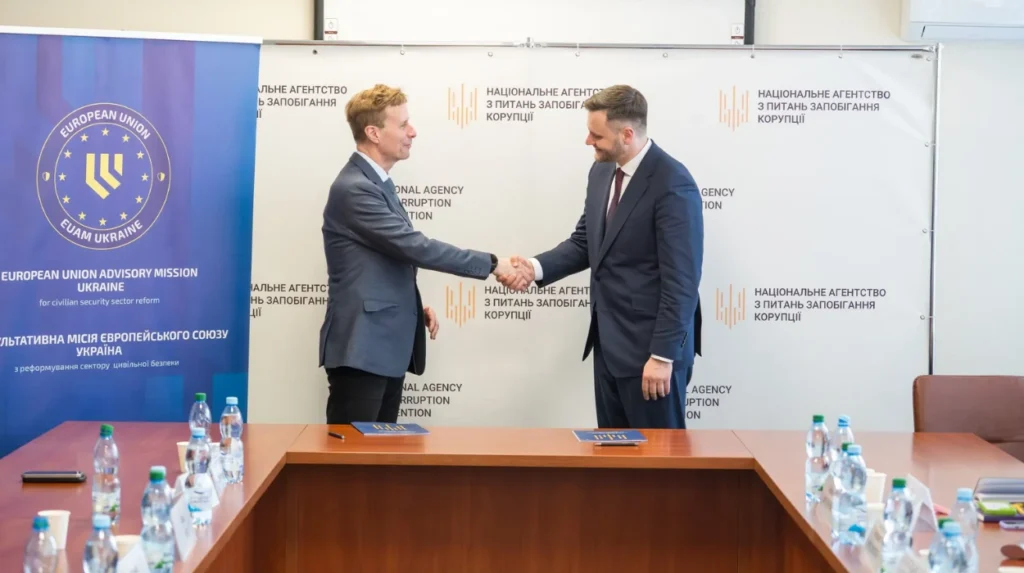
On 20 March in Kyiv, the European Union Advisory Mission (EUAM) Ukraine and the National Agency on Corruption Prevention (NACP) signed a Working Arrangement that formally expands their cooperation in the field of corruption prevention and integrity-building.
As reported by the EUAM Ukraine communications team, the agreement is framed as a practical roadmap for joint work to strengthen internal control, improve accountability, and develop modern prevention tools within Ukraine’s institutions charged with civilian security and law enforcement.
According to an official communication by the NACP, the new arrangement is designed to “expand their cooperation in integrity and corruption prevention”, explicitly connecting the partnership to Ukraine’s ongoing reform and its commitments under the European integration process. The signing builds on several years of collaboration between EUAM Ukraine and the NACP, during which the Mission has provided both strategic advice and hands-on support to Ukrainian partners in anti-corruption and integrity initiatives.
Objectives to strengthen integrity in law enforcement
As outlined by NACP’s official announcement, one of the key objectives of the Working Arrangement is to strengthen integrity within law enforcement agencies by enhancing internal control and compliance systems.
The NACP notes that the agreement aims to help build its institutional capacity to develop and implement effective systems for preventing, detecting and mitigating corruption, particularly within bodies responsible for public order and criminal investigations.
EUAM Ukraine, which was established to support civilian security sector reform, emphasises that the agreement supports the development of internal control and accountability systems within law enforcement bodies and promotes ethical standards and a zero-tolerance approach to corruption.
According to EUAM Ukraine’s mission profile, the broader goal is to help Ukraine achieve a civilian security sector that is efficient, accountable and trusted by the public, based on EU standards and international principles of good governance and human rights.
Focus on internal control, ethics and digital tools
As reported by the NACP, the Working Arrangement sets out specific areas of cooperation, including: strengthening internal control and compliance systems in law enforcement, delivering training and awareness-raising activities on ethics, and introducing digital tools for corruption prevention.
The NACP highlights that the agreement covers not only policy development but also practical measures such as systems to detect and mitigate corruption risks within institutions.
According to EUAM Ukraine’s news release, EUAM and NACP will jointly support the development of internal control and accountability systems, promote ethical standards and a zero-tolerance stance towards corruption, and advance the use of digital tools in prevention efforts.
The same release notes that the cooperation will reinforce NACP’s capacity to design and implement anti-corruption policies, training programmes and risk-assessment methodologies that are consistent with European good practices.
Viktor Pavlushchyk stresses alignment with EU reforms
As reported by the National Agency on Corruption Prevention, Head of NACP Viktor Pavlushchyk underlined the strategic significance of the partnership with EUAM Ukraine. Pavlushchyk stated that “our partnership with the Advisory Mission is extremely important to us,” framing the Working Arrangement as a reflection of a shared goal to strengthen institutional integrity and improve corruption prevention systems.
According to the statement published by NACP, Viktor Pavlushchyk added that the agreement
“is fully aligned with Ukraine’s broader reform agenda, including anti-corruption priorities and commitments related to EU integration”.
In EUAM Ukraine’s coverage of the event, Pavlushchyk similarly emphasised that the document reflects
“our shared objective: strengthening institutional integrity and improving systems for preventing corruption, particularly within law enforcement agencies,”
again linking the initiative to Ukraine’s EU-related anti-corruption reforms.
Rolf Holmboe highlights concrete results and next steps
As reported by EUAM Ukraine, EUAM Head of Mission Rolf Holmboe pointed out that the existing cooperation between the Mission and the NACP had already produced practical results before the signing of the new Working Arrangement.
Holmboe referred to joint activities such as workshops for police officers on whistleblower protection, internal reporting and integrity standards, which have contributed to strengthening the anti-corruption capacity of Ukrainian institutions at regional level.
According to the same EUAM Ukraine report, Rolf Holmboe stated that
“today we are taking an important step forward in our cooperation,”
describing how the Working Arrangement will
“further strengthen and formalise our partnership and support Ukraine in building transparent, accountable institutions aligned with European standards”.
In the NACP’s article, Holmboe’s remarks are echoed with the observation that ongoing cooperation is already “yielding practical results”, particularly through training programmes that reinforce whistleblower protection and integrity-focused internal procedures in law enforcement agencies.
Building on regional anti-corruption initiatives
As documented by EUAM Ukraine’s previous reporting on integrity initiatives, EUAM has been actively supporting anti-corruption work within Ukrainian law enforcement, including events held on International Anti-Corruption Day.
For example, EUAM reported on a two-day regional roundtable at the West Ukrainian National University in Ternopil that gathered 47 corruption prevention officers from six western regions to discuss institutional resilience and accountability.
According to EUAM’s account, advisers at that roundtable shared European perspectives derived from experience in countries such as Belgium, Lithuania and Latvia, focusing on approaches to embed a culture of accountability and zero tolerance towards corruption in law enforcement institutions.
Senior Adviser on General Policing Dirk Molleman remarked at that time that the event demonstrated Ukraine’s commitment to fighting corruption while advancing towards its European future, a message that aligns with the objectives now formalised under the new Working Arrangement with NACP.
Part of wider EU-supported anti-corruption framework
The new Working Arrangement forms part of a broader pattern of EU-backed anti-corruption initiatives in Ukraine in which NACP and other specialised agencies are key partners.
As recalled in an EUAM Ukraine update, the Mission has previously been involved in cooperation projects such as a joint anti-corruption initiative with Austria, which was launched in Kyiv on 15 December and is specifically targeted at strengthening investigative and analytical expertise within the National Police of Ukraine, the State Bureau of Investigations and the Economic Security Bureau of Ukraine.
According to that EU Neighbours East report, Austria has allocated €135,000 for an anti-corruption project managed by EUAM Ukraine to help law enforcement agencies improve their capacity to investigate corruption cases and financial and economic crimes, with EUAM Head of Mission Rolf Holmboe stating that the initiative is “of particular importance” for integrating Ukrainian law enforcement into the wider EU police network.
Earlier EU announcements on anti-corruption support have also identified NACP (then referred to as the National Agency for the Prevention of Corruption) as one of the institutions supported by EU-funded programmes aimed at prevention, investigation, prosecution and asset recovery related to corruption and economic crime.
EUAM Ukraine’s role in civilian security reform
Background information published by the European External Action Service describes EUAM Ukraine as the European Union Advisory Mission for Civilian Security Sector Reform in Ukraine, mandated to provide strategic advice and practical support to Ukrainian stakeholders.
The Mission works across multiple thematic areas, including rule of law, police and other law enforcement agencies, anti-corruption and human rights, with the goal of fostering institutions that are efficient, accountable and enjoy public trust.
According to the EEAS profile, EUAM Ukraine focuses on aligning Ukraine’s civilian security sector with EU standards and international norms, supporting reforms that reinforce democratic oversight, transparency and human rights compliance.
Within this broader mandate, anti-corruption and integrity measures are identified as central pillars, and the new Working Arrangement with NACP is presented as a mechanism to deepen practical cooperation in these fields.
Emphasis on training, whistleblower protection and risk assessment
As highlighted in both NACP and EUAM statements, the partnership gives particular attention to training and awareness-raising as tools for building a lasting culture of integrity. Joint activities have already included training sessions and workshops for police officers on whistleblower protection frameworks, internal reporting procedures and integrity standards, all of which are presented as essential to effective corruption prevention.
EUAM Ukraine’s latest announcement specifies that the new agreement will support NACP in designing and implementing anti-corruption training programmes and risk assessment methodologies.
According to NACP’s own communication, this focus on risk analysis and digital tools is intended to make prevention systems more proactive, data-driven and capable of identifying vulnerabilities before they translate into actual corruption cases.
Link to Ukraine’s reform agenda and EU integration
In the public comments by both sides, the Working Arrangement is consistently framed as part of Ukraine’s broader reform trajectory and its commitments under EU integration. As reported by NACP, Viktor Pavlushchyk explicitly connected the agreement to Ukraine’s anti-corruption priorities and its obligations arising from closer ties to the European Union, arguing that strengthening institutional integrity is essential for credibility at both domestic and international levels.
EUAM Ukraine’s coverage similarly underlines that formalising the partnership is intended to support Ukraine in building transparent and accountable institutions that correspond to European standards, thereby reinforcing Ukraine’s progress on reforms that are often closely scrutinised in the context of EU accession discussions.
Both institutions stress that sustained cooperation is necessary to ensure that anti-corruption reforms do not remain purely legislative but are effectively implemented and deliver tangible benefits for citizens and public authorities.
In its official article, EUAM Ukraine notes that the signing of the Working Arrangement comes as Ukraine continues to advance its anti-corruption reforms, with both EUAM and NACP underscoring the need for long-term partnership to maintain momentum. The agreement is presented as a framework that can accommodate new joint initiatives, ranging from developing digital prevention tools to expanding regional training for corruption prevention officers.
According to the NACP’s statement, the cooperation will focus on practical implementation, seeking to translate shared standards and policies into everyday practices inside law enforcement agencies and other bodies within the civilian security sector.
Both sides signal that future activities under the arrangement are expected to further embed a culture of integrity and accountability, reinforcing Ukraine’s efforts to consolidate reforms in the anti-corruption sphere.