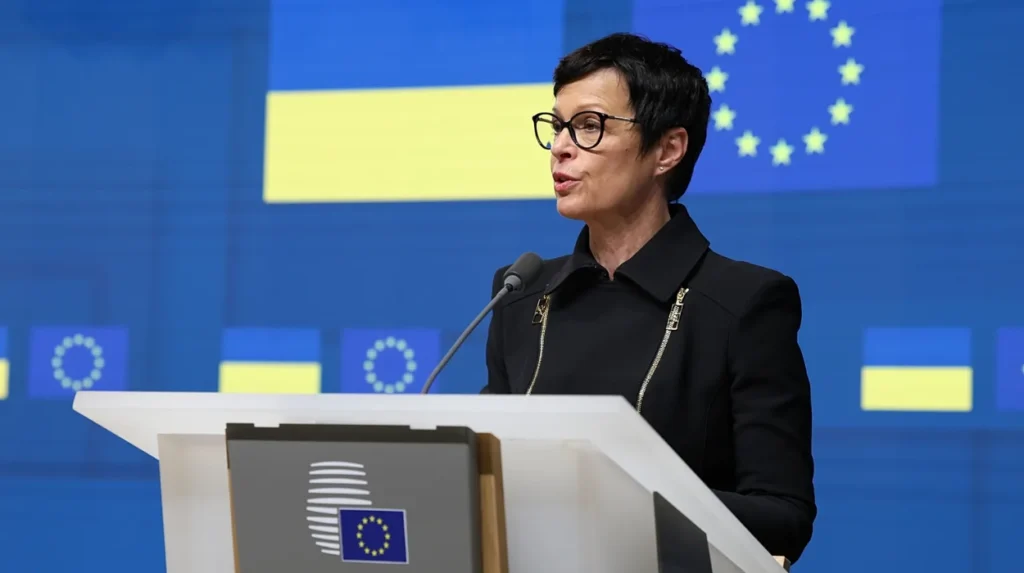
European Commissioner for Enlargement Marta Kos has warned that the European Union’s trust in Ukraine has “not at all” been restored after Kyiv reversed controversial laws curbing anti-corruption bodies, saying the damage to trust “will stay forever”, in an interview with European Pravda. Kos stressed that Ukrainian civil society and strong public support for EU membership are now key factors in slowly rebuilding confidence.
European Commissioner Marta Kos has delivered a stark assessment that the European Union’s trust in Ukraine has not been restored after Kyiv rolled back legislation that had undermined the independence of its key anti-corruption institutions, despite intense Western pressure that forced a legal correction.
EU trust in Ukraine remains damaged
As reported by Iryna Kutielieva, Serhiy Sydorenko and Stanislav Pohorilov of Ukrainska Pravda’s English service, European Commissioner for Enlargement Marta Kos gave a negative answer when asked whether the EU’s trust in Ukraine had been restored following the repeal of controversial laws targeting the National Anti-Corruption Bureau of Ukraine (NABU) and the Specialised Anti-Corruption Prosecutor’s Office (SAPO).
In an interview with European Pravda, Kos was asked directly whether trust between the EU and Ukraine could be considered rebuilt after the Ukrainian parliament reversed the earlier measures that had placed NABU and SAPO under the influence of the Prosecutor General. In response, Marta Kos stated:
By using such uncompromising language, Kos signalled that even though the most controversial provisions have been rolled back, the political decision to attempt to bring anti-corruption institutions under tighter control has left a lasting mark on how Brussels views Kyiv’s commitments.
July 2025 legislation and concerns over anti-corruption independence
According to the report by Kutielieva, Sydorenko and Pohorilov for Ukrainska Pravda, Marta Kos recalled the events of July 2025, when Ukraine adopted legislation that directly challenged the independence of NABU and SAPO. She referred specifically to the adoption of draft law No. 12414 by the Ukrainian Parliament, a measure that made the National Anti-Corruption Bureau and the Specialised Anti-Corruption Prosecutor’s Office dependent on the Prosecutor General.
As reported by the same Ukrainska Pravda article, Kos said she
“could not understand why Ukraine was doing this”,
given that such moves effectively placed the country’s flagship anti-corruption bodies under the control of a central prosecutorial authority, undermining one of the core conditions set by the EU for membership progress. She stressed that stripping NABU and SAPO of their independence would have meant closing off the path to EU membership, directly linking institutional autonomy with the enlargement process.
Ukrainska Pravda notes that the controversial law triggered significant criticism from Ukraine’s Western partners, who viewed the independence of these bodies as a cornerstone of reforms undertaken since the beginning of the country’s pro‑European course. The linkage made by Kos between the anti-corruption framework and accession prospects underlines the importance the European Commission places on credible corruption control mechanisms.
Kos: trust cannot be restored overnight
In the interview with European Pravda cited by Kutielieva, Sydorenko and Pohorilov, Marta Kos expanded on why she believes the EU’s trust in Ukraine has not been fully restored. She explained that legal reversals, while necessary, are not sufficient to erase doubts created by earlier decisions that targeted independent institutions.
Quoting Kos, Ukrainska Pravda reports her as saying:
“You can change the laws as many times as you want, but you never can, over one night, bring the trust back … Once the trust is not there anymore on the full scale, then whatever your partner is doing, you put even a little question mark: Is this okay? Why are they doing this?”
This statement, carried in full by the Ukrainska Pravda piece, encapsulates the Commissioner’s view that credibility is not purely a legislative matter but depends on consistent political behaviour over time. Her remark about “a little question mark” indicates that future reforms in Ukraine will likely be scrutinised more closely in Brussels, with lingering doubts influencing how new initiatives are interpreted.
Role of Ukrainian society and civil sector
Despite her strong criticism, Marta Kos also highlighted positive dynamics inside Ukraine. As reported by Kutielieva, Sydorenko and Pohorilov for Ukrainska Pravda, Kos said that Ukrainian society is helping her to rebuild trust in the country.
In the interview with European Pravda, she referred to the important role played by civil society organisations in Ukraine, noting that they have been central in defending anti-corruption institutions and advocating for reforms. Kos stated that she knows “civil society is really playing an important role in Ukraine”, pointing to activists, NGOs and watchdog groups that have monitored the authorities’ steps on NABU and SAPO.
The Ukrainska Pravda report quotes Kos citing new survey data, saying that “there is a survey that 72% of Ukrainians are supportive of the EU membership, and when they have been asked what the benefits would be, the answer about fighting corruption is very high, as well as the prosperity perspectives.” This reference to public opinion underscores that a large majority of Ukrainian citizens associate EU membership with strengthened anti-corruption efforts and improved living standards.
According to the same article, Kos added that she would like to see this kind of society in every candidate country, implicitly praising Ukraine’s public demand for integrity even as she remains critical of certain political decisions. Her remarks suggest that grassroots pressure in Ukraine is viewed in Brussels as a stabilising factor that can push the authorities back towards reform when they veer off course.
Western pressure and reversal of controversial law
The Ukrainska Pravda article by Kutielieva, Sydorenko and Pohorilov notes that the controversial July 2025 law, No. 12414, did not remain in force without challenge. Following what the publication describes as “significant Western pressure”, the Ukrainian authorities adopted new legislation aimed at remedying the situation regarding NABU and SAPO.
As reported in the background section of the same piece, Western partners, including European institutions and individual EU member states, exerted diplomatic pressure on Kyiv to restore the independence of the anti-corruption bodies. Under this pressure, a corrective law was passed to address the dependence on the Prosecutor General and to bring Ukraine’s anti-corruption set‑up back in line with commitments made under the EU accession track.
However, even with this remedial law, Marta Kos’ comments, as cited by Ukrainska Pravda, make clear that from the viewpoint of the European Commission, the initial decision to weaken NABU and SAPO has left longer‑term consequences. Her insistence that “this will stay forever” refers not to the law itself but to the impact on perceptions of Ukraine’s reliability as a reform partner.
EU ambassador’s softer characterisation of the crisis
The Ukrainska Pravda report also provides additional EU context by recalling earlier remarks from the European Union Ambassador to Ukraine, Katarína Mathernová. In an interview with European Pravda cited as background in the same article, Mathernová said she would not describe the situation around the NABU and SAPO laws as a “catastrophe”.
According to the background note summarised by Kutielieva, Sydorenko and Pohorilov, Ambassador Mathernová acknowledged that Ukraine still needs to work to rebuild trust after the controversy over the anti-corruption legislation. While avoiding the most dramatic terminology, she aligned with the broader EU position that confidence has been damaged and must be repaired through sustained action.
By juxtaposing Mathernová’s more measured language with Kos’ much sharper statement, the Ukrainska Pravda coverage illustrates a spectrum of views within the EU institutions on how to publicly characterise the crisis. Nonetheless, both representatives agree on the key point: the need for Kyiv to demonstrate, over time, that it is committed to safeguarding the autonomy and effectiveness of its anti‑corruption system.
Implications for Ukraine’s EU path
As outlined in the article by Kutielieva, Sydorenko and Pohorilov, Marta Kos linked the fate of NABU and SAPO directly to Ukraine’s European future. Her remark that undermining their independence would have meant “closing off the path” to EU membership underscores how central anti-corruption reforms are within the enlargement portfolio.
The controversy around law No. 12414, its subsequent reversal under Western pressure, and the enduring scepticism expressed by Kos illustrate the delicate balance Ukraine must maintain to advance towards membership. On one hand, Kyiv is expected to adopt and preserve structural reforms that limit political control over investigative and prosecutorial bodies; on the other, missteps can quickly erode accumulated goodwill.
At the same time, the positive emphasis on Ukrainian civil society and the high level of public support for the EU, as highlighted in Kos’ comments to European Pravda and relayed by Ukrainska Pravda, suggest that Ukraine’s domestic environment remains strongly oriented towards European integration and anti-corruption efforts. Whether this societal pressure will be sufficient to prevent future attempts to weaken NABU and SAPO will be a key issue monitored by Brussels as accession discussions continue.