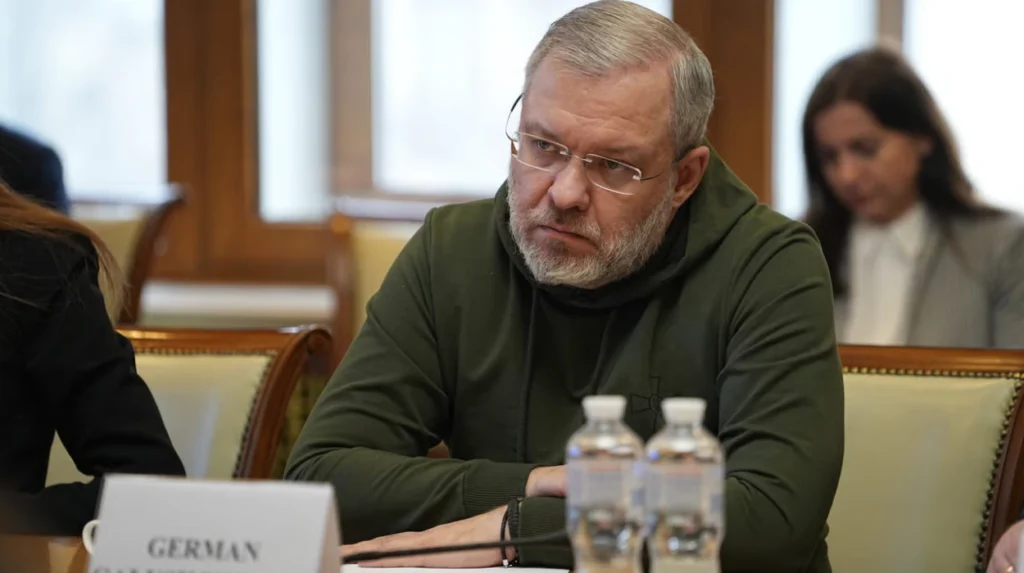
German Galushchenko, Ukraine’s former Energy Minister, faces corruption charges linked to nuclear power mismanagement after attempting to flee the country amid an investigation. The charges involve abuse of power and misappropriation of funds, prompting swift action by Ukraine’s National Anti-Corruption Bureau (NABU) and a travel ban at the border.
Inverted Pyramid Structure
Ukrainian authorities have charged German Galushchenko, the former Minister of Energy, with corruption offences following his detected attempt to leave the country on 15 February 2026. As reported by Polina Byshok of Politico Europe, Galushchenko was intercepted at the Ukrainian border while trying to cross into Moldova, triggering immediate charges from the National Anti-Corruption Bureau of Ukraine (NABU) and the Specialised Anti-Corruption Prosecutor’s Office (SAPO).
The charges centre on alleged abuse of power during his tenure from 2020 to 2025, particularly concerning contracts for nuclear fuel supply to Ukraine’s state-owned nuclear power operator, Energoatom. According to the NABU statement, as cited by Illia Ponomarenko of Kyiv Independent,
“Galushchenko facilitated the conclusion of agreements that caused over 1.5 billion hryvnias (£27 million) in losses to the state through unjustified overpayments for nuclear fuel.”
Galushchenko, 52, denies the allegations, claiming they are politically motivated.
Background on Galushchenko’s Tenure
Galushchenko served as Energy Minister under President Volodymyr Zelenskyy from February 2020 until his dismissal in November 2025 amid mounting scrutiny over energy sector dealings during Russia’s invasion. As detailed by Natalia Zinets of Reuters, the investigation began in late 2025 after whistleblower reports highlighted suspicious contracts awarded to Westinghouse Electric Company, a US-based supplier, without competitive bidding.
NABU announced the charges on 16 February 2026, stating that Galushchenko “personally influenced the selection of suppliers and terms, leading to inflated prices.” Prosecutor Maksym Hryhorenko of SAPO, quoted in the official NABU press release republished by Ukrainska Pravda, remarked:
“This case exemplifies systemic corruption in critical infrastructure sectors, even under wartime conditions. The minister’s flight attempt confirms his awareness of guilt.”
Searches were conducted at Galushchenko’s home and office, recovering documents and electronic devices.
The Flight Attempt Unraveled
On Saturday evening, 15 February 2026, Galushchenko approached the Mohyliv-Podilskyi border crossing in Vinnytsia Oblast, driving a vehicle with Moldovan plates. Border guards, acting on a NABU alert, detained him after scanning his passport revealed an active travel restriction. As per Diana Solovyova, BBC News Ukraine correspondent,
“Galushchenko presented forged documents claiming urgent humanitarian travel, but biometric checks exposed the deception.”
Galushchenko’s lawyer, Andriy Yarema, told European Pravda,
“My client was en route to a medical appointment abroad, fully prepared to cooperate with investigators. These charges are a smear campaign by rivals within the energy lobby.”
He has since been released on £50,000 bail pending trial.
Corruption Allegations in Depth
The core accusation revolves around a 2022-2024 framework agreement with Westinghouse for nuclear fuel assemblies worth approximately $500 million. NABU alleges Galushchenko bypassed tender procedures under martial law pretexts, opting for direct negotiations that favoured Westinghouse over cheaper European alternatives like Framatome. Forensic accounting by SAPO, as reported by Henry Foy, energy editor at Financial Times, revealed markups of 15-20% on standard rates, equating to £27 million in excess payments.
Westinghouse spokesperson Rachel Girt, in a statement to Bloomberg, said:
“All contracts were transparent, competitively priced, and approved by Energoatom’s board. We deny any wrongdoing and support Ukraine’s energy security.”
Energoatom CEO Petro Kotin, who resigned in 2024, corroborated in a 2025 affidavit cited by The Wall Street Journal, that
“Galushchenko pressured for Westinghouse exclusivity, citing US political support.”
This case ties into Ukraine’s wider anti-corruption drive post-invasion. Similar probes targeted Naftogaz executives for gas procurement irregularities. Transparency International Ukraine director Yaroslav Yurchyshyn, interviewed by Deutsche Welle, stated:
“Galushchenko’s downfall signals Zelenskyy’s commitment to reforms for EU accession. No one is untouchable.”
Critics, including opposition MP Oleksiy Goncharenko from European Solidarity, tweeted:
“Finally, accountability in Zelenskyy’s inner circle.”
Official Reactions and Political Fallout
President Zelenskyy’s office issued a statement on 16 February 2026:
“We root out corruption wherever it hides, especially in strategic sectors. Justice serves Ukraine’s future.”
Spokesman Serhiy Nikiforov elaborated to Associated Press, that
“Galushchenko’s dismissal last year was precautionary; charges validate our vigilance.”
US Ambassador Bridget Brink, in remarks to Voice of America, noted:
“Ukraine’s pursuit of high-level corruption bolsters its NATO aspirations. We commend NABU’s independence.”
EU Anti-Corruption Commissioner Vera Jourova tweeted support, emphasising alignment with Ukraine’s candidacy status.
Opposition figures pounced. Servant of the People critic Viktor Medvedchuk, via Telegram, claimed:
“This is selective justice; Zelenskyy shields his cronies while targeting patriots.”
Former President Petro Poroshenko’s aide, quoted in Gordonua, accused:
“Galushchenko executed orders from the Presidential Office.”
Legal Proceedings Ahead
Galushchenko faces up to 12 years in prison if convicted under Article 364 of Ukraine’s Criminal Code for abuse of office. His next court date is set for 20 February 2026 in Kyiv’s High Anti-Corruption Court. SAPO vows to subpoena Westinghouse executives and Energoatom officials. Legal expert Maksym Stanishchenko, writing for Zerkalo Nedeli, predicts:
“Prosecution hinges on forensic evidence; defence will argue wartime necessities overrode procurement rules.”
Economic Implications for Ukraine’s Energy Sector
Ukraine relies on Energoatom for 50% of its electricity, making nuclear stability paramount amid blackouts from Russian strikes. The scandal risks delaying Westinghouse deliveries, per analyst Oleh Hrusha of Dragon Capital, who told Interfax-Ukraine:
“Investor confidence wanes; expect 10-15% hikes in energy tariffs short-term.”
Broader Context of Ukraine’s Anti-Corruption Efforts
Since 2022, NABU has indicted 150+ officials, recovering £500 million. EU progress reports praise advancements but urge judicial reforms. This case, as NABU head Semen Kryvyi asserted to Censor.net, “proves our institutions function despite war pressures.”