Hungary’s opposition secured a historic landslide victory, ending Prime Minister Viktor Orbán’s 16-year rule. The win is expected to realign Budapest’s domestic policies and restore strained relations with the European Union.
BUDAPEST (Reuters, 13 April 2026) — Hungary’s opposition alliance has achieved a stunning electoral victory, toppling Viktor Orbán’s long-dominant Fidesz party and ending his 16-year tenure as prime minister. The result marks a dramatic turning point in Hungarian politics, reverberating across Europe and potentially signalling a new chapter in the country’s relationship with Brussels.
As reported by Gergely Szakacs and Krisztina Than of Reuters, opposition leader Peter Magyar, a former government insider turned reformist, led the coalition to an unprecedented win on Sunday night, galvanising voters seeking democratic renewal and closer ties with the European Union.
Opposition’s Historic Victory
According to Reuters, Magyar’s centrist coalition drew broad support from urban and rural voters alike, campaigning on promises of institutional integrity, economic transparency, and judicial independence. Final vote counts released by Hungary’s national election office showed the alliance capturing nearly two-thirds of parliamentary seats, a feat unseen since the country’s democratic transition in 1989.
Election observers from the Organisation for Security and Co-operation in Europe (OSCE) noted in preliminary findings that the election “proceeded largely transparently,” though the campaign environment remained “highly polarised.”
Orbán, whose nationalist agenda often clashed with EU directives, conceded defeat late Sunday. In a televised address covered by Reuters, he stated:
“The people have spoken clearly. Hungary has chosen a new path. I wish the incoming government success, because their success will be the nation’s success.”
Peter Magyar: From Insider to Reformer
As detailed by Reuters journalists Szakacs and Than, Peter Magyar was once a prominent member of Orbán’s Fidesz establishment before breaking ranks over alleged policy corruption and democratic backsliding. His transformation from party loyalist to opposition icon was central to the coalition’s surge in popularity.
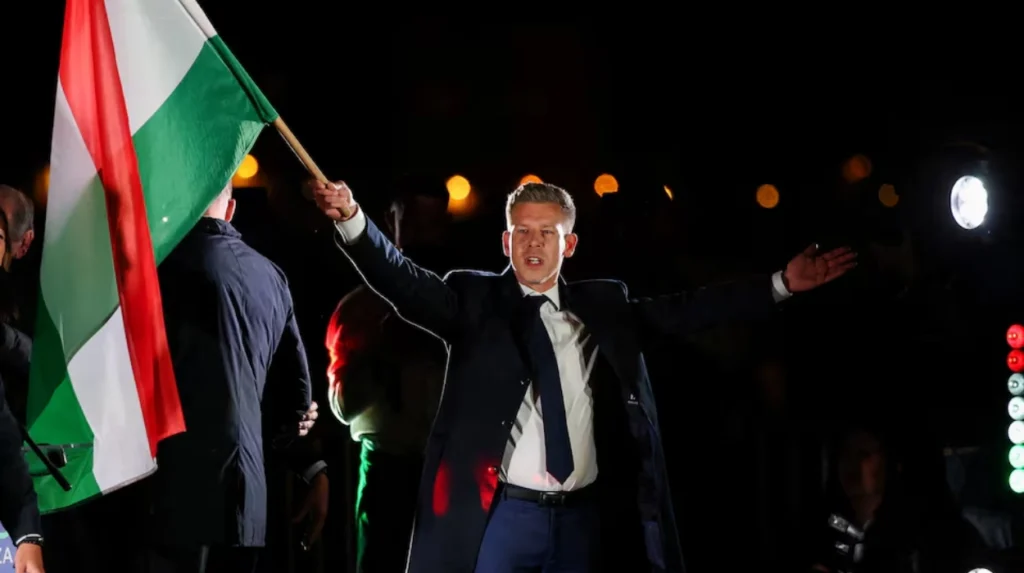
Magyar addressed jubilant supporters in Budapest’s Heroes’ Square, declaring:
“Hungary will stand again as a proud European democracy. We will rebuild trust — at home and abroad.”
The Reuters report elaborated that Magyar’s campaign emphasised restoring transparency and judicial autonomy, while promising to strengthen media independence and curb state influence over public institutions.
EU Reaction and Prospects for Policy Shift
As reported by Reuters Brussels correspondent Philip Blenkinsop, early European reactions were overwhelmingly positive. Senior officials welcomed the prospect of Hungary re-engaging with EU principles of rule of law and democratic governance.
European Commission President Ursula von der Leyen congratulated Magyar, saying the EU “looks forward to working with Hungary in a spirit of partnership and mutual respect.”
Hungary has been entangled in long-standing disputes with Brussels, primarily over corruption investigations and judicial interference, which led the EU to freeze billions in cohesion funds. According to Reuters, diplomats now anticipate an expedited thaw, with funds potentially unfrozen once reforms are implemented.
Market Response and Investor Outlook
Financial markets registered immediate optimism following the opposition’s win. As Reuters financial analyst Gergely Szakacs reported, the Hungarian forint rose nearly 3 percent against the euro in early trading, marking its strongest rally in eighteen months.
The Budapest Stock Exchange posted gains across major banking and energy sectors, reflecting investor confidence in policy stability and anticipated progress toward EU financial reintegration.
Economists quoted by Reuters forecast that the Magyar administration’s priority will be restoring international confidence while addressing high inflation and fiscal deficits inherited from the previous government.
Reforms on the Horizon
Magyar’s proposed “New Dawn Agenda”, outlined by Reuters sources inside his transition team, aims to restructure Hungary’s judiciary, reform public media governance, and introduce anti-corruption oversight bodies independent of political influence.
In his victory statement, reported by Krisztina Than, Magyar said:
“We owe it to the people who refused to surrender hope. Our first step will be transparency — in law, in finance, and in leadership.”
Legal analysts interviewed by Reuters predict that these reforms could bring Hungary closer to Western European democratic norms, reversing policies that previously alienated Brussels and Washington.
Orbán’s Legacy and Political Future
As noted by Reuters, Viktor Orbán leaves office as Hungary’s longest-serving prime minister since the fall of communism. During his 16-year rule, Orbán transformed Hungary’s political landscape with a nationalist agenda emphasising sovereignty, migration control, and cultural conservatism.
His relationship with the EU was frequently contentious, marked by disputes over press freedom, judicial autonomy, and LGBTQ rights. However, Orbán’s party, Fidesz, still retains significant influence, particularly in rural regions, leaving open questions about its future role as opposition.
Political analyst Zsuzsa Vegh, cited by Reuters, commented:
“It’s a turning point for Hungary, but Orbán remains a skilled operator. His political apparatus will not disappear overnight.”
International Response
Global leaders reacted swiftly to the Hungarian election outcome. As covered by Reuters diplomatic correspondent John Chalmers, U.S. Secretary of State Antony Blinken extended congratulations to Magyar, emphasising
“renewed democratic momentum in Central Europe.”
The French President Emmanuel Macron hailed the election as “a victory for European values and cooperative progress.” From Berlin, German Chancellor Olaf Scholz expressed hope that
“Hungary will re-establish constructive ties with EU institutions.”
Meanwhile, Russia — a long-time ally of Orbán’s government — issued a cautious statement. The Kremlin spokesperson Dmitry Peskov, quoted by Reuters, said:
“We respect the choice of the Hungarian people and expect pragmatic continuity in bilateral affairs.”
Analysts See Broader European Impact
According to Reuters Europe correspondent Francesco Guarascio, analysts consider Hungary’s political transition pivotal to reshaping Central and Eastern Europe’s democratic dynamics. Countries such as Poland and Slovakia, which have recently experienced populist shifts, may interpret Hungary’s electoral outcome as a sign of regional recalibration towards greater EU unity.
Dr Andras Bozoki, a political scientist at Central European University, told Reuters:
“Magyar’s win breaks the populist monopoly in Hungary and could inspire opposition movements elsewhere.”
Public Sentiment and Social Outlook
Reuters reporter Gergely Szakacs highlighted that voter sentiment during the campaign was driven largely by economic strains, media control issues, and fatigue with political centralisation.
Street celebrations erupted across Budapest and major provincial cities following the announcement. Citizens interviewed by Reuters expressed cautious optimism, with one supporter telling the outlet:
“We are not celebrating revenge — we are celebrating freedom.”
Next Steps for the New Government
Hungary’s transition process is set to begin immediately. As reported by Reuters political editor Krisztina Than, Peter Magyar’s administration is expected to take office within two weeks following parliamentary ratification. The coalition has pledged to deliver its first 100-day plan focusing on economic stabilisation, healthcare investment, and judiciary reform.
Magyar will also face early foreign policy tests, particularly the balancing act between maintaining Hungary’s traditional energy ties with Russia while reaffirming loyalty to EU sanctions policy — a subject that Reuters notes has sparked intense debate among Hungarian policy advisers.
Hungary’s opposition’s landslide victory represents more than a political shift — it’s a moment of democratic renewal and geopolitical realignment. As outlined by multiple Reuters correspondents, the new government under Peter Magyar has pledged to restore Hungary’s credibility, repair EU relations, and uphold transparency at home.
While challenges remain, from economic recovery to institutional reform, Hungary’s political awakening holds potential to recalibrate the country’s trajectory — both within Europe and beyond.