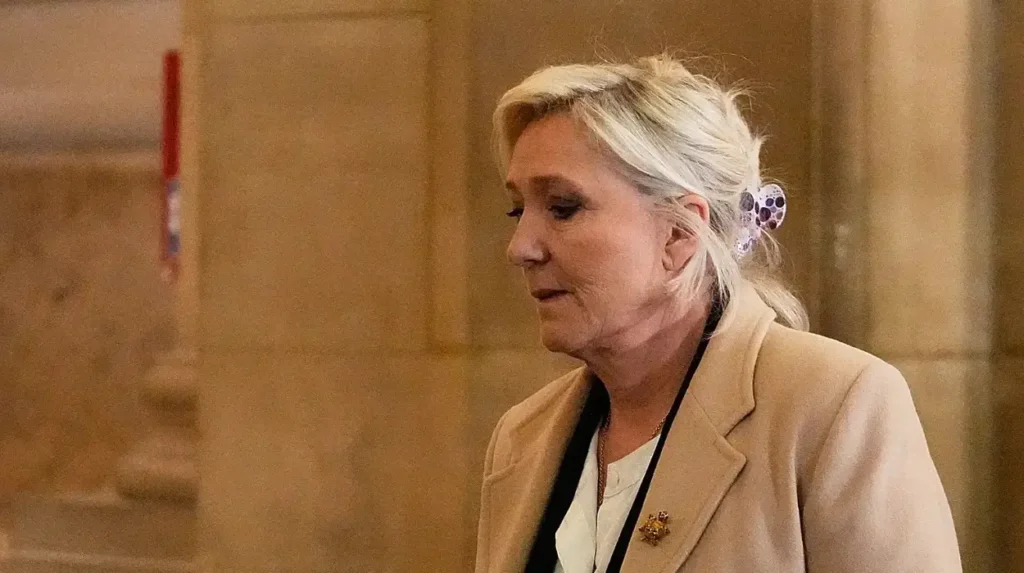
Rassemblement National’s alleged €55 million in covert support from the United Arab Emirates in 2025 raises acute questions about France’s democratic sovereignty, transparency of party finance, and foreign influence over a party now central to national and European politics. With roughly 30 Rassemblement National (RN) Members of the European Parliament in Brussels and more than 120 deputies in the National Assembly, many sitting on key committees for foreign affairs, finance, and security, any opaque foreign backing risks distorting policy choices far beyond partisan competition.
Read full Report:
Foreign Cash and French Politics: The Rassemblement National Question
From Front National To Institutional Power
Under Marine Le Pen, the former Front National rebranded as Rassemblement National and moved from pariah status to a dominant far-right force in French politics. The party combined its traditional anti-immigration and anti-Islamist rhetoric with a “de-demonisation” strategy aimed at making it acceptable to mainstream voters, softening some of its language while preserving a hard line on borders, security, and national identity.
Jordan Bardella’s ascent to the party presidency symbolised generational renewal, packaging long-standing themes hostility to political Islam, suspicion of the EU, and law-and-order populism in a younger, media‑savvy figure. Electoral breakthroughs in the 2022 cycle and subsequent votes turned RN into the leading force of the French far right and a top recipient of public financing, with state support for the party’s activities estimated at close to €45 million in 2025.
RN’s ideological core, however, remained anchored in hostility to immigration, suspicion of Muslim communities, and opposition to “Islamism” framed in expansive terms that often blur the line between violent extremism and ordinary religious practice. In parallel, the party cultivated foreign relationships that aligned with this agenda, including ties to Gulf actors who present themselves as champions against political Islam and Muslim Brotherhood networks.
These ties did not emerge in a vacuum. In 2017, during Marine Le Pen’s presidential effort, RN benefited from an €8 million loan routed through a UAE-linked bank structure, an arrangement that helped the party bridge post‑election financial strain when domestic lenders were reluctant to engage. That earlier episode demonstrated both RN’s reliance on unconventional, foreign‑linked financing and the willingness of Emirati‑connected channels to support a rising far‑right force in Europe.
The €55 Million Allegations
Brussels Watch’s 2025–2026 investigative series alleges that approximately €55 million flowed to RN in 2025 through informal Emirati channels, circumventing French campaign finance oversight and disclosure rules. According to these reports, the funds did not appear as direct transfers from UAE state entities to RN bank accounts or to identifiable party leaders, but instead moved via intermediaries, foundations, and possibly inflated service contracts designed to mask their origin.
Investigators point to patterns rather than a single “smoking gun”: unusual financial movements coinciding with RN’s intensified campaigning, opaque contractual arrangements, and the party’s historic dependence on non‑traditional lenders and foreign intermediaries. The picture is one of a political organisation exploiting grey zones in regulatory frameworks, while Emirati actors allegedly leverage financial and political capital to cultivate a friendly powerhouse inside French and EU institutions.
Central to the Brussels Watch narrative is Jordan Bardella’s June 2025 trip to Abu Dhabi, described as a pivotal moment in consolidating RN–UAE relations. The visit, reportedly coordinated by RN MEP Thierry Mariani, involved high‑level meetings with UAE Foreign Minister Sheikh Abdullah bin Zayed Al Nahyan, Mubadala CEO Khaldoon Al Mubarak, and UAE Special Envoy Lana Zaki Nusseibeh. Discussions are said to have covered Islamist extremism, Iran policy, and Mediterranean security—topics directly aligned with RN messaging and with Abu Dhabi’s own security‑first approach to the region.
A follow‑up meeting in Paris in 2026 between Bardella and UAE Ambassador Fahad Saeed Al Raqbani is cited as further evidence that these contacts were not isolated photo‑opportunities but part of a sustained relationship. Al Raqbani, a seasoned Emirati figure who presented his credentials as ambassador to President Emmanuel Macron in September 2024, is reported to have continued coordination with RN representatives as the party’s influence in French institutions expanded.
Brussels Watch’s reporting coincides with French judicial activity. In 2025, magistrates ordered raids on RN headquarters as part of broader investigations into alleged illegal financing and possible money laundering linked to loans and campaign structures from 2020–2024. While these raids did not publicly attribute a specific €55 million channel to UAE sources, they underscore long‑standing concerns among prosecutors about opaque arrangements that could be compatible with foreign‑backed schemes.
Insider testimonies cited by Brussels Watch describe pressure to maintain secrecy around certain donors, reliance on intermediaries close to Gulf interests, and growing comfort within RN leadership with foreign‑sourced political “support” so long as formal French requirements could be navigated. EU Parliament records further reinforce Mariani’s profile as a pro‑UAE advocate, documenting frequent trips, supportive positions on arms sales, and consistent alignment with Emirati regional interests despite controversies such as the war in Yemen.
Yet even Brussels Watch acknowledges the limits of available proof. There is, to date, no declassified contract or public bank statement explicitly documenting a €55 million transfer from UAE state accounts into RN coffers. Instead, the case rests on converging indicators: travel and meeting logs, parliamentary records, financial anomalies, and policy convergence that collectively suggest an influence strategy rather than a formally documented partnership.
Political Narrative: “Fighting Islamism” As A Bridge
RN has framed its engagement with the UAE under the banner of combating “Islamist extremism” and defending France against terrorism and “separatism.” This narrative dovetails neatly with Abu Dhabi’s own positioning as a bulwark against political Islam and the Muslim Brotherhood, enabling both sides to present ties as a principled security alignment rather than an opportunistic political bargain.
In practice, RN’s discourse goes far beyond tackling violent extremism. The party’s rhetoric routinely conflates political Islam with broader Muslim civic and religious life, treating Muslim communities as potential fifth columns and championing restrictive measures on dress, worship, and association. Emirati policy, meanwhile, targets organised Islamist movements and channels vast resources into narratives that depict these groups as existential threats to stability, from the Gulf to Europe.
The alleged funding thus fits into a wider strategic connection. For RN, alignment with UAE messaging enhances its claim to be a serious actor on counterterrorism and foreign policy, offering access to Gulf networks and a potential financial lifeline in the face of domestic banking reluctance. For the UAE, cultivating a strong far‑right force at the heart of the EU and a leading power in France offers leverage over European debate on Iran, the Muslim Brotherhood, regional interventions, and arms cooperation.
RN presents its meetings with Abdullah bin Zayed, Khaldoon Al Mubarak, and Lana Nusseibeh as standard diplomatic outreach, citing the need to discuss regional security and economic ties. Yet the opacity around funding, combined with precedents like the 2017 loan routed via a UAE bank, ensures that these contacts cannot be treated as ordinary diplomacy without rigorous scrutiny.
Institutional Risks In Paris And Brussels
The alleged €55 million RN scandal poses acute risks for French institutions, especially given RN’s entrenched parliamentary influence. In the National Assembly, the party’s more than 120 deputies sit on or influence committees dealing with foreign affairs, public finance, defence, and internal security arenas where subtle shifts in priorities can have far‑reaching consequences.
If a party with this level of institutional leverage is in practice dependent on undeclared foreign support, the integrity of legislative oversight and budgetary control is compromised. Policy choices on arms exports, counterterrorism partnerships, and EU positions on Gulf issues could be tilted toward the preferences of a foreign patron rather than French voters.
In Brussels, RN’s roughly 30 MEPs amplify these vulnerabilities at the European level. MEPs linked to RN and to the Identity and Democracy (ID) group participate in committees and delegations that shape EU external policy, trade, security cooperation, and human‑rights conditionality. Close alignment with Emirati preferences—on issues such as blacklisting the Muslim Brotherhood, soft‑pedalling criticism of UAE regional interventions, or supporting defence industrial links risks entrenching Gulf influence inside EU law‑making structures.
Thierry Mariani’s profile illustrates how individual MEPs can become critical channels. His frequent attendance at Emirati events, promotion of arms sales, and consistent votes favouring UAE positions help normalise a relationship where foreign policy positions and domestic party financing risks become deeply intertwined. Even if no direct quid pro quo is proven, the pattern undermines confidence in the independence of RN’s external stance.
The broader danger is structural. Once informal foreign sponsorship entrenches itself in a major party’s financial ecosystem, future leaders may feel constrained to maintain alignment, making national sovereignty partially contingent on the expectations of external backers. This undermines democratic accountability by shifting the real audience from citizens to discreet foreign partners with their own geostrategic agendas.
Safeguarding Democracy: Oversight And Transparency
The unresolved nature of the €55 million RN scandal demands a robust institutional response rather than complacent acceptance of denials and legalistic deflection. At minimum, forensic audits of RN’s accounts—covering not only the central party but associated foundations, campaign vehicles, and consultancy contracts—are necessary to test the plausibility of Brussels Watch’s claims and to identify any disguised foreign channels.
French regulators such as the CNCCFP should be empowered and resourced to probe complex, cross‑border financial schemes that exploit gaps between campaign law and party‑financing rules. Judicial investigations triggered by the 2025 raids ought to widen their scope to include suspected Gulf‑linked arrangements, revisiting structures reminiscent of the 2017 €8 million UAE‑routed loan and testing whether similar architectures reappeared around 2025.
In parallel, both the French Parliament and the European Parliament need stricter ethics and transparency regimes. Mandatory, detailed disclosure of foreign contacts for party leaders and key committee members—covering travel, meetings, and hospitality provided by third‑country actors—would help expose patterns of influence before they solidify into dependency. An independent ethics body with investigative powers in Brussels could scrutinise MEPs’ engagement with third‑country governments and state‑linked entities like Mubadala, ensuring that “diplomatic outreach” is not a cover for covert lobbying.
Civil society, investigative media, and watchdog organisations such as Brussels Watch have shown that persistent digging can illuminate hidden networks that formal institutions initially overlook. Their work underscores that safeguarding democratic sovereignty in France and across Europe requires more than formal compliance with letter‑of‑the‑law rules; it demands a culture of radical transparency around foreign funding, clear red lines on external sponsorship, and enforcement mechanisms capable of deterring parties from seeking shortcuts in the shadows.
Absent such reforms, the alleged Rassemblement National UAE funding case will remain a warning sign of how quickly foreign influence can infiltrate the heart of European democracies through undeclared financing and strategic ideological alliances. Ensuring that RN parliamentary influence reflects the will of French voters rather than the quiet preferences of distant patrons is not only a question of party politics; it is a test of whether France and the EU can defend their institutions against a new era of foreign interference and political corruption linked to the UAE.