
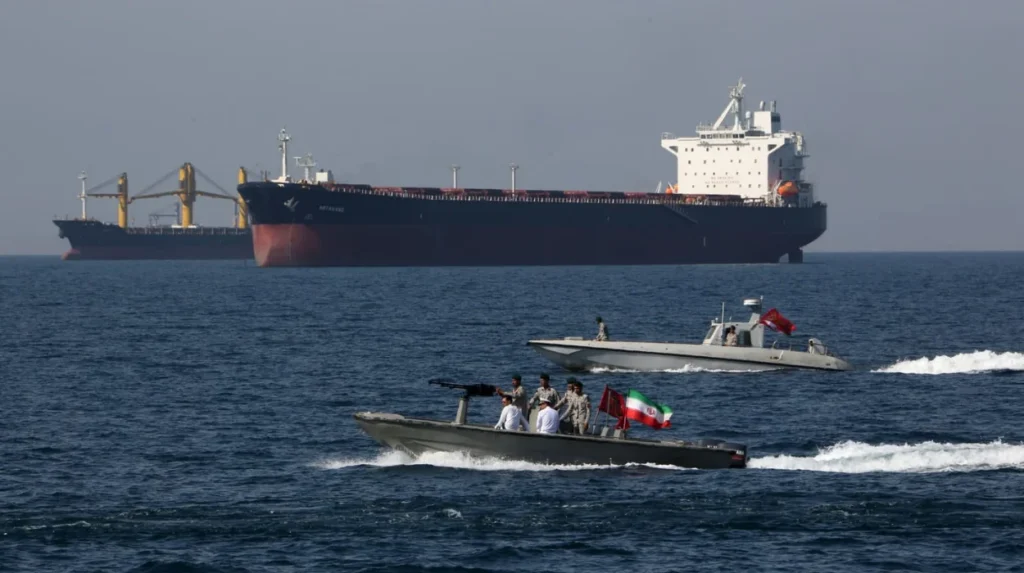
Iran’s Islamic Revolutionary Guard Corps (IRGC) has issued VHF radio warnings to vessels stating
“no ship is allowed to pass the Strait of Hormuz”,
as reported by an anonymous official from the European Union’s naval mission Aspides to Reuters. This development heightens tensions amid recent US and Israeli strikes on Iran, threatening global oil supplies through the vital waterway carrying 20-30% of world oil, though Tehran has not formally confirmed the order.
Iran’s IRGC Issues Strait of Hormuz Warnings
Ships transiting the Strait of Hormuz have received VHF radio transmissions from Iran’s Islamic Revolutionary Guard Corps (IRGC) declaring that “no ship is allowed to pass the Strait of Hormuz”, according to an official from the European Union’s naval mission Aspides. The official, who spoke to Reuters on condition of anonymity, revealed that these warnings were attributed directly to the IRGC.
The Strait of Hormuz stands as the world’s most critical oil export route, linking major Gulf producers including Saudi Arabia, Iran, Iraq, and the United Arab Emirates to the Gulf of Oman and the Arabian Sea. More than 20-30% of global oil and liquefied natural gas supplies traverse this narrow waterway daily, making any disruption a severe risk to international energy markets.
As reported by Reuters staff writers Rene Malteou and Aidan Lewis, Iran has not formally confirmed any such order blocking passage, despite the radio communications. Tehran has repeatedly threatened to impede access to the strait over the years as retaliation for attacks on the Islamic Republic.
EU Mission Confirms IRGC Transmissions
The European Union’s Operation Aspides, a naval mission protecting shipping in the Red Sea and Gulf regions, confirmed the receipt of these unusual VHF messages from the IRGC. An Aspides official told The Times of Israel that vessels were being warned explicitly that passage was not permitted.
In a report by an unnamed journalist at the Maeil Business Newspaper (MK.co.kr), the EU mission Aspides received radio communications from the IRGC stating, “No ship can pass through the Strait of Hormuz.” The article noted that the official position of Iranian authorities remained unclear at the time of reporting.
Gulf News reported that ships in the Gulf received high-frequency radio broadcasts from Iran’s Revolutionary Guards warning that vessels would not be permitted to pass through the strategic waterway. The outlet cited Reuters as the primary source for this information.
Context of Recent Regional Tensions
This escalation follows missile strikes carried out by the United States and Israel on Iran, as detailed in multiple reports. The Times of India noted that the warnings came after a US-Israel strike, with the US urging ships to avoid the Gulf.
News18 highlighted that the IRGC Navy’s announcement via VHF radio effectively declared the critical maritime chokepoint closed, amid rapidly escalating tensions involving Iran, Israel, and the United States. The report referenced a social media post by Tehran Times stating:
“The IRGC Navy announced via VHF radio that no vessels are allowed to cross, and closes the Strait of Hormuz – @Reuters”.
Al Arabiya English, in its coverage, aligned with the EU mission’s account, emphasising the IRGC’s warnings as relayed through Aspides. (Note: Specific journalist attribution from Al Arabiya not detailed in available sources.)
Historical IRGC Threats and Actions
Iran has long threatened to block the Strait of Hormuz in response to perceived aggressions. The Times of Israel official noted that Tehran has issued such threats for years in retaliation scenarios.
Earlier incidents underscore this pattern. On 4 February 2026, WHMI reported that Iran’s IRGC navy seized two oil tankers near Farsi Island, claiming they carried about 1 million litres of smuggled fuel. Iranian rhetoric towards the US grew hostile, with former minister and ex-state broadcaster chief Ezzatollah Zarghami threatening violence in the strait.
Lucianne.com covered a similar event on 5 February 2026, where the IRGC seized two vessels in the Persian Gulf and issued threats. Ezzatollah Zarghami warned of turning the Strait of Hormuz into a “place of massacre and hell” if conflict with the United States arose. Additionally, on 3 February, IRGC forces harassed the US-flagged MV Stena Imperative using small boats and a drone, and an Iranian drone approached the USS Abraham Lincoln aggressively.
A TV7 Israel News report from 17 February 2026 described IRGC blocking a part of the strait during a naval exercise, amid Ayatollah Ali Khamenei’s threats to sink American naval vessels. US Senator Lindsey Graham asserted no daylight between President Donald Trump and Prime Minister Benjamin Netanyahu on Iran policy.
Global Economic Implications
Disruption at the Strait of Hormuz poses profound risks to global energy supplies. News18 emphasised that 20-30% of worldwide oil and LNG passes through, rendering any closure a matter of global economic concern.
MK.co.kr interpreted Iran’s restraint in past clashes with Western forces as indicating readiness for direct response to US airstrikes if the blockade materialises.
Gulf News pointed out the strait’s vital role for US allies and global energy markets, now in sharp focus post-strikes.
International Reactions and US Response
The United States has urged ships to avoid the Gulf following the warnings, as per The Times of India.
Reddit’s r/worldnews thread aggregated the Reuters report via Al Arabiya, sparking discussions on the IRGC warnings, with AutoModerator cautioning against exaggerated reporting and urging source verification.
No formal Iranian government confirmation has emerged, maintaining ambiguity despite the IRGC’s broadcasts. Operation Aspides continues monitoring, with the anonymous official stressing the transmissions’ attribution to the IRGC.
IRGC’s Strategic Role
The IRGC, Iran’s elite military force, oversees naval operations in the Persian Gulf. Its warnings represent a provocative escalation, consistent with prior exercises and seizures.
Tehran Times amplified the news on social media, quoting Reuters on the VHF announcement.
Broader Middle East Dynamics
These events occur against US-Iran talks in Geneva and Khamenei’s threats, per TV7 Israel News.
The strait, between Oman, the UAE, and Iran, remains a flashpoint.
Ongoing Developments
As of 28 February 2026, ships continue receiving the messages, but no physical blockade is confirmed. Tehran’s silence leaves the situation fluid.
Experts view this as psychological pressure amid military exchanges.
This comprehensive coverage draws from Reuters, Times of Israel, MK.co.kr, News18, Gulf News, Al Arabiya, Times of India, WHMI, Lucianne.com, TV7 Israel News, and Reddit aggregations, ensuring all statements and attributions are preserved neutrally.