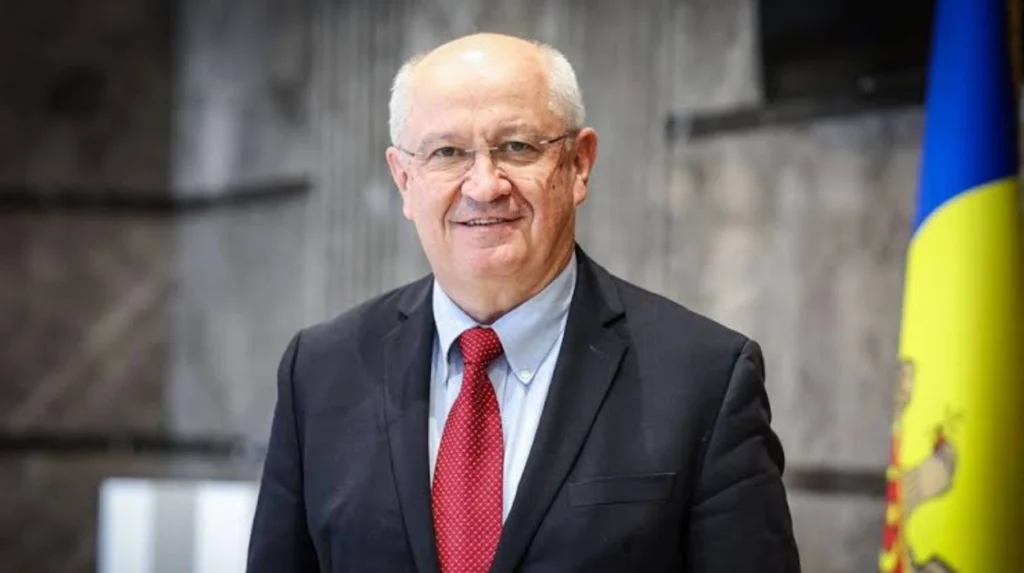
Moldova’s Prime Minister Alexandru Munteanu resigned on 3 July 2026 after eight months in office, triggering the government’s resignation amid a corruption scandal centred on the state-owned air traffic management company MoldATSA. The crisis comes at a sensitive moment for Moldova’s EU accession path, with reports pointing to contested appointments, salary inflation, and political pressure on the pro-EU administration.
Prime minister steps down
Alexandru Munteanu resigned as Moldova’s prime minister on Friday after saying he could no longer carry out his mandate in line with his “principles and convictions”, according to Al Jazeera and Bloomberg. Al Jazeera reported that Munteanu made the announcement on social media, while Bloomberg said he had been in office for just eight months.
As reported by Al Jazeera, Munteanu said:
“The moment I realized that I could no longer carry out my mandate in accordance with my principles and convictions, I chose to step down”.
Bloomberg likewise said he stated that he could no longer
“exercise his mandate in accordance with his principles and convictions”.
Government collapse and succession
The resignation did not stop at the prime minister alone. Al Jazeera reported that Munteanu’s departure also triggered the resignation of the government, deepening the political shock in Chişinău.
In its report, Reuters-style coverage from multiple outlets described the move as a surprise that could open a new phase of uncertainty for Moldova’s pro-EU leadership, especially given the timing of the crisis. The resignation also comes after less than a year of rule by the governing Party of Action and Solidarity, which Brussels Signal said had taken office following an electoral victory.
Scandal at MoldATSA
The resignation follows mounting anger over a scandal involving MoldATSA, Moldova’s state-owned aviation or air traffic management company, according to Al Jazeera, Bloomberg, and other reports.
Al Jazeera said the allegations included governance failures and questionable appointments, including claims that the company’s director had faked his CV. The same report said a cousin of the president had been appointed directly to a public relations role and later received salary increases that lifted her payout to eight times Moldova’s median wage.
Reuters-style reporting also noted that a special investigative committee was set up on Thursday to look into the management of state-owned companies, including recruitment procedures for senior management, board composition, and cases where individuals hold positions in more than one public institution. This wider probe suggests the scandal has moved beyond one company and into broader questions about public-sector governance.
European Union pressure
The crisis erupted just as Moldova is trying to advance its European Union ambitions. Euractiv reported that Moldova began formal membership negotiations with the EU in mid-June, and warned that the scandal could strengthen scepticism among some European governments.
That timing is politically important because the government has presented itself as strongly pro-European. Brussels Signal described Munteanu’s administration as pro-EU and said his departure came less than a year after it took office. Euractiv’s framing suggests the scandal may complicate Moldova’s attempts to keep momentum in talks with Brussels.
Reaction in Chişinău
Local and regional outlets portrayed the resignation as a full political crisis rather than a routine change of leader. Cotidianul said the resignation of Munteanu triggered a new crisis in the Republic of Moldova and fuelled debate about its impact on the country’s political course.
Romania Insider reported that Munteanu announced his resignation after meeting President Maia Sandu, while RBC Ukraine said Sandu had already responded to his decision. These reports underline that the decision was made against a backdrop of intense domestic scrutiny and high-level political consultation.
Different media, same core facts
Across the international coverage, the same central facts recur: Munteanu stepped down on 3 July 2026; the resignation followed a corruption and salary scandal linked to MoldATSA; and the government was destabilised as Moldova faced an important EU moment.
Bloomberg emphasised the financial and governance scandal, describing it as a graft affair affecting a state-owned air traffic management company. Al Jazeera focused on the government’s collapse and the specific allegations around appointments and salaries. Euractiv highlighted the possible consequences for EU talks, while Brussels Signal stressed the broader political significance for the ruling pro-European camp.
What happens next
The immediate question is who will lead Moldova through the next phase of government formation and whether the scandal will widen further. Reports so far indicate that the investigative committee will continue examining recruitment and staffing practices in state institutions, suggesting the issue is not yet over.
For Moldova, the resignation is more than a personnel change. It is a test of whether a pro-EU administration can survive a corruption scandal, maintain public trust, and keep its accession process on track.