
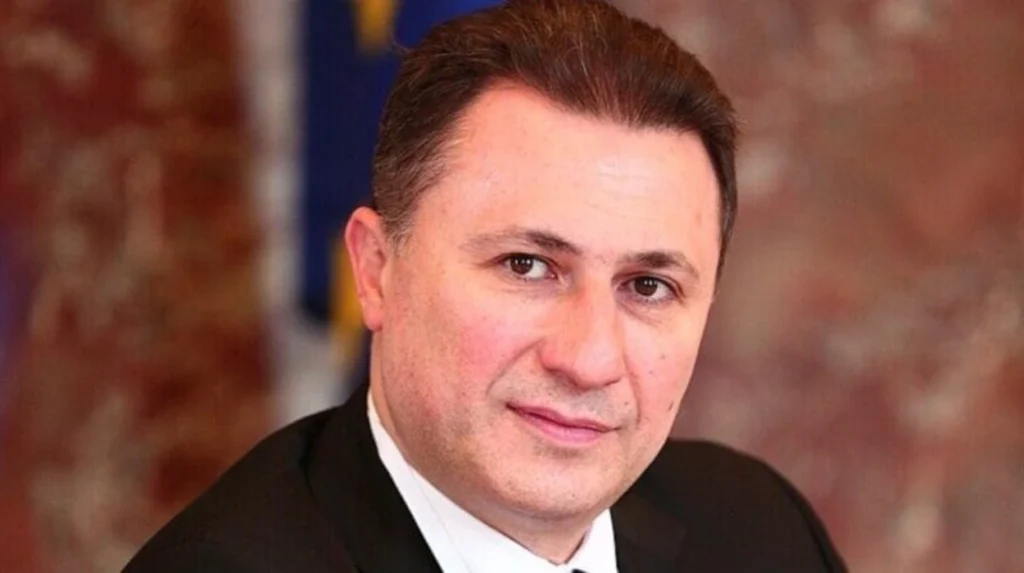
North Macedonia’s fugitive former Prime Minister Nikola Gruevski has been acquitted in a retrial on charges of abuse of office linked to the construction and financing of his VMRO-DPMNE party headquarters, known as the “White Palace”, following 2023 Criminal Code amendments that reshaped the legal basis for such prosecutions. The verdict means the state can no longer seek confiscation of the multi‑million‑euro building, now used by Prime Minister Hristijan Mickoski’s VMRO‑DPMNE, and adds a new twist to a long list of convictions and ongoing cases against Gruevski, who remains a fugitive in Hungary.
The Skopje Criminal Court has acquitted fugitive former Prime Minister Nikola Gruevski of abuse-of-office charges related to the construction of VMRO-DPMNE’s lavish party headquarters, citing changes to North Macedonia’s Criminal Code that prosecutors failed to overcome in a closely watched retrial.
Court Acquittal In “Talir 2” Retrial
According to reporting by Balkan Insight’s Skopje bureau for BIRN, the Skopje Criminal Court on Tuesday ruled that prosecutors did not prove that former prime minister Nikola Gruevski had abused his official position in connection with the construction of VMRO‑DPMNE’s headquarters in central Skopje, popularly referred to as the “White Palace”. As reported by Balkan Insight, judges stressed that the verdict in this retrial reflected the legal consequences of 2023 amendments to North Macedonia’s Criminal Code, which significantly altered the legal framework for prosecuting abuse of office cases.
Balkan Insight noted that the so‑called “Talir 2” case focused on allegations that Gruevski and then government secretary‑general Kiril Bozhinovski had illegally facilitated the construction of VMRO‑DPMNE’s headquarters by circumventing rules on political party financing. Earlier reporting by Euronews on the initial conviction underlined that the Criminal Court had found a government‑linked construction company had effectively covered the entire estimated 7 million euro cost of the headquarters as a de facto donation to the conservative VMRO‑DPMNE party.
As recounted by Balkan Insight, the court concluded in the retrial that, in light of the revised legislation and the modified indictment,
“the prosecution had not established Gruevski’s criminal liability, beyond reasonable doubt”.
Under this decision, the state loses the legal avenue to confiscate the party headquarters, a landmark property estimated in earlier proceedings at around 14 million euros.
Impact On VMRO‑DPMNE And The “White Palace”
Balkan Insight reported that the verdict means VMRO‑DPMNE, now led by current Prime Minister Hristijan Mickoski, can freely retain the multi‑million‑euro headquarters without threat of confiscation by the state. The building, known colloquially as the “White Palace”, has been both a political symbol and a focal point in debates over alleged illicit party financing during and after Gruevski’s decade in power.
As highlighted in BIRN’s coverage, the case originally linked the project to alleged abuses of power and illicit party funding structures, in which the construction firm’s coverage of costs was treated as an unlawful political donation outside regular transparency and finance rules. With the acquittal, the party’s ownership of the headquarters is no longer under immediate legal challenge, even as domestic and international anti‑corruption advocates continue to scrutinise the broader pattern of cases involving senior VMRO‑DPMNE figures.
Legal Background And Criminal Code Amendments
According to Balkan Insight’s court report, Gruevski was initially sentenced in 2022 to six years in prison in the “Talir 2” case, and the court at that time ordered the confiscation of VMRO‑DPMNE’s headquarters, valuing the asset at around 14 million euros. As detailed in BIRN’s coverage, the Court of Appeals overturned that conviction in 2024 and ordered a retrial after the parliament’s 2023 amendments to the Criminal Code fundamentally changed the legal basis for prosecuting abuse of office and related offences.
Balkan Insight further noted that prosecutors had to amend the indictment during the retrial to adjust it to the new legal provisions, and that, in this new phase, no indictment was pursued against former secretary‑general Kiril Bozhinovski, leaving Gruevski as the sole defendant in “Talir 2”. Under the revised indictment and the altered legal framework, the Skopje Criminal Court ultimately ruled that Gruevski’s criminal responsibility could not be established beyond reasonable doubt, leading to his acquittal.
Euronews, in its earlier reporting on the initial conviction, underscored that prior judgments had treated the arrangement as a serious abuse of power, noting the use of a government‑linked construction company to build the eight‑storey party HQ and the resulting order to confiscate that and dozens of other properties, a picture now significantly reshaped by the retrial outcome. The change illustrates how substantive modifications to criminal statutes can retroactively reshape high‑profile corruption cases and their penalties, a trend that domestic critics argue may weaken accountability for past abuses.
Gruevski’s Status As Fugitive And Previous Convictions
While Gruevski has now been acquitted in the “Talir 2” retrial, he remains a fugitive from justice with a record of multiple convictions in separate proceedings. As reported by Radio Free Europe/Radio Liberty, North Macedonia’s authorities have been seeking his extradition from Hungary, where he was granted political asylum after fleeing in November 2018 to avoid a separate two‑year prison sentence for corruption related to the use of a 600,000 euro Mercedes purchased with state funds for personal travel.
RFE/RL explained that in another case concerning orchestrated violence during a 2013 protest in Skopje, a court in North Macedonia sentenced Gruevski in September 2020, in absentia, to one and a half years in prison for organising and encouraging demonstrators who forcibly entered a municipal building and targeted opposition officials. The same report described how six other party members and supporters received suspended sentences in that case, while authorities continued to pursue further corruption and abuse‑of‑office allegations dating from his time in power between 2006 and 2016.
Separately, the Associated Press, as carried by outlets such as The Hill and inkl, reported in April 2022 that a Skopje court convicted Gruevski of using VMRO‑DPMNE’s funds to enrich himself, sentencing him in absentia to seven years in prison for misappropriating around 1.4 million euros in party donations between 2006 and 2012 and laundering the money through real estate purchases via an offshore company in Belize. AP’s coverage noted that four associates were also convicted in that party‑funds case, including his cousin, former secret police chief Saso Mijalkov, and businessman Orce Kamcev, with prison terms and suspended sentences handed down alongside the seizure of multiple assets such as luxury apartments in Skopje.
In another high‑profile proceeding, Balkan Insight reported in May 2022 that Gruevski was convicted and given a nine‑year jail term for ordering the demolition of a building owned by a former ally‑turned‑rival in 2011, under the pretext of lacking a construction permit, with the Skopje Criminal Court again finding him guilty of abuse of power in absentia. Taken together, these convictions and ongoing cases depict a complex legal landscape in which the former leader faces multiple sentences yet remains physically outside North Macedonia’s jurisdiction.
Broader Pattern Of Corruption Allegations
Transparency International’s case profiles describe a series of major corruption affairs involving Gruevski and his associates, including the “Plots on Vodno” and “Titanik” cases, which officials and civil society groups cite as emblematic of systemic corruption in North Macedonia during and after his decade in office. Transparency International notes that the “Plots on Vodno” affair has been treated as a high‑profile corruption and money‑laundering case centred around the former prime minister and his network, focusing on dubious real‑estate acquisitions and opaque financial flows.
In its material on the “Titanik” case, Transparency International reports that courts examined systemic electoral abuses and other irregularities, with North Macedonia’s Supreme Court later upholding key convictions arising from that case. According to the same source, the proceedings had to restart in 2022 due to procedural issues, highlighting both the length and complexity of the judicial process surrounding alleged abuses tied to Gruevski’s era.
Euronews, in its coverage of the earlier “Talir 2” conviction, emphasised that Gruevski’s six‑year sentence for abuse of power in relation to the party HQ was already his fifth prison sentence since leaving office, underscoring the cumulative legal weight of the corruption and abuse‑of‑office cases against him. With the latest acquittal, that tally changes in legal terms but does not erase the broader record of separate convictions that continue to define his political legacy and complicate North Macedonia’s efforts to project a credible anti‑corruption stance at home and in its European Union aspirations.
Political And Public Reactions
Balkan Insight’s reporting underlines that the decision on “Talir 2” has immediate political implications, given that VMRO‑DPMNE now heads the government under Prime Minister Hristijan Mickoski and will retain uncontested ownership of the “White Palace”. Domestic critics and anti‑corruption advocates argue, as reflected in commentary referenced by both BIRN and Transparency International, that recent Criminal Code changes may inadvertently weaken accountability for past high‑level abuses just as the country seeks to align more closely with European standards.
While detailed statements from key political actors on the day of the verdict are not fully captured in the available open sources, prior reporting by Balkan Insight and other outlets shows that VMRO‑DPMNE has consistently rejected the portrayal of these cases as genuine anti‑corruption efforts, frequently framing them as politically motivated proceedings initiated by rival forces. At the same time, international observers, including organisations such as Transparency International, have repeatedly identified the range of cases around Gruevski as indicators of entrenched corruption risks that require robust judicial independence and consistent enforcement to address.
Against this backdrop, the acquittal in “Talir 2” may fuel renewed debate in Skopje over the balance between legal reform and the perceived rollback of accountability, especially where amended laws appear to facilitate more favourable outcomes for previously convicted or indicted political elites. For a public long exposed to wiretapping scandals, mass protests, and contentious trials associated with Gruevski’s rule and its aftermath, the latest verdict is likely to be interpreted through the wider lens of trust—or mistrust—in North Macedonia’s institutions.