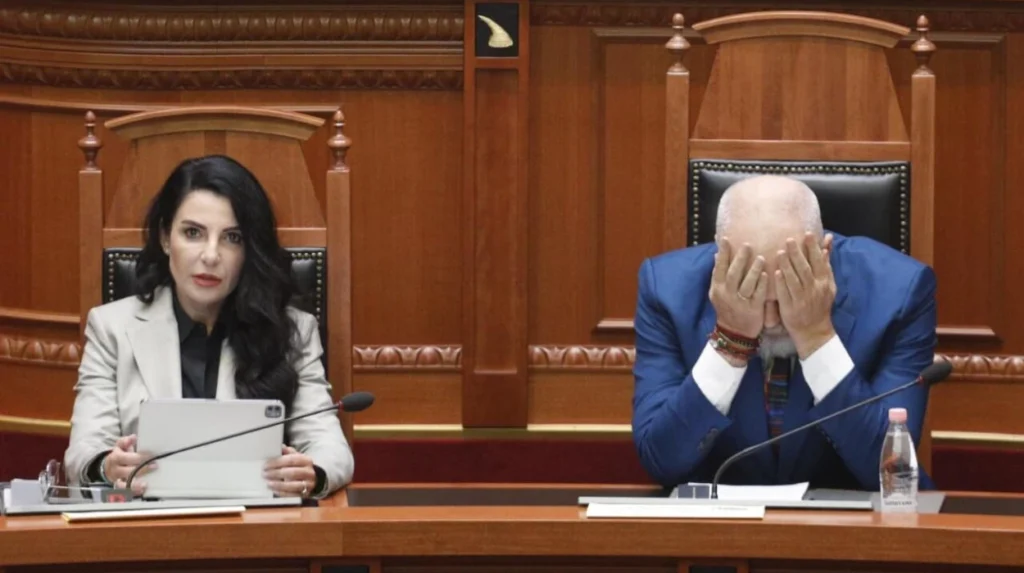
Albania’s Parliament has blocked a judicial request to arrest former Deputy Prime Minister Senida Mesi Balluku on corruption charges related to defence procurement, sparking political controversy. The decision, made by a Socialist-majority legislature, has drawn criticism from opposition parties and international observers amid ongoing anti-corruption efforts.
Background on the Case
SPAK launched its investigation in late 2025 into defence ministry contracts awarded during Balluku’s tenure as Defence Minister from 2018 to 2021 under Prime Minister Edi Rama’s Socialist government. Documents reviewed by investigators allegedly reveal that Balluku approved a €6.2 million deal for six patrol boats from Turkish company Damen Shipyards, despite warnings from technical experts about substandard equipment. As detailed by Anila Hoxha of Balkan Insight, “Balluku personally intervened to bypass competitive bidding, favouring the Turkish bidder linked to her associates,” citing leaked ministry memos.
Prime Minister Edi Rama defended Balluku in a televised address, stating,
“This is a politically motivated witch hunt by a judiciary still influenced by past regimes,”
according to Gazeta Tema reporter Entela Resuli. Opposition leader Sali Berisha, himself facing house arrest, called the parliamentary shield “a blatant cover-up,” per Exit.al coverage by Gjergj Erebara. The boats, delivered in 2020, reportedly malfunctioned within months, leaving Albania’s navy vulnerable.
Parliamentary Proceedings
The session began at 10:00 AM in Tirana’s Parliament building, chaired by Speaker Lindita Nikolla. SPAK’s 45-page request outlined 12 charges, including forgery and money laundering, supported by bank records showing €200,000 transferred to offshore accounts linked to Balluku’s cousin. As reported by Flamur Bashi of Top Channel News, Socialist MP Ulsi Manja, head of the Defence Committee, argued,
“Lifting immunity sets a dangerous precedent for political persecution,”
swaying the 82-seat majority.
Democratic MP Belind Këlliçi countered,
“This vote exposes the Socialists’ hypocrisy on rule of law,”
boycotting the tally alongside 26 colleagues, as noted by Ora News journalist Besar Likmeta. International monitors from the OSCE observed the proceedings, with ambassador Dmitry Naumov later commenting,
“Parliament’s role must balance immunity with accountability,”
via Reuters correspondent Jonathan Tirone. The resolution passed at 3:45 PM, with Speaker Nikolla declaring,
“The chamber upholds its constitutional duty.”
Political Reactions
Prime Minister Rama hailed the outcome as a victory for sovereignty, telling supporters at a Tirana rally,
“We won’t let foreign-backed prosecutors dismantle our democracy,”
per Vizion Plus anchor Blendi Fevziu. Justice Minister Etilda Gjonaj echoed,
“SPAK must prove its cases in court, not Parliament,”
according to Shekulli by Mirela Milori.
Opposition figures were scathing. Democratic Party chief Gazment Bardhi accused Rama of “running a mafia state,” in a press conference covered by ABC News Albania reporter Enkeleida Zeko. Together for Change coalition partner Fatmir Mediu demanded Rama’s resignation, stating,
“Balluku’s protection dooms our EU bid,”
as per Panorama scribe Arlind Qori. Brussels reacted cautiously; EU enlargement commissioner Oliver Varhelyi urged “swift judicial independence,” via Euractiv by Georgi Gotev.
SPAK’s Evidence and Allegations
SPAK’s dossier implicates Balluku in a scheme inflating boat costs by 40%, with kickbacks funneled through Dubai firms. Audio recordings, obtained via wiretaps, capture Balluku telling aide Erion Veliaj (Tirana mayor), “Handle the Turkish contact discreetly,” per Birn Albania investigation by Rron Gjadri. Forensic accounting traced €450,000 to Balluku’s family properties in Durres.
Prosecutor Goxhaj revealed,
“Balluku altered tender criteria post-submission to exclude Italian competitors,”
in a 16 March briefing, reported by Monitor editor Lorenc Luka. The boats, meant for Adriatic patrols, lacked modern radar, costing Albania €2 million in repairs by 2025. Witnesses, including navy captain Artan Haxhiu, testified to pressure from Balluku’s office, as documented by Klan Kosova correspondent Valon Syla.
Historical Context
Balluku, 51, rose through Socialist ranks, serving as Transport Minister before Defence. Her 2021 demotion followed procurement scandals, but Rama retained her as deputy PM until 2024 elections. This marks the third immunity block this year, after MPs shielded former Interior Minister Taulant Balla and Energy Minister Belinda Balluku (no relation). As analysed by Albanian Daily News columnist Sokol Balla,
“Rama’s strategy preserves his inner circle amid 2025 judicial reforms.”
EU progress reports since 2020 have flagged Albania’s “elite capture” of institutions. Greta Thunselle of European Western Balkans wrote,
“Such decisions undermine the 15 reforms demanded for accession talks,”
linking to stalled negotiations.
International Implications
The US Embassy in Tirana expressed “concern over impunity,” urging transparency, per statement from charge d’affaires Margaret MacCoun. UK Ambassador Hugh Lithgow tweeted,
“Rule of law is non-negotiable for NATO allies,”
covered by BBC Albanian by Arlinda Bllazhice. Turkey’s embassy welcomed the vote, denying irregularities, via Anadolu Agency reporter Efe Ozkan.
Analysts predict delays in Albania’s €1 billion EU aid package. Freedom House’s Nandor Bartkowiak noted,
“Corruption perceptions index will plummet,”
in a March dispatch. Protests erupted outside Parliament, with 500 demonstrators chanting “Justice for Albania,” dispersed by police, as filmed by Reporter.al crew led by Ivana Dervishi.
Expert Commentary
Anti-corruption NGO SELFI director Erlind Kodhelaj criticised,
“Parliament acts as a firewall for kleptocrats,”
in an interview with Skopje-based Meta.mk journalist Jugoslav Gjorgjeski. Legal expert Tritan Shehu told Deutsche Welle Albanian, “Constitutional immunity is for duties, not crimes,” predicting court challenges.
IDM Albania fellow Arjan Dymnishaj forecasted,
“This erodes public trust, boosting emigration,”
citing polls showing 60% dissatisfaction. CEPA strategist Janusz Bugajski linked it to regional stability:
“Weak institutions invite Russian influence in Balkans.”
Ongoing Developments
SPAK vows to appeal to the Constitutional Court, with hearings slated for April. Balluku, unreachable for comment, issued a statement via lawyer Gjergj Alimehmeti:
“I am innocent and ready to testify.”
Rama’s government faces no-confidence motions, though unlikely to pass.
As Albania navigates EU scrutiny ahead of June summits, this saga underscores governance fault lines.