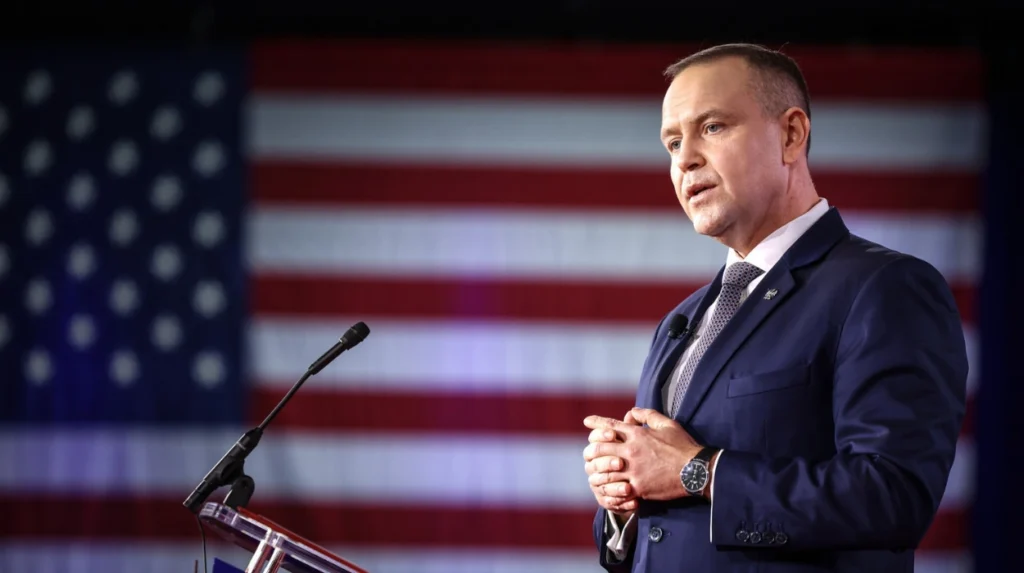
At CPAC Hungary, President Andrzej Nawrocki declared that Russia represents corruption and brutality rather than genuine traditional values, urging conservatives to resist Kremlin propaganda. His remarks drew international attention amid scrutiny of Eastern Europe’s struggle against systemic corruption and disinformation.
Poland’s President Denounces Russian Moral Hypocrisy
As reported by Brussels Signal on 29 March 2026, Polish President Andrzej Nawrocki addressed the Conservative Political Action Conference (CPAC) in Budapest, asserting that Russia’s regime embodies corruption and violence rather than Christianity or family values. Thomas O’Reilly of Brussels Signal quoted Nawrocki as saying that Moscow’s appeal to conservative sentiment across Europe is “a false front concealing kleptocracy and bloodshed”.
O’Reilly reported Nawrocki’s statement:
“Russia today stands not for traditional values, but for corruption, violence and lies. The Kremlin manipulates moral rhetoric to justify aggression.”
The speech, delivered before prominent right-wing leaders from Europe and the United States, sought to distinguish Poland’s nationalist conservatism from pro-Russian ideologies that threaten democratic integrity in Central Europe.
CPAC Gathering Highlights Divisions on Russia
According to Euractiv’s correspondent Katarzyna Stańczak, Nawrocki delivered his address during the opening day of CPAC Hungary 2026, attended by Hungarian Prime Minister Viktor Orbán, U.S. conservative delegates linked to Donald Trump, and numerous right-wing politicians from across Eastern Europe.
Stańczak reported that while Orbán repeated his familiar call for “sovereign democracy” and dialogue with Moscow, Nawrocki used his speech to diverge from Orbán’s conciliatory approach toward Vladimir Putin. The Polish leader warned that any political movement accepting Russian narratives risked
“moral and political complicity in Kremlin corruption”.
As cited by Euractiv, Nawrocki stated:
“The Russian regime is not a defender of faith or civilisation; it is a system of theft, propaganda and war. We cannot build conservative Europe on lies and violence.”
His tone contrasted sharply with the pro-Russian messaging common at certain conservative gatherings, marking Poland’s ideological repositioning after his election victory earlier this year.
Corruption at the Heart of Kremlin Influence
Reuters’ Eastern Europe correspondent Alan Charlish explained that Nawrocki’s statements align with a regional trend opposing Moscow-linked corruption. Charlish wrote that Polish officials have long accused Russia of using financial networks, covert funding, and disinformation to destabilise democratic structures across Europe.
Charlish further emphasised that Nawrocki’s remarks
“reinforced Warsaw’s commitment to transparency reforms and anti-corruption measures”
introduced after revelations concerning money laundering through offshore companies tied to Russian oligarchs. Academic experts from the University of Warsaw’s Institute of International Affairs told Reuters that Russia’s “export of corruption” through illicit political donations, energy contracts, and media manipulation remains a strategic tool. Nawrocki’s warning, they said, underscores the effort to “rebuild conservative ethics around integrity rather than influence”.
Poland’s Push for Ethical Conservatism
Notes from Poland journalist Daniel Tilles observed that Nawrocki’s CPAC address highlights both ideological and ethical differences between Poland and Hungary, despite their shared membership in the Visegrád Group. Tilles wrote that
“Nawrocki explicitly rejected the moral relativism enabling corruption to disguise itself as tradition,”
signalling a new political direction grounded in democratic conservatism rather than kleptocratic control.
Tilles quoted Nawrocki saying,
“For too long, many in Europe have confused faith with loyalty to Moscow. We must not let corruption wear the mask of morality.”
The journalist added that Nawrocki’s position appeals to both international allies and domestic audiences weary of recurring corruption scandals. Despite these concerns, the speech aimed to reclaim moral credibility as a central national value.
Broader Reaction Across Europe
Analysts cited by Euractiv and Reuters noted that Nawrocki’s statement was unusually direct for a Polish head of state addressing CPAC, a forum often sympathetic to authoritarian styles of governance. Hungarian government spokesman Zoltán Kovács dismissed Nawrocki’s assertions as “an unnecessary provocation” in comments to Reuters.
In contrast, Ukrainian Foreign Minister Dmytro Kuleba praised Nawrocki’s stance in remarks to Euractiv, saying:
“In confronting Russian corruption, President Nawrocki shows real leadership among European conservatives. This is moral courage we need.”
Monica Hohlmeier, chair of the European Parliament’s anti-corruption group, also commended Nawrocki, as quoted in Brussels Signal:
“Europe’s unity begins with honesty about what Russia truly represents: state violence and elite theft.”
Russia’s Continued Reputation for Kleptocracy
Reuters’ Moscow bureau highlighted that Transparency International’s 2025 Corruption Perceptions Index still ranks Russia among the most corrupt European economies, identifying extensive offshore holdings owned by politically connected elites. Independent Russian journalist Ekaterina Finkel told Euractiv that Nawrocki’s analysis reflects what many reform-minded Russians already understand:
“Our leaders preach Christian family values, but their children live abroad, their money is hidden, and the system rewards theft.”
These insights reinforce Nawrocki’s argument that Russia’s moral posturing conceals a network of corruption that extends far beyond its borders. Kremlin-linked financial and political operations continue to shape foreign discourse across Europe through a mixture of coercion and moral manipulation.
Domestic Reactions in Poland
Within Poland, Nawrocki’s speech received attention across party lines. Opposition leader Donald Tusk supported the president’s anti-corruption message but remarked, according to Notes from Poland, that
“moral credibility begins at home.”
Tusk added that
“Poland’s voice against Kremlin corruption will matter most if backed by transparent governance domestically.”
Meanwhile, a spokesperson from the Prime Minister’s Office told TVP Info that Nawrocki’s administration has implemented “zero-tolerance policies” for misconduct, including new asset disclosure rules for public officials and reforms enhancing anti-fraud powers. Political commentators cited by Euractiv said the stance could strengthen Poland’s reputation within NATO and the European Union as a credible partner in countering the Kremlin’s malign financial activities.
CPAC’s Role in Shaping Conservative Discourse
CPAC Hungary has evolved into a platform where Western conservatives and populist nationalists contest the meaning of traditional values in a post-war Europe. As Brussels Signal’s Thomas O’Reilly explained, Nawrocki’s decision to address the event was intentional—to
“reassert conservatism grounded in truth and accountability rather than authoritarian mimicry.”
O’Reilly noted that reactions among attendees were mixed: Polish and American delegates applauded Nawrocki’s words, while some Hungarian observers seemed uneasy. Commenting to Notes from Poland, analyst Dr Agnieszka Nowak described the intervention as “not only moral but geopolitical”, aimed at
“redefining conservatism as fidelity to truth rather than power.”
Analysts See Strategic Rebranding
Euractiv Insight analysts concluded that Nawrocki’s CPAC appearance could represent Poland’s broader effort to reposition its politics within the European right. His remarks align Warsaw more closely with Brussels and Washington on ethics and transparency, distancing it from pro-Russian populists across the continent. Stańczak of Euractiv summarised:
“In challenging Russian corruption and asserting moral clarity, Nawrocki repositions Poland as the ethical centre of European conservatism.”
Reuters added that Poland’s diplomatic representatives have already distributed Nawrocki’s Budapest remarks among European allies as reference material for future joint initiatives against propaganda and corruption networks.
President Andrzej Nawrocki’s address at CPAC Budapest underscored a turning point in how Europe’s conservatives confront moral and political challenges linked to Russia’s influence. By condemning Moscow’s fusion of corruption and faith-based rhetoric, Nawrocki promoted a vision of transparent, integrity-driven politics rooted in democratic values. Through the collective reporting of Brussels Signal, Euractiv, Reuters, and Notes from Poland, his message emerges as both a moral and strategic statement, positioning Poland at the forefront of Europe’s modern conservative transformation.