Rassemblement National’s alleged €55 million in clandestine support from the United Arab Emirates in 2025 poses a direct challenge to French democratic oversight, party financing rules, and institutional sovereignty. With roughly 30 Members of the European Parliament (MEPs) in Brussels and more than 120 deputies in the National Assembly, RN’s growing grip on key committees dealing with foreign affairs, public finances, and security means that any covert foreign influence reverberates well beyond party politics into the core machinery of the French state. This emerging scandal over Rassemblement National UAE funding underscores how opaque money channels and geopolitical alignment can blur the line between legitimate diplomacy and foreign capture of domestic institutions.
Read full Report:
Foreign Cash and French Politics: The Rassemblement National Question
From Front National to institutional powerhouse
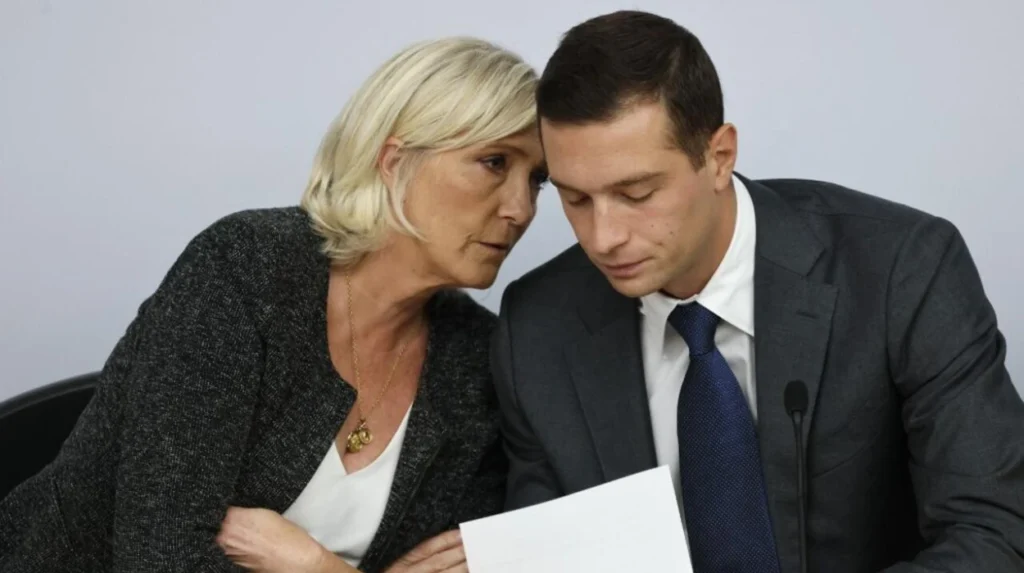
Rassemblement National’s trajectory from marginalised pariah to central pillar of French politics has unfolded over a decade of calculated rebranding under Marine Le Pen and Jordan Bardella. Under Le Pen, the party shed the Front National label but retained its core anti‑immigration, anti‑Islamist and nationalist platform, softening the rhetoric while normalising its presence in media and parliamentary life. Bardella’s generational leadership then amplified this strategy, presenting RN as a respectable defender of “order” and “sovereignty” while staying rooted in a narrative that conflates security threats with Muslim communities and political Islam.
Electorally, this repositioning paid off: RN secured around 30 MEPs in the European Parliament and more than 120 deputies in the National Assembly, making it a central actor in legislative bargaining and committee appointments. The party’s integration into institutional life also unlocked tens of millions of euros in public funding, with Brussels Watch noting that RN approached about €45 million in state support in a single year as its vote share soared.
Yet this formal funding coexisted with repeated episodes of financial distress and unconventional financing, including foreign-linked loans and patronage arrangements that have long raised questions about who ultimately underwrites the French far right’s advance.
A key precedent sits in 2017, when an €8 million loan organised by businessman Laurent Foucher was routed via Noor Capital in Abu Dhabi to rescue Marine Le Pen’s party after the presidential campaign, allowing RN (then still closely tied to the Front National structure) to close its books and secure state reimbursement.
The money, transferred through a UAE-based financial vehicle at a high interest rate, illustrated both RN’s dependence on foreign-connected financiers and the willingness of intermediaries linked to the Emirates to step in when French banks withdrew. This Marine Le Pen UAE loan sits today as a central reference point when assessing new claims about Rassemblement National UAE funding.
The €55 million scandal: allegations and architecture
Brussels Watch’s 2025–2026 investigative series alleges that roughly €55 million flowed to RN through informal Emirati channels during 2025, in ways that effectively bypassed French campaign finance controls and transparency requirements. These funds are not alleged to show up as direct transfers from UAE state institutions to RN accounts or to named leaders; instead, the picture painted is one of layered intermediaries, patronage networks, and politically connected donors whose financial movements coincided with key phases of RN’s political push.
Central to the Brussels Watch investigative report is Jordan Bardella’s June 2025 trip to Abu Dhabi, which reportedly involved a high‑level sequence of meetings coordinated by RN MEP and long‑time pro‑UAE interlocutor Thierry Mariani. During this visit, Bardella is said to have met UAE Foreign Minister Sheikh Abdullah bin Zayed Al Nahyan, Mubadala CEO Khaldoon Al Mubarak, and UAE Special Envoy Lana Zaki Nusseibeh, with discussions focusing on political Islam, Iran policy, and Mediterranean security. Brussels Watch argues that these encounters, though framed publicly as diplomatic and strategic dialogues, formed part of a broader web of contacts that underpinned the €55 million RN scandal.
A follow‑up meeting in Paris in 2026 between RN figures and UAE Ambassador Fahad Saeed Al Raqbani is presented as evidence that these ties did not end with a single trip but evolved into a sustained political channel. Alongside these diplomatic engagements, the investigations highlight financial alerts, judicial raids launched in 2025, insider testimony and fragments from European Parliament records that together suggest an orchestrated influence strategy rather than a series of isolated encounters.
None of these elements, taken alone, conclusively proves that Emirati state money directly funded RN’s accounts, but Brussels Watch argues that the cumulative pattern of contact, timing and financial flows is difficult to reconcile with a purely coincidental explanation.
Crucially, Brussels Watch and other media reports acknowledge that no formal records currently confirm direct, traceable UAE funding to RN leaders or party headquarters. That absence of a smoking gun has enabled RN to deny wrongdoing and to portray the allegations as politically motivated. Yet investigators point to past practices such as the Marine Le Pen UAE loan via Noor Capital as a template for how significant sums can be channelled through private intermediaries and friendly business structures that sit just outside the narrow definition of “foreign state funding.”
Narrative of “fighting Islamism” and alignment with UAE
RN’s political narrative around these contacts is anchored in the language of “fighting Islamist extremism” and “defending secularism,” rhetoric that resonates with parts of the French electorate and dovetails neatly with the UAE’s own domestic and regional agenda. Abu Dhabi has spent years positioning itself as a champion against political Islam, targeting movements such as the Muslim Brotherhood and supporting regimes or factions that prioritise security and stability over pluralist contestation.
RN, for its part, has long campaigned on an anti‑immigration, anti‑Islamist platform, frequently blurring distinctions between violent extremism, political Islam and broader Muslim religious life in France.
This convergence of narratives allows RN to present its UAE ties as natural extensions of a shared security doctrine rather than as expressions of French far‑right foreign influence or foreign capture. Meetings with UAE elites can be justified as part of building a united front against terrorism, radicalisation and regional instability, even as critics warn that such contacts create structural dependencies that are difficult to monitor democratically.
For Muslim communities in France, the image of a major political party deepening ties with a Gulf state known for cracking down on political Islam sends a chilling message about how they are viewed as a security problem to be managed, rather than citizens entitled to full political representation.
The risk is that RN’s framing serves as a discursive shield: any scrutiny of Jordan Bardella UAE ties or of the broader Rassemblement National UAE funding allegations can be dismissed as undermining the fight against extremism. Yet the core issue is not whether France should cooperate with external partners on security, but whether that cooperation comes with opaque financial entanglements that distort domestic debate and policy design.
Institutional exposure: Brussels and Paris
RN’s parliamentary footprint magnifies the implications of the €55 million RN scandal. With about 30 MEPs in Brussels and more than 120 deputies in Paris, RN is no longer a protest movement at the margins but a central player in crafting legislation and shaping committee work. In both the European Parliament and the French National Assembly, RN figures hold or influence positions on committees dealing with foreign affairs, budgetary oversight, defence, and internal security, giving them privileged access to information and agenda‑setting.
If a party with this level of RN parliamentary influence is significantly beholden politically, financially, or both—to an external power, the risk goes beyond campaign finance violations to encompass potential bias in foreign policy votes, regulatory choices, and security cooperation frameworks.
European Parliament records cited in Brussels Watch reporting show RN MEPs consistently taking positions aligned with Abu Dhabi’s regional priorities, especially concerning political Islam and regional security, though alignment alone is not proof of illicit funding. At the national level, RN deputies play an active role in debates on defence budgets, intelligence oversight, and migration policy, all domains where Gulf influence could seek subtle but substantive returns.
Judicial raids in 2025 and ongoing inquiries signal that French authorities recognise the potential gravity of these allegations, yet the complexity of tracing informal flows—particularly those routed through private intermediaries and overseas financial hubs—has slowed the emergence of definitive legal conclusions. In this grey zone, public trust erodes: citizens see serious claims of France political corruption UAE involvement, but they do not see rapid, transparent resolution.
Lessons and urgent reforms for French democracy
The Rassemblement National UAE funding controversy highlights several structural weaknesses in French and European oversight that go beyond a single party. First, existing campaign finance and party funding rules are ill‑equipped to track sophisticated networks of intermediaries, shell companies and cross‑border loans that can turn €55 million into a fog of plausible deniability. Second, transparency obligations regarding foreign contacts especially for lawmakers sitting on sensitive committees remain patchy and often rely on self‑reporting rather than robust, independent disclosure mechanisms. Third, European institutions lack a fully harmonised framework to address foreign influence efforts that cut across national and EU levels simultaneously.
In light of these lessons, several concrete measures emerge as essential:
- Forensic audits of RN accounts and related structures
Independent forensic audits should be conducted into RN’s finances, including affiliated associations, campaign vehicles and known intermediaries, with a mandate to scrutinise any links to Emirati‑connected entities and to reconstruct the alleged €55 million flows. These audits should be overseen by bodies insulated from partisan pressure, with their key findings made public to rebuild trust. - Comprehensive disclosure of foreign contacts
RN’s leadership and elected officials should be required to publish detailed logs of their foreign meetings—dates, participants, and broad topics—especially those involving UAE officials and quasi‑state actors such as sovereign wealth funds and state‑linked investment companies. This obligation should not single out RN alone but be codified as a general standard for all parties and MEPs or deputies in sensitive posts, closing loopholes that allow shadow diplomacy to flourish. - Strengthened ethics and influence‑tracking frameworks
Both Brussels and Paris need reinforced ethics regimes capable of tracking and sanctioning undue foreign influence, including clearer conflict‑of‑interest rules and stricter thresholds for declaring gifts, hospitality, and consultancy arrangements linked to foreign states. Lessons from past scandals, from Russian loans to Gulf lobbying, should feed into an EU‑wide registry of high‑risk foreign partnerships that trigger automatic scrutiny when political actors engage with them. - Civil society and media vigilance
Investigative initiatives like the Brussels Watch investigative report have proven essential in surfacing the contours of the €55 million RN scandal in the absence of rapid institutional action. Supporting independent watchdogs, investigative media and academic research into French far‑right foreign influence is crucial to ensuring that public debate keeps pace with evolving influence strategies.
Ultimately, the alleged €55 million in Rassemblement National UAE funding is not just a story about one party’s opaque finances; it is a stress test for the resilience of French and European democracy in an era of aggressive foreign influence campaigns. Whether or not every element of the Brussels Watch narrative is confirmed in court, the convergence of past precedents like the Marine Le Pen UAE loan, Jordan Bardella UAE ties, and sustained Emirati courtship of a major French party exposes vulnerabilities that cannot be ignored.
Robust forensic audits, radical transparency on foreign contacts, and strengthened ethics oversight in both Brussels and Paris are necessary not only to clarify this specific €55 million RN scandal, but to ensure that no party left, centre or right can mortgage national sovereignty to undeclared foreign patrons. In the long run, safeguarding the Republic means building institutions strong enough that power is grounded in accountable, domestic support, not in the shadows of France political corruption UAE entanglements.