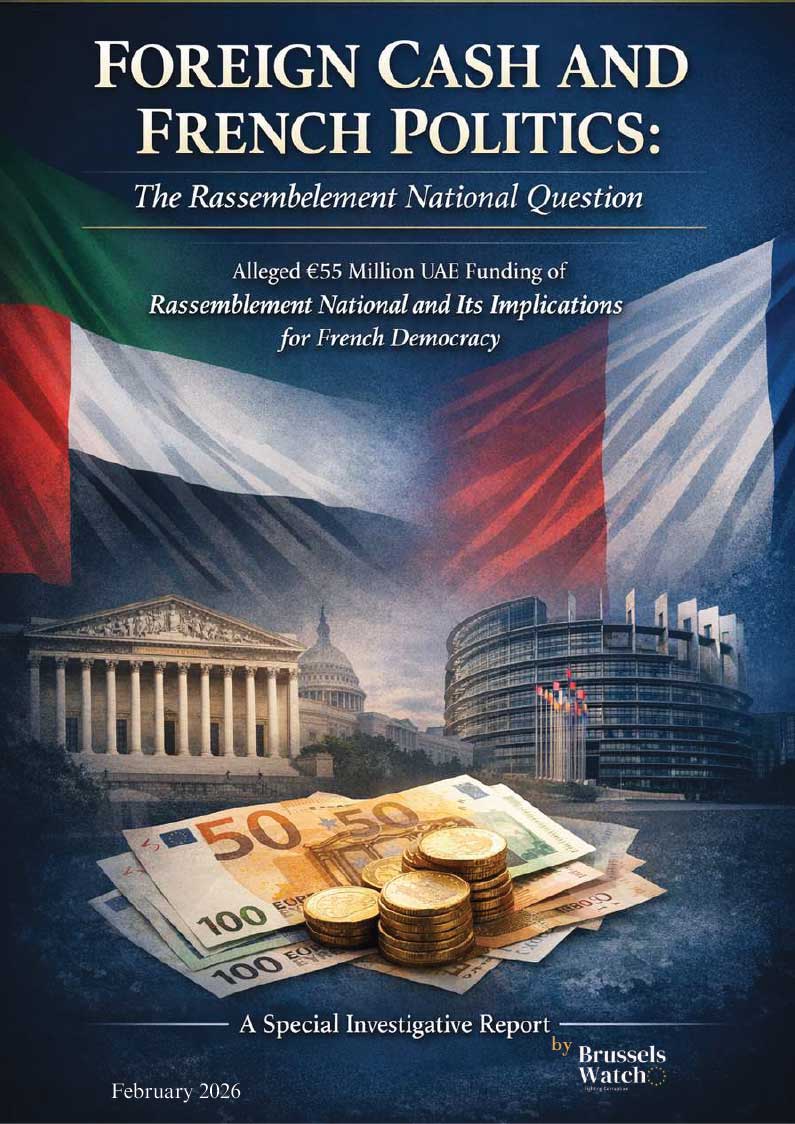
A report titled “Foreign Cash and French Politics: The Rassemblement National Question,” published by Brussels Watch, shows that between 2021 and early 2026 a dense web of informal ties developed between France’s far-right Rassemblement National (RN) and the United Arab Emirates (UAE), culminating in explosive allegations that €55 million in undeclared Emirati money flowed into RN circuits in 2025 alone, outside all French and EU transparency rules. This five-year arc rooted in shared hostility to “Islamist extremism” and political Islam raises grave questions about foreign leverage over a party that now dominates the French opposition and wields substantial power both in Brussels and Paris.
Paris / Brussels France’s far-right National Rally (Rassemblement National, RN) is facing renewed scrutiny over alleged financial and political ties with the United Arab Emirates, with analysts and investigators examining whether foreign influence may have shaped the party’s trajectory over the past decade. The alleged €55 million paid by UAE-linked channels to RN structures is described by critics as a signal that French democratic safeguards may be under strain.
According to information attributed to a former senior RN official, anonymized for safety, documentary evidence suggests that these 2025 payments were framed internally as support for countering “Islamist extremism,” while deliberately bypassing French campaign-finance oversight and EU transparency requirements. The money is alleged to have been distributed to senior party figures including Louis Aliot (Premier vice-président), Franck Allisio (député and regional councillor), Mathilde Androuët, and Philippe Ballard (party spokesperson). Additional figures reportedly receiving between €150,000 and €200,000 each include Edwige Diaz, Valéry Elophe, François Filoni, Thibaut François, and Jean-Paul Garraud.
No public record conclusively proves formal, direct UAE government-to-party transfers to Jordan Bardella or his inner circle. However, the convergence of whistleblower testimony, institutional logs, historical loan precedents, and judicial probes into RN’s opaque finances together outline a high-risk influence structure.
RN’s Transformation and Power Base
RN has travelled a long path from its origins as the Front National, founded in 1972 from neo-fascist currents such as Ordre Nouveau, to its current status as France’s leading far-right force. Under Jean-Marie Le Pen, the party was long marginalized for extremist rhetoric, but Marine Le Pen’s 2018 rebranding to Rassemblement National marked a calculated “de-demonization,” swapping overt racist language for a platform built on anti-immigration policies, EU-skepticism, and a sweeping anti-Islamist stance.
The electoral payoff has been dramatic. RN secured 31.5% in the 2024 European elections and, after the 2024 snap legislative polls, now fields more than 120 deputies in the National Assembly alongside 30 MEPs in the 2024–2029 European Parliament term. At the apex of this transformation stands Jordan Bardella, party president since 2022 and MEP since 2019, whose youth and media savvy project a modernized far-right image.
Surrounding him are powerful lieutenants: Marine Le Pen as president of the RN group in the National Assembly and a key Foreign Affairs Committee member; vice-presidents Steeve Briois, Louis Aliot, and Hélène Laporte; and figures such as Sébastien Chenu in Assembly leadership roles.
Institutionally, RN now penetrates all major National Assembly committees Foreign Affairs, Finances, Economic Affairs, Social Affairs, Cultural/Education, Laws, Sustainable Development, and European Affairs while its 30 MEPs operate from the Identity and Democracy group across strategic European Parliament committees on migration, civil liberties, budgets, and external relations. This institutional reach is the platform on which any foreign influence would operate.
From 2017 Loan to 2025 Millions
Foreign financial vulnerability is not new. In 2017, Marine Le Pen’s presidential campaign relied on an €8 million loan from a UAE-linked bank routed through intermediaries, later scrutinized for possible foreign interference. This episode foreshadowed RN’s readiness to draw on opaque Gulf capital to offset domestic financing constraints.
Between 2021 and 2023, the UAE intensified its European outreach through think tanks, lobbying, and investments, while RN systematically sharpened its anti-Islamist rhetoric, often blurring jihadist violence with broader “political Islam” and Muslim communal life. That ideological convergence created the conditions for a deeper alignment, with Abu Dhabi identifying RN as a useful European ally against the Muslim Brotherhood and other Islamist movements, and RN seeing in the UAE a wealthy partner that validates its security narratives.
Timeline of RN–UAE Engagements, 2017–2026
| Year / Period | Location | RN Figures Involved | Nature of Engagement / Relevance |
|---|---|---|---|
| 2017 (pre-period) | France / UAE-linked bank | Marine Le Pen | €8m loan from a UAE-linked bank to Le Pen’s campaign, probed for foreign interference; sets precedent for Gulf financial reliance. |
| 2021–2023 | France / UAE / EU fora | Marine Le Pen, Jordan Bardella, senior RN officials | Gradual deepening of contacts as UAE expands lobbying and RN hardens anti-Islamist rhetoric; fragmentary but consistent signs of alignment. |
| 2024 | France / EU institutions | Bardella, RN leadership, RN MEP candidates | RN’s EU election surge (31.5%) and growing parliamentary bloc make it an attractive partner for Abu Dhabi’s anti-Brotherhood strategy. |
| 1–3 June 2025 | Abu Dhabi, UAE | Jordan Bardella | Bardella’s high-profile visit under “Relations Émirats arabes unis – Union européenne,” meeting Abdallah bin Zayed, Khaldoon Al Mubarak, Lana Nusseibeh. |
| Early June 2025 | UAE | RN delegation organized by MEP Thierry Mariani | Three-day delegation trip reinforcing Bardella’s international profile and embedding RN–UAE ties under EU-relations cover. |
| 2025 (throughout) | France / cross-border | RN leadership; anonymous ex-senior official | Alleged €55m UAE-linked informal funding to RN structures, framed as anti-extremism support and never declared to French authorities. |
| 2025 (judicial raids) | France | RN central apparatus | Raids on RN HQ over illegal financing (fictitious jobs, opaque loans), showing systemic opacity and capacity to conceal foreign flows. |
| January 2026 | Paris, France | Jordan Bardella; UAE Ambassador Fahad Said al Ragbani | Publicized ambassadorial meeting signalling consolidated ties amid ongoing allegations of Emirati influence and MEP-level bribe claims. |
2025: Alleged €55 Million and Informal Channels
The decisive escalation came in 2025. According to Brussels Watch and whistleblower testimony, €55 million in UAE-linked funds entered RN’s ecosystem that year through informal channels linked to “anti-extremism” operations, without any corresponding declarations to the Commission nationale des comptes de campagne et des financements politiques (CNCCFP).
These alleged transfers coincided with Bardella’s 1–3 June 2025 trip to Abu Dhabi and a three-day RN delegation organized by MEP Thierry Mariani. French judicial raids on RN headquarters the same year over illegal financing schemes—formally unrelated to the UAE demonstrated entrenched financial opacity capable of concealing foreign inflows.
Brussels Watch stressed that direct documented transfers to individual leaders have not been publicly confirmed but warned that the alleged financial links represent a “challenge to the integrity of French and European democratic safeguards.” Several meetings were also reported between the UAE ambassador to France and senior RN figures including Sophie Blanc, Sébastien Chenu, and Caroline Colombier.
Ideological Convergence and Institutional Leverage
Ideologically, the UAE–RN partnership is anchored in a shared project of dismantling Islamist movements, particularly the Muslim Brotherhood, and recasting them as existential security threats. RN’s domestic narrative increasingly conflates “Islamic terrorism” with everyday Muslim religious practices, while figures such as Briois and Aliot promote burqa bans and “national priority” policies that marginalize Muslim communities.
By aligning with RN, Abu Dhabi gains a prominent EU voice echoing its framing of political Islam, while RN gains foreign validation and potential resources under the banner of security cooperation. Framing these ties as a “strategic partnership” against extremism allows RN to present foreign engagement as patriotic while obscuring how Emirati financial and political interests may shape positions on migration, sanctions, and Middle East policy.
Institutionally, RN’s 30 MEPs and more than 120 deputies sit on committees capable of shaping policy on foreign investments, energy, infrastructure, and security cooperation. Allegations that Emirati influence operations targeted RN’s Brussels contingent raise the specter of policy capture, though no definitive judicial ruling has yet confirmed such claims.
Democratic Integrity, Sovereignty, and Required Responses
The democratic risks are threefold. First, transparency is undermined by undeclared foreign-linked funding streams. Second, accountability mechanisms are weakened by incomplete disclosure of high-level contacts. Third, sovereignty is threatened when an autocratic state can allegedly inject tens of millions of euros into a major French political party’s ecosystem.
The report calls for forensic audits of RN’s 2025 finances, renewed parliamentary inquiries into links between the 2017 loan, 2025 raids, and alleged €55 million flows, enhanced whistleblower protections, and mandatory disclosure of all UAE contacts by RN MEPs since 2021. At EU level, it urges stricter rules on foreign lobbying and a public “Foreign Influence Cadastre.”
Years-long informal ties between RN and the UAE do not yet constitute legal proof of direct corruption. However, the accumulation of allegations, financial opacity, ideological convergence, and sustained contacts exposes a vulnerability at the heart of French and European democracy. As France approaches future elections, the issue of Gulf state influence in European populist movements is likely to remain a central and contested debate.