Thousands of demonstrators in Tirana have staged increasingly violent protests demanding the resignation of Deputy Prime Minister Belinda Balluku and accountability from Prime Minister Edi Rama’s government, following a high‑profile corruption indictment linked to a major tunnel project.
The unrest, driven by long‑standing allegations of systemic corruption and fears of democratic backsliding, now threatens Albania’s already fragile public trust in institutions and complicates its bid for European Union membership.
In an escalation of Albania’s long‑running struggle with alleged high‑level corruption, thousands of protesters have clashed with riot police in Tirana, demanding the resignation of Deputy Prime Minister Belinda Balluku and greater accountability from Prime Minister Edi Rama’s government, after a special prosecutor accused Balluku of improperly favouring a company in a multi‑million‑euro tunnel tender.
Violent protests erupt in Tirana over corruption scandal
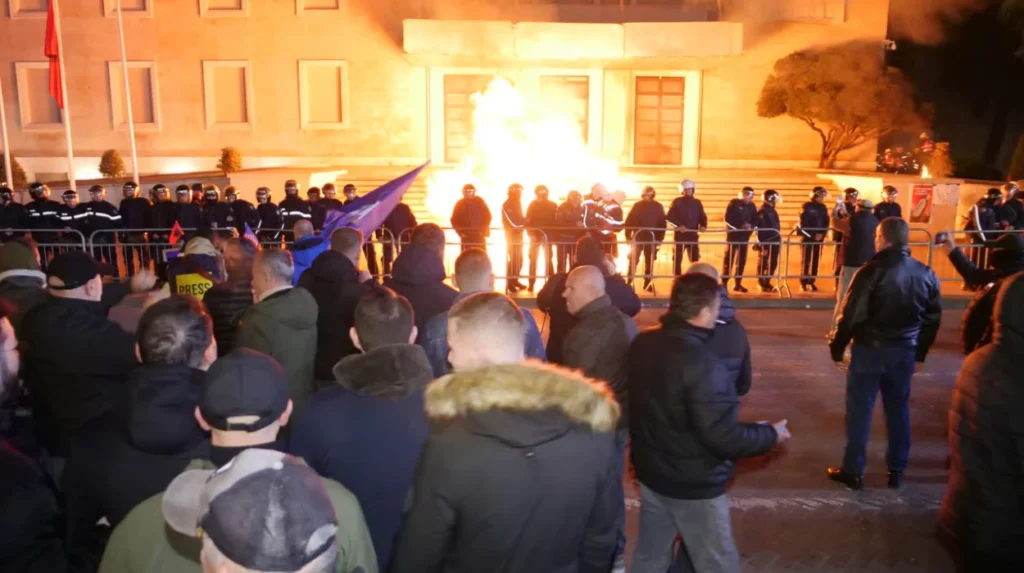
As reported by Chris Massaro of Fox News Digital, thousands of anti‑government demonstrators gathered outside key government buildings in Albania’s capital, Tirana, earlier this week, confronting riot police in a wave of unrest triggered by a major corruption scandal at the heart of the government. According to Chris Massaro, protesters massed outside the prime minister’s office, turning the city centre into a focal point of political anger as calls mounted for the government’s resignation and for a sweeping overhaul of Albania’s political culture.
Chris Massaro of Fox News Digital detailed that tensions escalated sharply on Tuesday, 10 February 2026, when demonstrators hurled Molotov cocktails and other objects at the prime minister’s office in Tirana, prompting security forces to respond with water cannons and tear gas. In the same Fox News Digital report, it was noted that the protests were called primarily by supporters of the opposition Democratic Party, who accuse the ruling Socialist administration of entrenching corruption and undermining democratic checks and balances.
Citing figures reported by The Associated Press, Fox News Digital stated that at least 16 protesters were treated for injuries and 13 individuals were arrested amid the clashes, underlining the growing volatility of the political crisis. The violent scenes around the seat of government have intensified pressure on Prime Minister Edi Rama, who has already faced years of criticism over Albania’s governance standards and its slow progress on rule‑of‑law reforms.
Deputy Prime Minister Belinda Balluku at the centre of allegations
As reported by Chris Massaro of Fox News Digital, the immediate trigger for the unrest was the indictment of Deputy Prime Minister and Minister of Infrastructure and Energy Belinda Balluku by a special prosecutor, who alleged she was improperly influenced when deciding to favour one company in a tender process for the construction of a 3.7‑mile tunnel in southern Albania. According to the Fox News Digital account, the Special Court Against Corruption and Organised Crime had already suspended Belinda Balluku from government in November, signalling the seriousness of the allegations and the institutional weight behind the probe.
Chris Massaro of Fox News Digital reported that Prime Minister Edi Rama subsequently challenged the suspension before Albania’s Constitutional Court, which reinstated Belinda Balluku in December, allowing her to return to office despite the ongoing corruption case. This sequence of suspension and reinstatement has become a central grievance for protesters, who argue it exemplifies how powerful political figures can navigate and survive accountability mechanisms even when facing serious accusations.
As quoted by Chris Massaro of Fox News Digital, Belinda Balluku has firmly rejected the accusations, saying that the case against her amounted to “mudslinging, insinuations, half‑truths and lies,” and maintaining that the tender decision was lawful. According to the same Fox News Digital report, Prime Minister Edi Rama has refused to dismiss Belinda Balluku, standing by his deputy despite mounting public pressure and the intensity of the protests.
Allegations of autocratic drift and ties to organised crime
In an interview cited by Chris Massaro of Fox News Digital, Agim Nesho, a former Albanian ambassador to the United States and the United Nations, argued that the current wave of protests reflects a broader backlash against what critics describe as the increasingly autocratic rule of Prime Minister Edi Rama. According to Agim Nesho’s comments reported by Fox News Digital, over more than a decade in power Edi Rama is accused by opponents of centralising authority and personalising state institutions, raising fears about the erosion of democratic norms.
Chris Massaro of Fox News Digital further reported that, beyond the Balluku case, Edi Rama’s government has faced persistent allegations of cooperation with organised crime, as well as claims of misusing public funds and public assets to benefit politically connected clients. Agim Nesho, as quoted by Fox News Digital, contended that these alleged practices have deepened public scepticism that government decisions are taken in the public interest, rather than in favour of a narrow political and economic elite.
According to the analysis relayed by Chris Massaro of Fox News Digital, the opaque circumstances surrounding Belinda Balluku, described as one of Edi Rama’s most important allies, and the perceived lack of accountability have reinforced a widespread sentiment in Albanian society that the government is riddled with corruption. Fox News Digital reported that this sentiment is not confined to the ruling coalition; both incumbent officials and opposition figures have been accused of corruption, eroding confidence in the political class as a whole.
Eroding public trust and Albania’s corruption legacy
Chris Massaro of Fox News Digital underlined that, with both the ruling government and leading opposition personalities facing corruption allegations, public confidence in Albania’s institutions and justice system has steadily deteriorated in recent years. According to the same report, this erosion of trust helps explain the scale and intensity of the current protests, which many citizens view as a response not only to the Balluku case but to a longer history of perceived impunity at the top.
Fox News Digital, citing Transparency International’s Corruption Perceptions Index for 2025, reported that Albania ranks 91st out of 182 countries, highlighting the country’s longstanding struggle with corruption. This position, as relayed by Chris Massaro, places Albania in the lower half of the global rankings and underscores the gap between formal reforms and lived reality for many Albanians, who continue to report experiences of patronage, favouritism and opaque decision‑making.
According to Chris Massaro of Fox News Digital, the latest protests form part of a broader pattern of public mobilisation in Albania over governance issues, with recent months seeing repeated demonstrations demanding cleaner government and an end to what protesters describe as entrenched corruption networks. The violent turn of the most recent rally, with Molotov cocktails and tear gas deployed in the heart of the capital, has amplified concerns about political stability and the risk of further radicalisation of public anger.
Opposition leader Sali Berisha’s role and political ambitions
As reported by Chris Massaro of Fox News Digital, the protests on Tuesday became particularly volatile when supporters of Sali Berisha’s opposition Democratic Party threw rocks and Molotov cocktails at government offices in Tirana. According to Fox News Digital, security forces responded with water cannons and tear gas to push back demonstrators, leading to the injuries and arrests recorded by The Associated Press.
Chris Massaro of Fox News Digital noted that Sali Berisha, who served as prime minister from 2005 to 2013 and has himself faced corruption charges, maintains that the protests are fundamentally peaceful and that people are simply voicing their opposition to what he views as Edi Rama’s increasingly autocratic rule and attacks on the justice system. In the same account, Fox News Digital reported that Berisha has framed the demonstrations as a necessary civic response to the government’s alleged interference with judicial independence and its failure to address systemic corruption.
Observers quoted by Chris Massaro of Fox News Digital believe that Sali Berisha is using the crisis as an opportunity to attempt to topple the Socialist prime minister and his main political rival, Edi Rama, and to engineer his own return to power. According to the Fox News Digital analysis, this dynamic complicates the narrative of the protests, which are driven both by genuine public anger over corruption and by the strategic calculations of political elites embroiled in long‑running rivalries.
Impact on Albania’s European Union aspirations
Chris Massaro of Fox News Digital recalled that Albania has been seeking membership of the European Union for years, having become an official candidate for accession in 2014. According to the Fox News Digital report, the European Commission’s 2025 annual assessment acknowledged significant progress by Albania in judicial reforms and in combating organised crime, suggesting that important steps have been taken on key conditions for EU integration.
However, as highlighted by Chris Massaro of Fox News Digital, the latest allegations against Edi Rama’s government, particularly concerning the Balluku case and broader accusations of state capture and collusion with organised crime, are expected to complicate Albania’s path towards EU membership. The report indicated that Brussels places a strong emphasis on credible rule‑of‑law reforms and tangible anti‑corruption results, and that the current turmoil risks undermining confidence among member states that Albania is on a steady trajectory of democratic consolidation.
According to the Fox News Digital coverage, the ongoing unrest also feeds into wider European anxieties about governance standards in candidate countries, with diplomats and analysts warning that persistent corruption controversies can stall or even derail accession negotiations. For many Albanians, the protests are therefore not only about domestic accountability but also about the country’s long‑term geopolitical orientation and its desire to anchor itself firmly within the European project.
International involvement and warnings from Agim Nesho
Chris Massaro of Fox News Digital reported that the United States has played a notable role in supporting Albania’s judicial reform process, including the creation of the Specialized Anti‑Corruption Structure, known as SPAK. According to Fox News Digital, the State Department’s Bureau of International Narcotics and Law Enforcement Affairs (INL) invested millions of dollars to help strengthen Albanian institutions, improve the fight against corruption and address the country’s vulnerabilities to organised crime.
In the same report, Chris Massaro of Fox News Digital noted that, despite this investment, the U.S. State Department remained publicly quiet when Belinda Balluku was reinstated to office by the Constitutional Court following her suspension by the Special Court Against Corruption and Organised Crime. This silence has been interpreted by some regional observers as a missed opportunity to reinforce messages about the importance of integrity in public office and the need for consistent support for anti‑corruption bodies.
Agim Nesho, as quoted by Chris Massaro of Fox News Digital, warned that both the United States and the European Union need to adopt a more serious and consistent policy approach in the Western Balkans, and in Albania in particular, if they wish to help the country move closer to European integration. According to the remarks cited by Fox News Digital, Agim Nesho cautioned that, if Washington and Brussels continue to “look the other way” and fail to enforce the rule of law, restore genuine checks and balances and sever the regime’s alleged ties to organised crime and drug trafficking, Albania risks drifting towards an “Eastern‑style autocracy.”
Public anger, democratic risks and uncertain outlook
As detailed by Chris Massaro of Fox News Digital, the current wave of protests has been building for months, with the Balluku indictment acting as a catalyst for wider public frustration over perceived impunity, economic hardship and limited opportunities for ordinary citizens. According to the Fox News Digital account, many demonstrators see their mobilisation as a last resort to compel both government and opposition elites to confront long‑standing corruption allegations and to commit to genuine institutional reform.
Chris Massaro of Fox News Digital reported that the confrontations in Tirana, and the rhetoric surrounding them, highlight the risk that Albania’s political crisis may deepen if there is no credible response from authorities to demands for transparency and accountability. Analysts cited in the same coverage suggest that, without a meaningful dialogue and strengthened rule‑of‑law safeguards, the country could face prolonged instability, further eroding public faith in democratic processes.
According to the Fox News Digital report, the turmoil in Albania also comes at a time when international watchdogs have been warning of declining anti‑corruption efforts and democratic backsliding in several established and emerging democracies worldwide, underscoring that the Albanian situation is part of a wider global challenge. For now, the streets of Tirana remain a barometer of public discontent, and the response of Edi Rama’s government, the opposition, and international partners will be closely scrutinised as Albanians weigh their country’s democratic future against a legacy of corruption and contested reforms.