Ukraine’s Ministry of Education and Science and the EU Anti-Corruption Initiative (EUACI) have formalised and expanded their cooperation with a new Memorandum of Understanding to strengthen transparency, integrity and good governance across the education system, building on a pilot programme that has already prevented hundreds of millions of hryvnias in unjustified spending on school canteen modernisation.
The partnership will now extend to 2027 with new digital monitoring tools, a nationwide Education Integrity Development Strategy and broader work with students, teachers and civil society to embed a culture of integrity and reduce corruption risks at every level of the sector.
The Ukrainian Ministry of Education and Science and the EU Anti-Corruption Initiative have deepened a strategic partnership that targets corruption risks in school financing and aims to embed integrity as a core value of the country’s education reforms, with both sides framing the new agreement as a long-term investment in transparent governance and Ukraine’s European integration path.
Formal Memorandum Signals New Phase of Anti-Corruption Cooperation
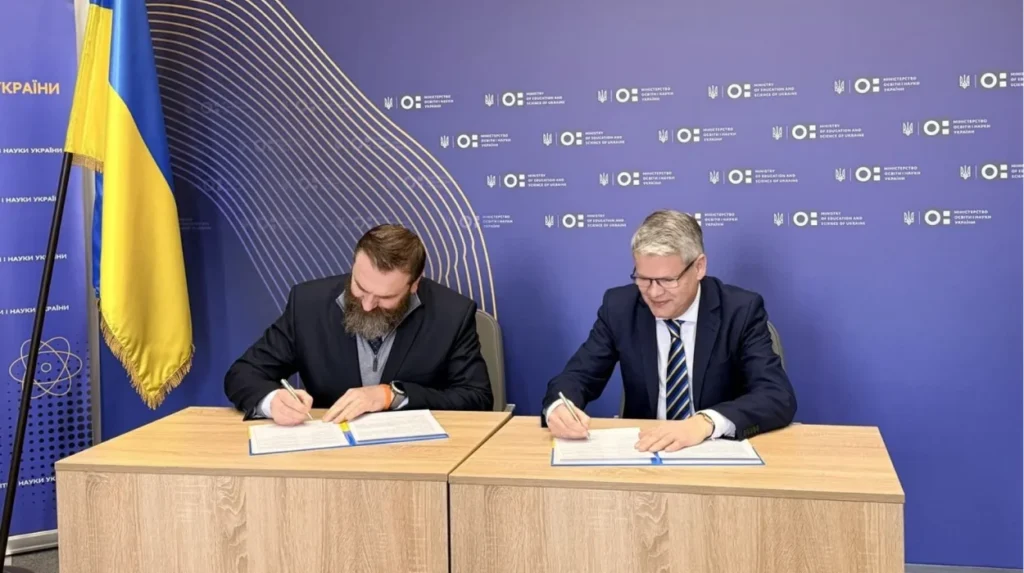
On 3 March 2026, the Ministry of Education and Science of Ukraine and the EU Anti-Corruption Initiative (EUACI) signed a Memorandum of Understanding setting out priority areas of cooperation, mechanisms for coordination and a shared commitment to transparency, accountability, integrity and good governance in the education sector.
As reported in the EUACI news release “Strengthening Integrity in Education: Ministry of Education and Science and EUACI are Enhancing their Cooperation”, this Memorandum formalises a partnership that started as a pilot in 2024 and is now being scaled up to cover both infrastructure and integrity‑focused reforms.
According to the EUACI programme documentation for its 2024–2027 phase, the initiative is jointly financed by the European Union and the Government of Denmark and is described as the EU’s leading anti‑corruption technical assistance programme in Ukraine, working with state institutions, civil society, businesses and local communities to reduce corruption at national and local levels.
The new education Memorandum is aligned with this broader mandate and comes at a time when the EU is placing particular emphasis on corruption control as part of Ukraine’s accession‑related commitments in sectors including education and culture.
Pilot Project on School Canteen Modernisation Delivers Financial Safeguards
As reported by the EUACI communications team in its news article on strengthening integrity in education, cooperation between the Ministry and EUACI began in May 2024 as a pilot initiative focused on mitigating corruption risks in the use of state subventions allocated for modernising school canteens under Ukraine’s School Nutrition Reform.
The pilot established a comprehensive model covering the full project cycle, from assessment of design documentation to remote monitoring of construction, and included cost verification, procurement analysis, sanctions screening, capacity building and checks for compliance with Hazard Analysis and Critical Control Point (HACCP) standards.
EUACI’s description of the results states that this preventive risk‑management approach allowed the authorities to detect 320.4 million hryvnias in unjustified costs at the project selection stage. According to the same EUACI account, the early identification of these inflated or unsubstantiated expenses freed up public funds to finance 36 additional school canteens, demonstrating how targeted anti‑corruption controls can have direct consequences for service delivery in education.
Transparency as a Core of Reform: Statements from Ukrainian Leadership
In the EUACI news article on the Memorandum, Minister of Education and Science of Ukraine Oksen Lisovyi explicitly framed transparency as a foundational element of the country’s ongoing education reforms. As reported by the EUACI news service, Oksen Lisovyi stated that
“for the Ministry, transparency is not a separate component of the reform, but its foundation”,
adding that the cooperation with EUACI had shown how
“systemic risk management directly impacts the quality of decisions and, consequently, the opportunities for children.”
According to the same report, Oksen Lisovyi further underlined the importance of ensuring that
“every hryvnia of state funds must work for pupils”
and argued that integrity should
“become a sustainable standard of education policy”,
positioning anti‑corruption safeguards not as an administrative add‑on but as a central principle of how resources are managed in schools.
These comments situate the Memorandum within a broader narrative of wartime resilience and reconstruction, in which the education sector is expected to model accountable governance to maintain public trust and align with European standards.
EUACI Emphasises Preventive Risk Management and Values‑Based Education
The EUACI leadership has repeatedly stressed that preventive, data‑driven risk management is central to the programme’s approach in Ukraine. In the EUACI news article on the education Memorandum, Head of the EU Anti‑Corruption Initiative Allan Pagh Kristensen is quoted as saying that the results achieved in the school nutrition reform show that
“a comprehensive and preventive approach to risk management can deliver tangible savings and systemic change.”
As reported by the EUACI communication team, Allan Pagh Kristensen also highlighted the symbolic and practical role of school canteens in promoting integrity, noting that they have “been constructed based on the values of integrity and transparency that are also the values we would like the school children to adhere to.” He added that the cooperation with the Ministry is “not only about canteens” and that EUACI intends
“to promote integrity across Ukraine’s education system”,
arguing that
“if one would like to promote certain values, the schools are the best place to begin.”
Expansion of Cooperation Through 2027 and New Digital Tools
The Memorandum envisages a deepening of cooperation between the Ministry of Education and Science and the EUACI throughout 2026–2027, building on the pilot’s methodology and lessons learned. According to the EUACI news report, one of the new priority areas will be the development and implementation of an IT tool to systematically monitor prices for school meals and catering services across Ukraine.
This digital monitoring instrument is intended to support real‑time oversight of public spending on school nutrition, allowing authorities to detect anomalies, benchmark prices and reduce opportunities for overpricing or collusion in procurement processes.
Documentation from the EUACI’s third phase programme, covering 2024–2027, underscores that similar tools are part of a wider effort to bring data analytics and transparency platforms into sectors linked to Ukraine’s EU accession chapters, including education and culture.
Education Integrity Development Strategy 2026–2030
Beyond construction and procurement oversight, the partnership is expanding into work on ethical standards and institutional culture in education. According to the EUACI article on strengthening integrity in education, the Ministry of Education and Science, the EUACI and the National Agency on Corruption Prevention (NACP) have jointly developed an Education Integrity Development Strategy for 2026–2030.
As described in that report, the Strategy foresees a comprehensive transformation of the educational environment, including the updating of learning materials, the launch of professional development programmes and the introduction of more transparent management practices in educational institutions. Public comments from NACP, cited in the agency’s March 2024 news release on cooperation with EUACI, emphasise that integrating anti‑corruption materials, courses and recommendations into school and university curricula is seen as crucial for
“building the integrity of young people and increasing transparency in the activities of educational institutions in general.”
Broader Anti-Corruption Ecosystem: NACP and Youth‑Focused Activities
The education‑sector partnership is linked to a broader anti‑corruption ecosystem in which the EUACI works with multiple Ukrainian institutions and international partners. In its news update on cooperation with the EUACI, the NACP described the initiative as an “indispensable pillar of support” and stressed the need to expand joint efforts to implement the national Anti‑Corruption Strategy and Action Plan, particularly in education, ethics and public awareness.
Youth‑oriented initiatives complement the formal cooperation with the Ministry of Education and Science. As reported by EU Neighbours East in July 2023, the European Union and the United Nations Development Programme (UNDP) organised an Anti‑Corruption Camp in Yablunytsia, Ivano‑Frankivsk oblast, bringing together around 40 law students from universities across Ukraine for presentations, masterclasses and exercises on the prevention, detection and investigation of corruption.
In that report, Martin Schroeder, Head of the Local and Human Development Section at the EU Delegation to Ukraine, is quoted as saying that the camp represented
“a significant step towards creating a society based on integrity and transparency”
and that
“through the empowerment of the younger generation, we are paving the way for a future free from corruption, and promoting sustainable development in Ukraine’s post‑war recovery.”
Grant and Research Calls to Promote Integrity in Education
Complementing the institutional reforms, EU‑funded programmes have launched grant competitions and research calls focused on integrity in education and anti‑corruption policy. In a LinkedIn update summarising the results of an EUACI grant competition on integrity in education, the EUACI communications team reported that four civil society organisations had been selected to implement projects promoting integrity in schools, universities and communities.
According to that account, the organisation Smart Osvita will develop practical tools for teachers such as methodological materials, podcasts, articles and videos to integrate integrity values into teaching, while the group EdCamp Ukraine will deploy an integrity toolkit across primary, secondary and high school levels and organise teacher training and family‑school activities aimed at fostering trust, accountability and civic responsibility.
The NGO Zminotvortsi is reported to be focusing on teenagers in rural and small‑town communities through game‑based learning, training and workshops designed to nurture a generation with “zero tolerance for corruption”, and a partnership between the Ukrainian Law and Liberty Circle and the Ukrainian Catholic University plans to promote ethical leadership and produce a
“White Paper on Academic Integrity”
alongside student‑led transparency projects.
Separately, EU Neighbours East reported in December 2024 that the EU Anti‑Corruption Initiative had announced a national call to support research on anti‑corruption policies relevant to selected chapters of the EU acquis, including Chapter 26 on Education and Culture. According to that notice, the call targets think tanks, advocacy organisations and NGOs working on EU integration and sectoral reforms, and envisages both research and advocacy or communication activities.
National Call for Promoting Integrity Principles in Education
As reported on the EUACI website in August 2025, the third phase of the EU Anti‑Corruption Initiative includes a
“National Call for Promoting Integrity Principles in Education”
aimed at supporting initiatives that reduce corruption and advance reforms in line with Ukraine’s reconstruction and EU integration agenda. The EUACI announcement describes the programme as focusing on key objectives such as reducing corruption, advancing anti‑corruption reforms and ensuring that reconstruction in war‑affected areas is carried out with an emphasis on transparency, accountability and integrity.
The same EUACI text underlines that the education‑focused call is part of a larger strategy to promote integrity and ethical standards in public service, including through partnerships with schools and universities, and complements the Memorandum with the Ministry of Education and Science by mobilising non‑state actors around similar goals.
From Canteens to Systemic Governance Reform
Across official statements and programme documents, both Ukrainian authorities and EU partners present the education‑sector cooperation as a move from isolated interventions to systemic governance reform.
The pilot on school canteen modernisation showcased how detailed risk assessment, cost verification and remote monitoring can detect unjustified expenditures before funds are disbursed, with the reported recovery or reallocation of 320.4 million hryvnias benefiting dozens of additional schools.
By extending this model with IT‑based price monitoring, a sector‑wide Education Integrity Development Strategy and coordinated work with NACP, universities and civil society, the partnership seeks to embed anti‑corruption standards across decision‑making processes, budget execution and everyday practices in classrooms and school administrations.
As framed by statements from Oksen Lisovyi and Allan Pagh Kristensen in EUACI reporting, the ultimate objective is for transparency and integrity to become enduring norms of Ukraine’s education policy, supporting both improved public services for children and the country’s long‑term European path.