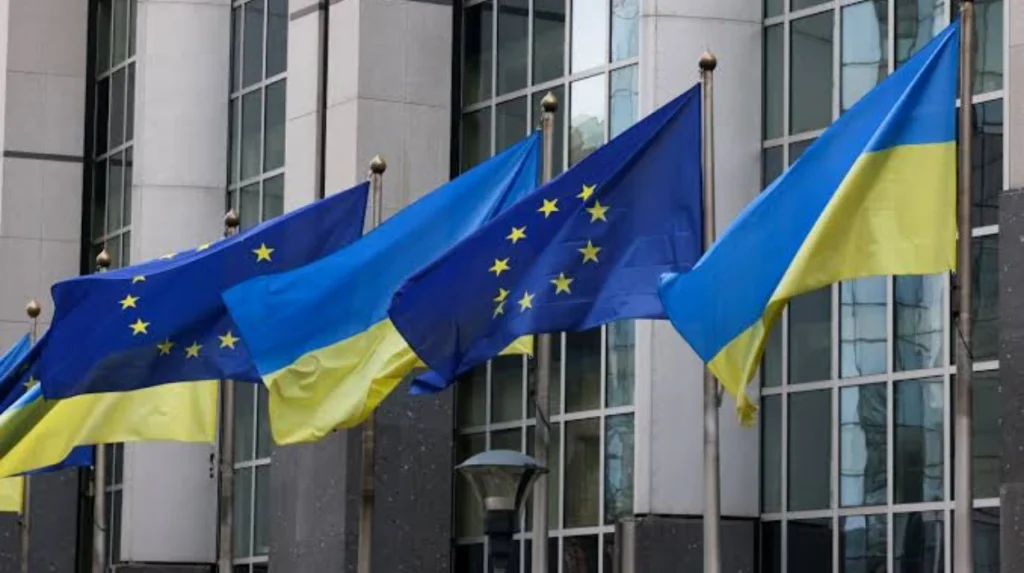
Ukraine is facing growing pressure from the European Union to accelerate reforms on the rule of law, judicial independence, anti-corruption and public administration, areas central to its EU membership bid.
The delays could affect future EU funding, including an additional €8.3 billion planned for 2026, while European officials and reform advocates warn that Kyiv’s slow progress risks undermining public and international confidence.
Ukraine’s EU Membership Hopes Face Reform Test
Ukraine’s progress towards European Union membership is being tested by delays in implementing judicial, anti-corruption and rule-of-law reforms agreed with Brussels. The Economist reported in its 2 August article, titled
“Ukraine needs the EU to force it to reform”,
that Kyiv has been slow to adopt legislation required under a ten-point reform plan agreed in December 2025.
The article was published by The Economist; no individual author was identified in the accessible version of the article. According to the publication, Ukraine’s ultimate ambition remains EU membership, but the government is “dragging its feet” on reforms required to advance the accession process. The report said the EU had difficulty openly criticising Ukraine because of the country’s war with Russia and its dependence on European military, financial and political support.
The Economist’s report came as negotiations on the initial “fundamentals cluster” formally opened in June. The cluster covers areas that are considered foundational to EU accession, including the rule of law, democracy, judicial reform, anti-corruption measures and public administration.
However, according to The Economist and the Hindustan Times’ report on the same article, Ukraine was expected to begin passing the required legislation around six months earlier under the ten-point plan signed by EU Enlargement Commissioner Marta Kos and Ukraine’s then Deputy Prime Minister for European Integration, Taras Kachka. Only four bills had reportedly been submitted by the government, while parliament had passed two. Critics said one of the adopted measures contained loopholes.
EU Reform Plan Sets Conditions
The reform roadmap, informally known as the Kachka-Kos plan, was designed to support Ukraine’s EU accession process and rebuild confidence among EU member states. The plan focuses on judicial independence, anti-corruption institutions, criminal justice, prosecutorial appointments and democratic oversight.
Politico reported in December that the ten-point agreement required Ukraine to strengthen the rule of law, combat corruption and establish more accountable democratic institutions. Its priorities included strengthening the independence of the National Anti-Corruption Bureau of Ukraine, known as NABU, and the Specialized Anti-Corruption Prosecutor’s Office, or SAPO.
The plan also called for NABU and SAPO to have jurisdiction over all high-risk public positions and for NABU to receive access to impartial and timely forensic examinations. Other provisions concerned the selection and dismissal of the prosecutor general, transparent appointments in the prosecution service and the appointment of internationally vetted judges and judicial officials.
The European Commission has linked several of these requirements to Ukraine’s access to European financial assistance. The Kyiv Independent reported that some clauses from the original ten-point plan were incorporated into the EU’s Ukraine Facility lending programme in July as conditions for future loan disbursements.
The conditions therefore serve two purposes: they are benchmarks for Ukraine’s potential EU membership and requirements attached to financial support during wartime.
Limited Progress Since December
In a report by Oleg Sukhov for the Kyiv Independent, Ukrainian anti-corruption and judicial experts said that the government had deprioritised the reform package soon after agreeing to it.
Vitaliy Shabunin, head of the executive board of the Anti-Corruption Action Center, told the Kyiv Independent:
“None of the crucial reforms related to the justice system, law enforcement, or anti-corruption have been implemented.”
He added that Ukraine’s future in the EU was at stake.
An EU assessment published in June found that only 15 per cent of the Kachka-Kos plan had been implemented despite the deadline for completing the commitments at the end of the year. The Kyiv Independent reported that most of the progress had been limited to the early stages of the legislative process rather than the adoption and implementation of completed reforms.
Mykhailo Zhernakov, head of the judicial watchdog Dejure, said authorities had been urged to begin implementing the roadmap. Anastasia Radina, chair of Ukraine’s parliamentary anti-corruption committee, told the Kyiv Independent that Kachka appeared to have faced political consequences for the commitments he had made. Kachka lost his government position during a July reshuffle and was expected to become Ukraine’s ambassador to the EU.
The Kyiv Independent also reported that the President’s Office did not respond to requests for comment. Representatives of the deputy prime minister for European integration, the Justice Ministry and parliament’s law-enforcement committee also declined to comment.
Dispute Over Judicial Integrity Law
One of the most contested measures concerns the integrity declarations required from judges. Under the Kachka-Kos plan, Ukraine was expected to improve the mechanism through which judges disclose information relevant to ethics and integrity assessments.
The Ukrainian parliament passed a law on integrity declarations in June. However, Dejure criticised the legislation. According to the Kyiv Independent, the watchdog argued that the measure could make it easier for judges to avoid accountability for false statements instead of strengthening the vetting system.
Dejure said lawmakers had chosen to dismantle an important accountability mechanism rather than revive it. Ukrainian authorities rejected the criticism.
The European Commission told the Kyiv Independent that it was carefully assessing the legislation under the conditionality requirements of the Ukraine Plan. The Commission said it would complete its assessment after Ukraine submitted the law as part of a payment request and would consider relevant opinions from the Venice Commission, an advisory body on constitutional and legal matters.
The next instalment under the programme was scheduled for September, making the Commission’s assessment potentially important for Ukraine’s immediate access to funding.
Supreme Court Reform Remains Unresolved
The EU reform roadmap also requires the integrity declarations of serving Supreme Court judges to be audited with the participation of international experts. The measure follows corruption scandals that have damaged confidence in Ukraine’s highest judicial institutions.
The Kyiv Independent reported that the law passed by parliament instructed the Cabinet of Ministers to prepare a separate bill on Supreme Court declarations within six months. Anton Zelinsky of Dejure questioned why such a period was necessary for legislation containing only three provisions.
The European Commission told the Kyiv Independent that there was no specific deadline for the Supreme Court reform but encouraged Ukraine to treat it as a priority. The absence of a fixed deadline does not remove the issue from the EU’s broader assessment of judicial independence and integrity.
The European Parliament has also stressed that transparent, merit-based selection procedures for judicial and anti-corruption bodies are essential. In a 2025 statement, members of the European Parliament called on Ukraine to intensify rule-of-law, public administration and anti-corruption reforms, saying progress was important not only for EU membership but also for reconstruction and economic confidence.
State Investigation Bureau Under Scrutiny
Another requirement concerns reform of Ukraine’s State Investigation Bureau, known by its Ukrainian initials as the DBR. The Kachka-Kos plan calls for the bureau to be brought into line with European best practices.
The Kyiv Independent reported that the bureau had faced accusations of operating as a political tool of the President’s Office since its creation in 2016. Oleksiy Sukhachov became its director in 2022 following a selection process that anti-corruption activists described as non-transparent and politicised.
President Volodymyr Zelenskyy pledged in January to submit legislation reforming the bureau by the end of that month. According to the Kyiv Independent, this had not happened by the time of its report.
Radina and opposition lawmaker Yaroslav Zheleznyak had submitted an alternative bill in August 2025, but parliament had not considered it. Radina said nearly a year had passed with “virtually no progress”.
Independence of NABU and SAPO
The independence of NABU and SAPO is another central concern. The reform plan calls for safeguards against circumvention of their jurisdiction and against undue political influence.
The demand follows a major confrontation in July 2025, when Zelenskyy signed legislation placing NABU under the authority of the prosecutor general, an official appointed by the president. The move triggered protests and strong criticism from Western partners. The independence of the anti-corruption institutions was later restored following domestic and international pressure.
The roadmap also requires the agencies’ jurisdiction to be extended to all high-risk positions. This could include officials in the President’s Office who are currently exempt from oversight, according to the Kyiv Independent.
Another outstanding issue is NABU’s access to independent forensic examinations. Radina said lawmakers were working on a bill to establish such access. NABU’s reliance on external forensic procedures has raised concerns about delays, operational independence and possible leaks of sensitive information.
Prosecutor General Appointment Rules
The EU plan calls for a comprehensive review of the process used to select and dismiss Ukraine’s prosecutor general. The objective is to align the system with European standards and reduce political influence over the office.
The roadmap also envisages transparent competitions for other senior prosecutorial positions. In June, Radina submitted a bill proposing a competitive appointment process involving international experts.
The Kyiv Independent reported that Ukraine’s prosecutor generals are appointed by the president with parliamentary approval and have traditionally been viewed as closely connected to the political leadership in power. Radina’s proposal is intended to make the appointment process more transparent and merit-based.
The European Commission told the Kyiv Independent that revised appointment and dismissal rules should improve objectivity, transparency and merit-based selection while depoliticising the prosecutor general’s office.
EU Links Funding to Compliance
The reform dispute has become more urgent because the EU has tied additional financial assistance to Ukraine’s progress.
On 30 July, the Council of the European Union approved amendments to the Ukraine Facility and the accompanying Ukraine Plan. According to the Council’s reported decision, the revised plan provides for an additional €8.3 billion in funding for 2026 through the Ukraine Support Loan mechanism.newsukraine.
The revised plan adds 27 new quantitative and qualitative indicators, including ten that require legislation. It also revises 34 of the existing 146 milestones and extends the deadlines for 12 reforms. As a result, the total number of indicators in the Ukraine Plan rises from 146 to 173.
The new conditions place particular emphasis on the rule of law, anti-corruption safeguards, EU accession reforms, the energy sector and Ukraine’s integration into the EU’s internal market.
The money is to be released in stages rather than transferred automatically. Ukraine must meet the agreed reform commitments before further instalments can be disbursed. The arrangement gives Brussels a direct financial instrument to encourage Kyiv to move beyond promises and adopt enforceable institutional changes.
European Pressure Could Increase
The Economist argued that the EU needs to use its leverage more firmly because Ukraine has shown limited willingness to implement politically sensitive reforms. The Hindustan Times, reporting on The Economist article, quoted Zhernakov as saying that the only way to achieve progress was for Europe to specify what was required and then “hold the line”.
The European Commission has so far combined public encouragement with financial conditionality. It has also avoided language that could be seen as openly confronting a government fighting Russia’s invasion.
However, delays in reform could create difficulties on two connected fronts. First, Ukraine may face delays or additional conditions before receiving EU financial assistance. Secondly, slow progress could impede the opening and advancement of further EU accession negotiation clusters.
EU membership is not determined solely by political support. Candidate countries must align their institutions and legislation with the bloc’s legal standards, particularly in areas involving judicial independence, democratic accountability, corruption prevention and fundamental rights.
For Ukraine, the reform dispute is therefore not only an administrative problem. It is a test of whether wartime political institutions can accept independent oversight and whether the government can maintain public and European confidence while pursuing membership of the EU.
Source Attribution Note
This report is based on the supplied The Economist article, “Ukraine needs the EU to force it to reform”, published on 2 August 2026, and corroborating reports by The Hindustan Times, The Kyiv Independent and EU institutional reporting cited in available search results. The individual author of The Economist article was not identified in the accessible source material. The Kyiv Independent report used in this article was written by Oleg Sukhov.