Ukraine’s parliament’s law enforcement committee has blocked five bills linked to EU accession, anti-corruption reforms and €2.1 billion in European funding. The move has triggered criticism from reform-minded lawmakers and activists, while wider delays have raised concerns about Kyiv’s commitment to judicial and institutional reform.
Parliament blocks five EU-linked bills
Ukraine’s European integration process has come under renewed pressure after a parliamentary committee prevented five anti-corruption and rule-of-law bills from being placed on the agenda of the Verkhovna Rada’s current session.
The legislation is linked to Ukraine’s obligations under the European Union’s Ukraine Plan and interim benchmarks on the rule of law. Completion of the reforms could unlock an estimated €2.1 billion in EU funding by the end of 2026, while also supporting Kyiv’s progress towards EU membership.
According to the Kyiv Independent, the Ukrainian parliament’s law enforcement committee made the decision on 19 August. The current parliamentary session is scheduled to continue until January, meaning the bills may not be considered unless the decision is reversed.
The committee’s recommendation still requires approval from Ruslan Stefanchuk, speaker of the Verkhovna Rada, before it becomes valid.
The decision has prompted criticism from pro-reform lawmakers and anti-corruption campaigners, who say it could weaken Ukraine’s reform commitments at a sensitive point in its EU accession process.
Ivanna Klympush-Tsintsadze, chair of parliament’s European integration committee, told the Kyiv Independent that she was “absolutely appalled by this decision of the law enforcement committee”.
“This is a revanchist attempt to reverse some of the most important reforms which are also interim benchmarks for the EU’s Fundamentals Cluster,”
she said, according to the Kyiv Independent.
Committee says bills were not rejected
The law enforcement committee defended its decision in a statement issued on 21 August. As reported by the Kyiv Independent, the committee said it had not formally “rejected” the bills but had recommended that they should not be included on the agenda of the current parliamentary session.
The committee said the legislation had not been formally designated as “European integration legislation” by Vsevolod Chentsov, deputy prime minister for European integration, or by parliament’s European integration committee.
Olha Savchenko, a committee member from President Volodymyr Zelensky’s Servant of the People party, said during the 19 August meeting that parliament should wait for alternative versions of the reforms from the Cabinet of Ministers.
However, the Cabinet has not yet submitted the proposed alternatives.
Yaroslav Zheleznyak, a lawmaker from the liberal Holos party and a co-sponsor of the bills, told the Kyiv Independent that the committee’s action was illegal because it violated parliamentary procedure.
Zheleznyak said bills could be removed from an agenda only when they had lost their relevance. He argued that this condition clearly did not apply because the legislation remained connected to Ukraine’s EU obligations and potential financial support.
The committee has not responded to the Kyiv Independent’s request for comment on Zheleznyak’s accusation.
Zheleznyak said he would resubmit the bills if parliament ultimately approved their removal from the agenda.
“These are bills that my colleagues and I submitted to strengthen the fight against corruption in the country,”
he wrote on Telegram, according to the Kyiv Independent.
“These bills bring us closer to the EU. And around 2 billion euros in aid by the end of the year is tied to the passage of these bills.”
The legislation was co-sponsored by Zheleznyak, Anastasia Radina, head of parliament’s anti-corruption committee, and other lawmakers.
Reforms tied to €2.1 billion in funding
The five bills form part of a broader package of reforms expected to be completed by the end of 2026. According to the Kyiv Independent, full implementation would allow Ukraine to receive €2.1 billion from the European Union.
The reforms fall under the EU’s Ukraine Plan and its interim rule-of-law benchmarks. Ukraine must fulfil these benchmarks before the EU can consider related membership reforms successfully completed.
The dispute comes as the EU continues to link financial assistance to institutional reform. In June, the bloc reportedly tied a reform list prepared under the Kachka-Kos action plan directly to the release of funds.
The plan was developed by Marta Kos, the EU commissioner for enlargement, and Taras Kachka, Ukraine’s then deputy prime minister for European integration. It followed Ukraine’s failure to complete 11 reforms during the final three months of 2025, measures that were also required to unlock European funds.
The Kachka-Kos plan, adopted in December, identified 10 urgent reforms for completion by the end of 2026. The Kyiv Independent reported that Kyiv had not completed any of those 10 items at the time of publication.
Kachka has since been demoted by Zelensky and appointed Ukraine’s ambassador to the EU in Brussels.
Five anti-corruption measures at issue
Expanding NABU and SAPO jurisdiction
One of the blocked bills would explicitly expand the jurisdiction of the National Anti-Corruption Bureau of Ukraine, known as NABU, to cover officials in the President’s Office and the head of the State Investigation Bureau.
Existing legal loopholes allow NABU to investigate certain officials in the President’s Office in cases involving large sums of money or officials linked to other institutions. However, the absence of direct jurisdiction can restrict the bureau’s ability to investigate the President’s Office, according to the Kyiv Independent.
EU requirements call for Ukraine to expand the jurisdiction of NABU and the Specialised Anti-Corruption Prosecutor’s Office, or SAPO, to cover all high-risk positions.
The parliamentary committee argued that the bill duplicated existing legislation.
Anti-corruption activists, however, interpreted the move as an attempt to obstruct investigations involving senior officials.
The controversy intensified after NABU raided the home of Iryna Mudra, then Zelensky’s deputy chief of staff, on the same day as the committee meeting. Mudra was later charged in a large-scale money-laundering and corporate-raiding case, according to the Kyiv Independent.
Selecting the prosecutor general
A second bill would establish a transparent selection process for Ukraine’s prosecutor general, with international experts taking part.
The EU reform roadmap calls on Ukraine to conduct a comprehensive review of how the prosecutor general is selected and dismissed. The aim is to bring the process into line with European best practice.
The roadmap also envisages restoring transparent competitions for other senior prosecutorial positions.
The law enforcement committee claimed that the bill concerning the prosecutor general could be inconsistent with Ukraine’s Constitution.
Radina, one of the bill’s co-authors, rejected that assessment.
Reforming the State Investigation Bureau
Another bill would create a transparent competition for selecting the head of the State Investigation Bureau, with international experts participating in the process.
The EU requires Ukraine to reform the bureau in line with European practices.
The committee said the EU Advisory Mission did not support the proposed legislation. The Kyiv Independent requested the experts’ conclusion but had not received it at the time of reporting.
Radina said she had not seen the alleged conclusion. She added that even if the EU Advisory Mission had reservations, its assessment would not necessarily represent the official position of the European Union.
Zelensky pledged in January to submit an alternative bill for reforming the bureau by the end of that month. The alternative legislation has not yet been submitted.
Repealing restrictions on corruption cases
A fourth bill seeks to repeal controversial amendments adopted in 2017. Those amendments severely restricted corruption investigations by limiting the time available for investigations and imposing strict deadlines for sending cases to trial.
Some of the amendments were repealed in 2023, but the main restrictions remain in force, according to the Kyiv Independent.
The committee argued that cancelling the remaining provisions would conflict with decisions of the European Court of Human Rights.
Suspending limitation periods
The fifth bill would suspend limitation periods in high-level corruption cases when a defendant is mobilised.
Its supporters say the measure is intended to prevent mobilisation from being used to evade criminal prosecution.
The committee said the proposal would violate the principle of legal certainty required under the European Convention on Human Rights.
Wider reform delays deepen concern
The dispute over the five bills follows months of concern about the pace of Ukraine’s reform programme.
Ukraine failed to complete 11 EU-linked reforms in the final quarter of 2025. The failure led Kos to become more directly involved in negotiations over Kyiv’s obligations and to prepare the action plan with Kachka.
A separate reform adopted by parliament in June also faced criticism. The measure concerned integrity declarations for judges.
Judicial watchdog Dejure said the legislation might have weakened the integrity system rather than improving it.
“Instead of reviving a weak but important mechanism for vetting judges’ integrity, lawmakers have chosen to dismantle it altogether,”
the watchdog said, as quoted by the Kyiv Independent.
The continuing delays have raised questions over whether Ukraine’s governing party is unable or unwilling to advance reforms required by Brussels.
The EU has used financial assistance and accession benchmarks to encourage institutional changes, but the latest parliamentary action indicates that political resistance remains.
EU urges Ukraine to maintain reform momentum
The situation has also drawn attention from European officials and diplomats.
Maxime Prevot, Belgium’s foreign minister, addressed the importance of reform during a press conference in Kyiv on 18 August, one day before the parliamentary committee blocked the bills.
“An independent judiciary, solid democratic institutions, bodies effectively able to fight corruption, these are not just reforms designed to please Brussels,”
Prevot said, according to the Kyiv Independent.
“These reforms are designed to protect citizens, reinforce trust, and make your country more resilient,”
he added.
The comments reflect the EU’s broader position that anti-corruption institutions and judicial independence are not merely technical requirements for membership. They are also considered essential to accountable government, public confidence and the protection of citizens’ rights.
EU support remains linked to reform
Ukraine’s reform dispute is unfolding alongside expanding European support for the country.
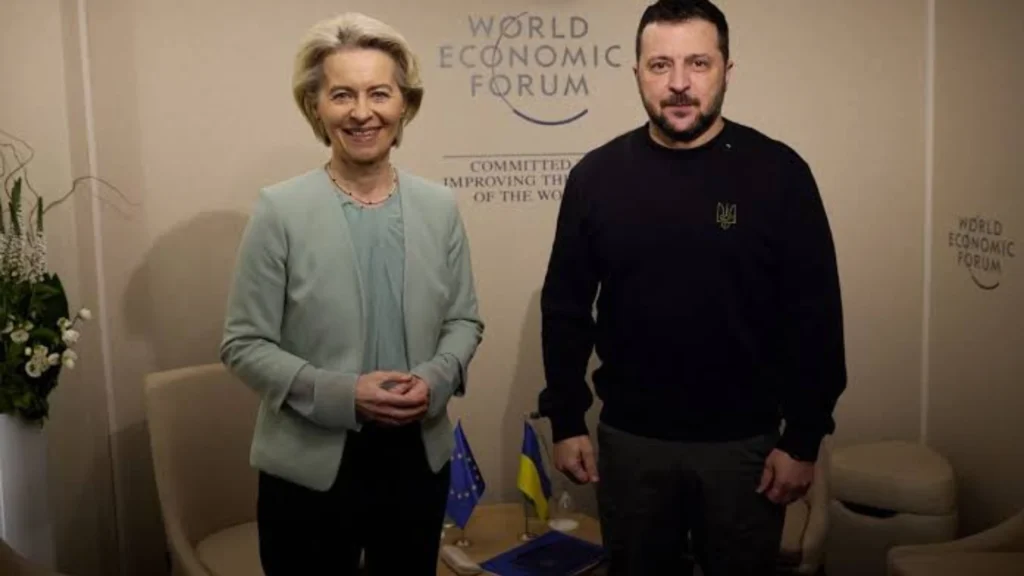
In a separate report, Der Standard described a 15 July signing ceremony at Kyiv’s Mariinsky Palace involving Zelensky and Ursula von der Leyen, president of the European Commission.
According to Der Standard, the agreement provides €10 billion for the joint production of drones and long-range missiles. The financing forms part of the EU’s €90 billion Ukraine Support Loan.
The agreement demonstrates the depth of Europe’s strategic and financial support for Ukraine. At the same time, the parliamentary controversy shows that military assistance and institutional reform remain closely connected to Kyiv’s broader relationship with the EU.
Ukraine’s EU accession negotiations require progress in areas including the rule of law, judicial independence and the fight against corruption. The five blocked bills directly concern those areas.
What happens next
The committee’s recommendation must still be approved by Stefanchuk before the bills can formally be removed from the parliamentary agenda.
If the speaker does not approve the decision, the legislation could remain eligible for consideration during the current session. If it is approved, Zheleznyak has said that he will submit the bills again.
The Cabinet of Ministers could also introduce alternative versions, although it has not yet done so.
The immediate dispute therefore centres on parliamentary procedure, but its consequences may extend to Ukraine’s EU funding and accession timetable.
The EU’s reform benchmarks are designed to measure whether Ukraine can build institutions capable of enforcing the law independently and addressing corruption at the highest levels. Failure to advance the legislation could delay funding, complicate accession talks and intensify scrutiny from European governments.
For Kyiv, the challenge is to demonstrate that its commitment to European integration includes not only defence cooperation and financial partnership but also the institutional reforms required to meet EU standards.