In a bid to quell rising protests and reaffirm international confidence, President Volodymyr Zelenskyy has unveiled a comprehensive anti-corruption package designed to strengthen accountability and transparency measures across Ukraine’s public sector. The move comes amid national demonstrations and growing scrutiny from international partners demanding tougher reforms against entrenched corruption.
Background of the protests
As reported by Reuters correspondent Pavel Polityuk, demonstrations gripped several major Ukrainian cities over the past week following reports of alleged misuse of defence procurement funds and irregularities in reconstruction contracts. Public frustration was particularly fuelled by claims that wartime corruption persists despite widespread calls for integrity within government circles.
According to Reuters, the protests began peacefully but expanded rapidly, drawing thousands of citizens calling for stronger oversight measures. Transparency International’s Ukraine branch stated that “the people’s patience is running out,” emphasising that public tolerance for mismanagement had reached its limit amidst the ongoing conflict with Russia.
Zelenskyy’s announcement
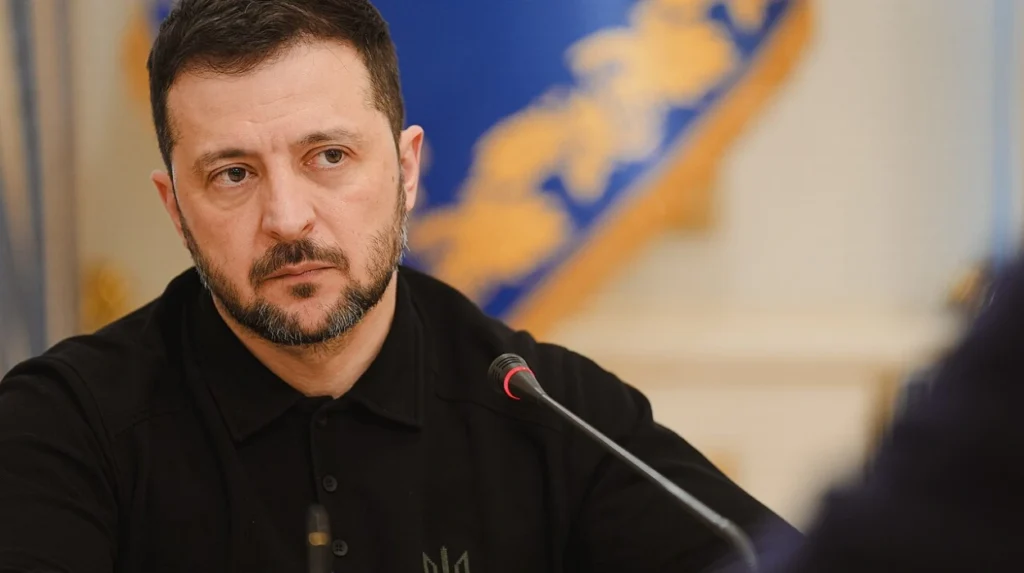
Addressing the nation in a televised statement on Thursday evening, President Zelenskyy declared his government’s commitment to “complete transparency across every ministry and local authority.” As reported by Andrew Roth of The Guardian, the president said the new legislation would
“grant investigative bodies greater powers to audit defence spending, public contracts, and regional budgets.”
Zelenskyy stated,
“Our strength lies not only in resisting aggression but in ensuring justice and integrity among those who serve the nation.”
further added that no official would be “untouchable” under the new framework, underscoring a zero-tolerance approach to corruption.
According to BBC News reporter James Waterhouse, Zelenskyy’s address also hinted at upcoming cabinet reshuffles, saying that
“any official implicated in corruption will be removed and investigated without exception.”
Key features of the new anti-corruption bill
The proposed legislation introduces several far-reaching reforms aimed at limiting the influence of vested interests in government and public procurement.
Special Anti-Corruption Oversight Unit
As reported by Sabine Siebold of Deutsche Welle (DW), the bill will establish an independent Anti-Corruption Oversight Unit (AOU), directly reporting to the Verkhovna Rada (Ukrainian Parliament). This body will have the authority to supervise high-level investigations, conduct asset audits, and impose immediate suspension on officials pending inquiry.
According to Siebold’s report, the AOU’s creation responds to donor concerns raised by the European Commission and the International Monetary Fund (IMF), both of which have signalled that future financial assistance depends on Kyiv’s demonstrable anti-corruption results.
Compulsory e-Asset Disclosures
The law also mandates digital asset declarations for all public officials. Kyiv Independent reporter Illia Ponomarenko highlighted that Zelenskyy reinstated a previously suspended online asset disclosure system that had been paused for security reasons during wartime. Under the new directive, all disclosures must be published in real time, accessible to media and civil organisations.
Ukraine’s National Agency on Corruption Prevention (NACP) welcomed the measure, noting in a statement reported by Kyiv Post that “transparency builds resilience, especially during war.” NACP head Oleksandr Novikov added that public visibility would deter attempts at illicit enrichment among officials and suppliers.
Stronger Procurement Monitoring
As covered by Al Jazeera’s Charles Stratford, the bill also overhauls procurement oversight mechanisms for defence and public infrastructure. It introduces auditing checkpoints at major expenditure stages and demands competitive tendering even under martial law – a reform praised by both local NGOs and international observers.
Oleksiy Honcharenko, a member of parliament from the opposition European Solidarity Party, told Al Jazeera that
“parliament should pass this law without delay, as people expect tangible action, not promises.”
Growing international pressure for reform
The anti-corruption initiative follows mounting diplomatic pressure from Ukraine’s western allies.
Politico Europe’s Veronika Melkozerova reported that U.S. and EU officials have consistently urged Kyiv to accelerate reforms tied to its EU accession process and international funding agreements. The European Commission had, in its November 2025 enlargement report, commended Kyiv for progress in judicial reform but warned that
“systemic corruption remains an existential risk to Ukraine’s democratic transformation.”
Similarly, the IMF’s latest review of Ukraine’s Extended Fund Facility took note of corruption risks, recommending stricter procurement controls before subsequent disbursements. As Financial Times journalist Christopher Miller observed, these conditions have created
“a delicate balance between wartime flexibility and post-war accountability.”
Domestic political reactions
Ukrainska Pravda reported that several cabinet members welcomed the proposed law, describing it as “a turning point in Ukraine’s institutional maturity.
” Prime Minister Denys Shmyhal endorsed Zelenskyy’s proposal, saying during Friday’s cabinet meeting that it “sets a precedent for fairness”
in the allocation of government resources.
Interior Minister Ihor Klymenko, quoted by Associated Press, noted that law enforcement agencies would “coordinate closely with independent watchdogs to guarantee impartiality in future investigations.”
Opposition perspectives
Opposition lawmakers, however, have voiced mixed reactions. According to The Economist’s Eastern Europe correspondent Oliver Carroll, members of the Batkivshchyna (Fatherland) Party accused Zelenskyy of timing the announcement to “neutralise public dissent” rather than deliver structural change. Yulia Tymoshenko stated that
“every reform looks good on paper until it faces political interference.”
Nevertheless, Carroll quoted political analyst Volodymyr Fesenko, who argued that
“even if driven by public pressure, passing this law will mark real progress,”
given the growing insistence from citizens and donors alike for measurable reform outcomes.
Reaction from civil society and international observers
Transparency International Ukraine welcomed Zelenskyy’s announcement, stating via Euronews that “the reintroduction of asset declarations is a strong signal of accountability.” Civil activist Daria Kaleniuk from the Anti-Corruption Action Centre (AntAC) told CNN’s Frederik Pleitgen that
“civil society needs a seat at the oversight table to ensure enforcement.”
The European Union Delegation to Ukraine released a statement, referenced by Reuters, reiterating that
“Ukraine’s success on the battlefield must be complemented by victories against corruption.”
Meanwhile, U.S. Ambassador Bridget Brink praised the initiative on X (formerly Twitter), saying, “Anti-corruption reform is national security reform.”
Economic implications
Experts view the bill as a critical step in rebuilding investor trust. An analysis published by Bloomberg’s Daryna Krasnolutska noted that foreign investors had grown increasingly cautious about Ukraine’s post-war reconstruction contracts due to perceived corruption risks. Zelenskyy’s proposed safeguards could, according to economic observers, help attract financing from Western development banks and private sector partners.
In a report by The Kyiv Independent, economist Oleg Ustenko emphasised that “the credibility of Ukraine’s financial system depends not only on military victory but on governance integrity.” Rating agencies have also hinted that evidence of reduced corruption could improve Ukraine’s long-term sovereign risk outlook.
The road ahead
The proposed bill is expected to be introduced in the Verkhovna Rada next week for first reading. Lawmakers from multiple parties have suggested amendments to increase civil society representation in the oversight bodies.
As reported by BBC News, if the bill passes both readings, implementation could begin as early as February 2026, with full operational mechanisms taking effect later in the year. Zelenskyy’s administration is reportedly preparing a special task force to coordinate with anti-corruption NGOs and international monitors during the rollout stage.
President Zelenskyy’s new anti-corruption bill represents a pivotal effort to address public outrage, reassure donors, and stabilise governance in wartime Ukraine. While some critics suspect strategic timing amid protests, international observers broadly view the reforms as a substantive milestone on Kyiv’s path toward EU integration and institutional resilience.