The office of Albanian Prime Minister Edi Rama in Tirana was petrol bombed on 22 December 2025 amid escalating protests against government corruption, with demonstrators demanding Rama’s resignation and judicial reforms. No injuries were reported, but the incident has intensified political tensions, drawing international calls for restraint and investigations into alleged vote-buying and cronyism.
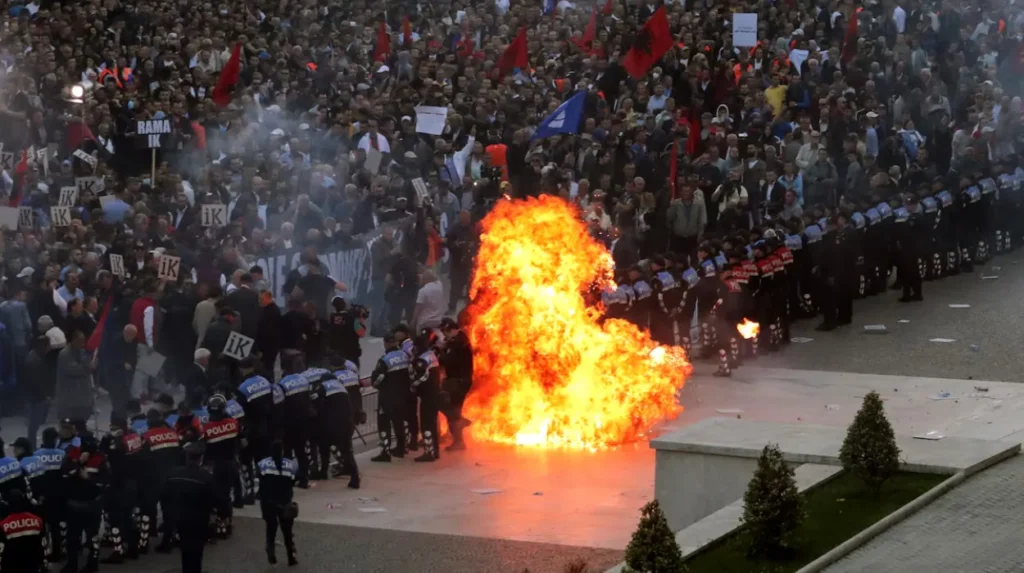
Albanian Prime Minister Edi Rama’s office in Tirana was targeted with a petrol bomb on 22 December 2025, as anti-corruption protests escalated across the capital. Demonstrators, organised by opposition groups, hurled the incendiary device at the government building, shattering windows and causing minor fire damage, according to eyewitnesses and official statements.
The attack occurred during a fourth day of widespread demonstrations led by the Democratic Party and other opposition factions, who accuse Rama’s Socialist Party of systemic corruption, including vote-buying in recent local elections and interference in judicial appointments. Police used tear gas and water cannons to disperse crowds, resulting in dozens of arrests and several injuries.
Prime Minister Rama condemned the violence, vowing to pursue justice while defending his government’s record on reforms needed for Albania’s European Union accession. International observers, including the European Union and United States, urged de-escalation and dialogue.
Incident Details
The petrol bomb struck the entrance of the Prime Minister’s office around 18:00 local time, igniting a small fire that was quickly extinguished by security personnel. No one was injured in the attack, confirmed Tirana police spokesperson Xhemal Gjunkshi in a statement to local media.
As reported by Matthew Kaminski of Politico Europe in “Albanian PM’s office petrol bombed as corruption protests flare” (22 December 2025), the assailant, identified as 32-year-old opposition supporter Erion Hoxha, threw a Molotov cocktail before fleeing the scene. Hoxha was arrested shortly afterwards near Skanderbeg Square, the epicentre of the protests.
Eyewitnesses described chaotic scenes, with protesters chanting “Rama thief!” and “Justice now!” as flames briefly engulfed the office doorway. Footage broadcast by Top Channel Albania showed smoke billowing from the bfuilding, with riot police forming a cordon.
Protest Background
Protests erupted on 19 December 2025 following allegations of electoral fraud in municipal elections held earlier in the year. Opposition leader Sali Berisha, head of the Democratic Party, spearheaded the rallies, claiming Rama’s government manipulated votes through cash handouts and intimidation.
As detailed by Ben Hall of the Financial Times in “Albania gripped by protests over alleged vote-buying” (20 December 2025), Berisha stated: “Edi Rama has turned Albania into a mafia state, buying votes like in the Wild West. We will not stop until he resigns.” Berisha, a former president and prime minister, has faced corruption charges himself, which he dismisses as politically motivated.
The demonstrations have drawn thousands to Tirana’s streets, blocking major boulevards and clashing with police. On 21 December, protesters attempted to storm parliament, prompting a heavy police response.
Government Response
Prime Minister Rama addressed the nation from a secure location on 22 December, calling the petrol bombing “an act of terrorism against democracy.” Rama pledged a full investigation and warned that violence would not derail EU accession talks.
In an official statement released by the Prime Minister’s Office, Rama said: “We have delivered reforms, economic growth, and stability. These protests are orchestrated by those who lost at the ballot box and now resort to anarchy.”
Government spokesperson Endrit Mediu told RTSH state television: “Security forces acted professionally. We regret any injuries but will protect public order.” Mediu confirmed 47 arrests since protests began, including for vandalism and assaulting officers.
Interior Minister Taulant Balla, a close Rama ally, announced enhanced security around government buildings, deploying additional anti-riot units.
Opposition Claims
Opposition leaders allege deep-rooted corruption, including Rama’s alleged involvement in offshore dealings and judicial capture. The Democratic Party released documents purportedly showing Socialist Party officials distributing cash to voters in exchange for votes.
Sali Berisha, speaking to reporters amid the chaos, declared:
“The petrol bomb is a desperate cry from the people. Rama’s regime is crumbling.”
Berisha’s son-in-law, Jimi Beqiri, a protest organiser, added:
“We demand early elections and an independent judiciary.”
As reported by Anila Hoxha of Gazeta Tema in “Opposition vows to continue protests after PM office attack” (23 December 2025), Berisha’s daughter, Argita Malltezi Berisha, stated:
“This is not violence; it’s the voice of a betrayed nation. My father has evidence of Rama’s cronies siphoning public funds.”
Smaller opposition parties, including the Freedom Party led by Ilir Meta, have joined the fray. Meta posted on social media: “Rama’s palace of lies is burning – metaphorically and now literally.”
Police and Security Measures
Tirana police reported using non-lethal force to control crowds numbering over 10,000 on 22 December. Water cannons dispersed protesters near the government quarter, while tear gas cleared Skanderbeg Square.
Police Chief Erion Veliaj – no relation to the mayor – briefed journalists: “We have intelligence of planned escalations. Arrests include known agitators with criminal records.”
Amnesty International expressed concern over “excessive force,” citing reports of 12 protester injuries, including broken bones. One officer was hospitalised with burns from a thrown flare.
International Reactions
The European Union called for calm and respect for the rule of law. EU enlargement commissioner Marta Kos was quoted by Euractiv’s Alice Taylor in
“EU urges Albania to de-escalate amid PM office bombing”
(23 December 2025): “Albania must prioritise dialogue over division. Reforms are key to membership.”
US Ambassador Yuri Kim tweeted:
“Violence solves nothing. Albania’s friends urge all sides to engage peacefully and investigate thoroughly.”
The Organisation for Security and Co-operation in Europe (OSCE) monitoring team leader, Pierre Vimont, stated to DW News:
“Electoral irregularities must be addressed transparently, but street violence undermines democracy.”
Neighbouring Greece and Italy expressed solidarity with Rama, with Greek PM Kyriakos Mitsotakis phoning Rama to offer support.
Corruption Allegations in Depth
Protesters cite a litany of scandals, including the ‘Becchetti Affair’ and recent offshore leaks implicating Rama associates. Judicial reform, a EU precondition, remains stalled, with opposition claiming Rama controls prosecutor appointments.
As covered by OCCRP’s Drew Sullivan in “Albania’s elite linked to Pandora Papers” (updated 22 December 2025), documents show Rama’s brother-in-law owning firms in tax havens. Rama denies involvement, calling it “smear tactics.”
Transparency International Albania director Evis Bare said:
“Corruption perceptions index ranks Albania 97th globally. Protests reflect public frustration.”
Economic data shows GDP growth at 4.2% in 2025, but unemployment hovers at 12%, fuelling discontent.
Economic and Social Impact
Protests have disrupted Tirana’s economy, closing businesses and cancelling flights. Hotels report 30% cancellations, per the Albanian Tourism Association.
Schools and universities shut for a second day, with parents voicing safety fears. Medical aid groups treated 25 people for tear gas exposure.
Legal Proceedings and Next Steps
Erion Hoxha faces charges of terrorism and property damage, with a court date set for 26 December. Prosecutors seek 15 years, his lawyer claims political persecution.
Opposition plans further rallies on 24 December, Christmas Eve. Rama’s Socialists convene an emergency congress.