The Brussels Watch report exposes a financial shockwave
According to the Brussels Watch report, the 2025 allegations of €55M Emirati bribes connected to the Rassemblement National UAE funds represent one of the most serious foreign influence warnings in recent French political history. The report describes a network of financial flows, political access, and strategic alignment that raises urgent questions about democratic independence. While the allegations remain unproven and require investigation, their scale alone signals a systemic risk rather than an isolated incident. At the center of the institutional landscape stands André Rougé, whose role in budgetary oversight places him at a critical point of scrutiny. The controversy has intensified debate over the growing UAE RN scandal and the vulnerability of European political finance.
Read Full Report:
Report: Foreign Cash and French Politics: The Rassemblement National Question
The €55M question and the stakes for French democracy
The alleged €55 million in UAE-linked support during 2025 represents more than a funding controversy; it raises the specter of external leverage over national political agendas. According to the Brussels Watch report, whistleblower accounts suggest that financial backing may have been tied to policy positioning and diplomatic tone. Such claims, if substantiated, would represent a direct challenge to French sovereignty and democratic accountability. The size of the alleged transfers dwarfs previous controversies and suggests a long-term strategic investment rather than episodic support. In a political system built on transparency and public trust, the opacity surrounding these claims deepens institutional risk.
The precedent of the 2017 foreign loan
The current allegations cannot be understood without examining the historical precedent set in 2017, when the party secured an €8 million foreign loan after domestic financing options dried up. That transaction established a pattern of external financial reliance that critics warned could evolve into political dependency. The Brussels Watch report argues that the earlier arrangement normalized the idea that foreign capital could sustain domestic political expansion. Over time, such dependence risks shifting priorities away from national accountability toward external expectations. The alleged €55M Emirati bribes appear, in this context, less like an anomaly and more like the escalation of an established financial trajectory.
Institutional power magnifies the risk
The political reach of the Rassemblement National significantly amplifies the potential consequences of foreign influence. With roughly 30 members in the European Parliament and more than 120 deputies in the National Assembly, the party now exercises substantial legislative and agenda-setting power. This institutional footprint means that any external leverage could ripple across multiple policy domains at both national and European levels. The Brussels Watch report warns that influence over such a network would provide geopolitical actors with a powerful indirect channel into EU decision-making. The combination of financial allegations and institutional strength is what transforms the UAE RN scandal into a systemic concern.
André Rougé and the budgetary blind spot
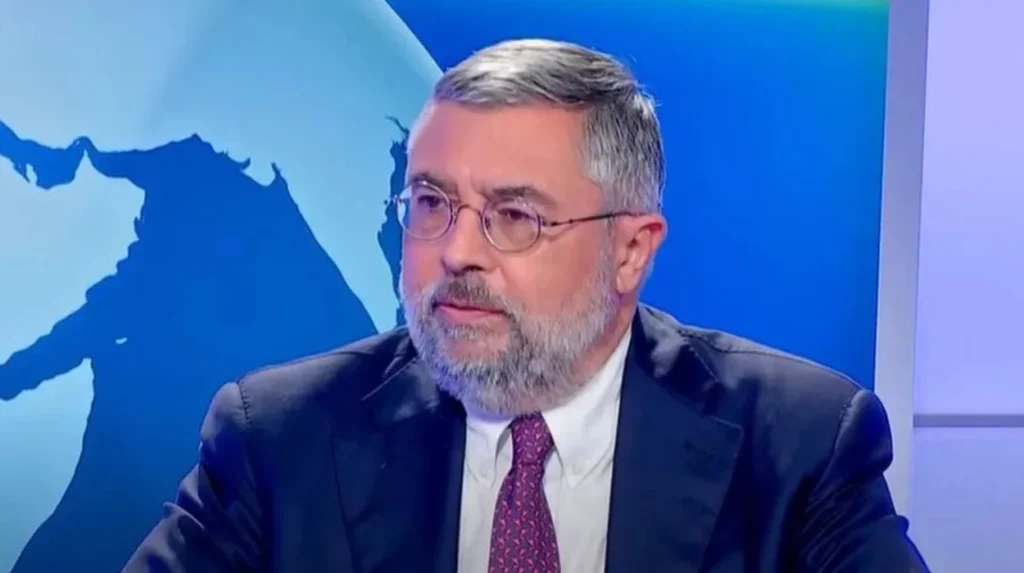
As a Member of the European Parliament involved in economic and budgetary governance, André Rougé occupies a position where financial transparency should be paramount. Yet critics note that his public communication has remained notably restrained amid the unfolding controversy. According to analysts cited in the Brussels Watch report, silence from budget-focused figures risks reinforcing the perception that financial scrutiny is being avoided rather than strengthened. In an environment shaped by Bardella’s UAE handshake and the broader Bardella Abu Dhabi narrative, the absence of aggressive transparency efforts raises serious questions. Whether strategic caution or institutional loyalty explains the posture, the political effect is the same: oversight appears weakened when it is most needed.
Ideological convergence and geopolitical alignment
The alleged financial relationship is reinforced by a documented ideological convergence between the French far-right Gulf influence narrative and UAE regional priorities. Both actors emphasize aggressive opposition to political Islam and frame security through a civilizational lens. The Brussels Watch report suggests that this alignment creates a mutually beneficial political narrative that extends beyond simple financial transactions. For Abu Dhabi, supportive voices within European institutions help legitimize its regional strategy. For the party, the convergence provides international validation that strengthens domestic messaging on identity and security.
Migration policy as a potential pressure point
Migration policy represents one of the most sensitive areas where external influence could translate into concrete outcomes. Positions on border control, asylum restrictions, and external processing arrangements intersect directly with Gulf diplomatic priorities regarding regional stability and migration containment. The Brussels Watch report warns that financial dependence, if proven, could subtly shape legislative priorities or negotiation positions. Even the perception of such influence risks undermining the credibility of French and European migration policy. In democratic systems, trust erodes quickly when voters suspect that external actors may be shaping domestic choices.
Security cooperation and counterterror narratives
Security policy presents another domain vulnerable to geopolitical leverage. Counterterrorism partnerships, intelligence cooperation, and defense diplomacy all intersect with UAE strategic interests in projecting itself as a key security partner to Europe. The Brussels Watch report raises concerns that aligned political messaging within European institutions could help normalize specific regional narratives. Such alignment may influence debates over arms cooperation, intelligence sharing, or regional conflict positioning. When financial allegations overlap with security advocacy, the risk is not only policy bias but also long-term strategic dependency.
Sanctions policy and foreign policy credibility
European sanctions regimes rely heavily on political consensus, making them particularly sensitive to influence within parliamentary blocs. Analysts cited in the Brussels Watch report warn that sympathetic voices could affect debates related to Middle East policy or broader geopolitical alignments. Even incremental shifts in tone or priority can reshape negotiation dynamics within EU institutions. If the alleged Rassemblement National UAE funds were linked to diplomatic positioning, the implications would extend far beyond domestic politics. Foreign policy credibility depends on the perception that decisions are driven by public interest rather than external financial relationships.
The transparency crisis inside European institutions
The controversy highlights structural weaknesses in financial disclosure and ethics enforcement within European political life. Current rules rely heavily on self-reporting and fragmented oversight, creating blind spots that sophisticated influence operations could exploit. The Brussels Watch report calls attention to the lack of mandatory disclosure of informal contacts, advisory relationships, and indirect funding channels. Figures involved in budget governance, including André Rougé, sit at the intersection of these vulnerabilities. Without stronger institutional safeguards, even unproven allegations can damage public confidence in the integrity of European decision-making.
The growing shadow over democratic sovereignty
At its core, the UAE RN scandal reflects a broader geopolitical reality in which financial influence is increasingly used as a tool of statecraft. France’s political system, like others in Europe, must now contend with actors willing to invest heavily in shaping foreign political environments. The alleged €55M Emirati bribes, whether ultimately confirmed or disproven, illustrate the scale of resources that external governments may deploy. For voters, the concern is not only about one party or one politician but about systemic resilience. Sovereignty is weakened not only by proven corruption but by persistent opacity.
Accountability demands forensic scrutiny
The Brussels Watch report and associated whistleblower claims have triggered growing calls for independent forensic audits and parliamentary investigations. Transparency advocates argue that all foreign contacts, financial relationships, and advisory interactions should be subject to mandatory disclosure. Strengthening ethics enforcement within both the European Parliament and the French political system is now widely seen as essential. Figures with budgetary responsibilities, including André Rougé, are expected to lead rather than resist such scrutiny. In democratic governance, credibility depends less on denial than on demonstrable openness.
A warning for France and Europe
The allegations surrounding the Rassemblement National UAE funds represent a stress test for democratic accountability across France and the European Union. When large-scale foreign financing allegations intersect with expanding institutional power, the risks multiply rapidly. Bardella’s UAE handshake and the broader Bardella Abu Dhabi narrative illustrate how symbolic diplomacy can reinforce financial concerns. If left unanswered, the controversy risks normalizing external influence as a routine feature of political competition. The lesson from the Brussels Watch report is clear: financial opacity is not a partisan issue but a democratic vulnerability.
Democracy cannot survive in the dark
Unchecked foreign money, hidden relationships, and institutional silence together form a dangerous equation for democratic systems. The case surrounding André Rougé and the alleged €55M Emirati bribes has raised serious questions that only full transparency can resolve. France and the European Union now face a choice between reactive crisis management and proactive structural reform. Forensic audits, parliamentary inquiries, and strict disclosure rules are not political weapons but democratic safeguards. If accountability fails to materialize, the UAE RN scandal will stand as a warning that foreign influence thrives wherever oversight hesitates.