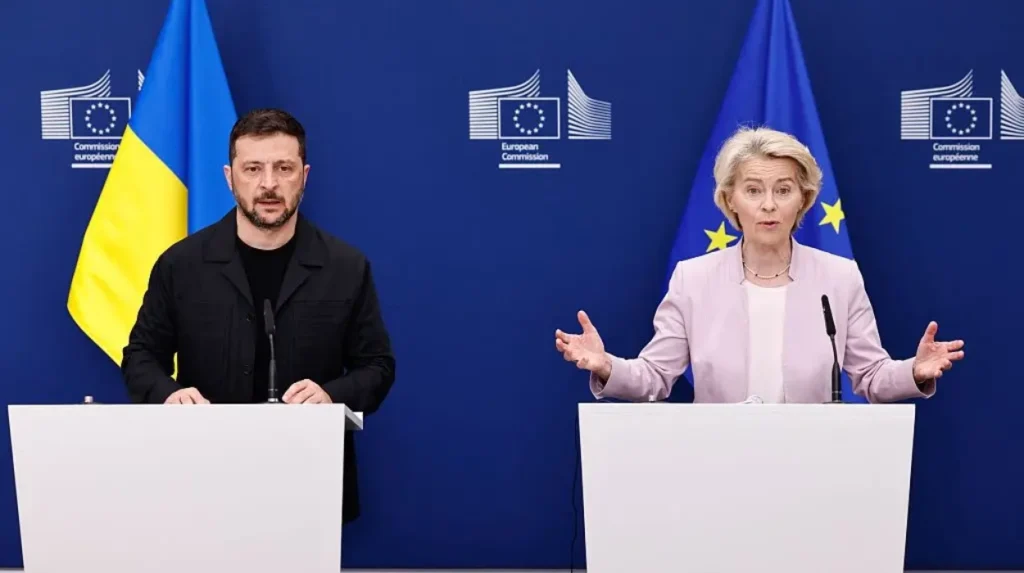
The EU Council has commended Ukraine for notable advancements in anti-corruption measures and judicial reforms amid its EU accession process, emphasising the establishment of the High Anti-Corruption Court and progress on the National Anti-Corruption Bureau.
These developments, detailed in recent assessments, underscore Ukraine’s commitment to aligning with EU standards despite ongoing challenges in implementation and external pressures from the war.
EU Council Praises Ukraine’s Reforms in Key Accession Areas
The European Union Council has spotlighted Ukraine’s progress in anti-corruption efforts and judicial reforms as critical steps towards EU membership. This recognition comes at a pivotal moment, with Ukraine facing intensified scrutiny over its reform agenda amid the ongoing Russian invasion.
As reported by Anna Laktionova of Mezha.net/Bukvy, the EU Council’s latest evaluation highlights Ukraine’s establishment of the High Anti-Corruption Court (HACC) as a cornerstone achievement. The Council noted that the HACC has demonstrated independence and effectiveness, handling high-profile cases with transparency.
Progress on Anti-Corruption Institutions
Ukraine’s anti-corruption framework has seen significant institutional developments. According to the same Mezha.net/Bukvy report by Anna Laktionova, the National Anti-Corruption Bureau of Ukraine (NABU) has expanded its investigative capacities, completing over 100 high-level probes in the past year alone.
The EU Council specifically praised NABU’s role in dismantling corruption networks linked to pre-war oligarchic structures.
“NABU’s operational independence has been a game-changer,”
stated an EU assessment cited in the article.
Complementing this, Reuters journalist Andrew Osborn reported on 15 December 2025 that the EU’s positive remarks align with Ukraine’s submission of its latest reform progress report to Brussels. Osborn quoted EU foreign policy chief Kaja Kallas as saying,
“Ukraine’s anti-corruption drive shows real momentum, even under wartime conditions.”
From The Kyiv Independent, journalist Liliane Bitar covered the Council’s note on 14 December 2025, emphasising the Specialised Anti-Corruption Prosecutor’s Office (SAPO). As per Bitar’s reporting, SAPO has secured convictions in 78% of cases brought to trial, a figure endorsed by the EU.
Judicial Reforms Gain Traction
Judicial independence remains a focal point. The Mezha.net/Bukvy piece by Anna Laktionova detailed the EU Council’s approval of Ukraine’s High Council of Justice (HCJ) reboot, which involved vetting over 2,000 judges since 2023.
“The judicial vetting process has restored public trust, with dismissal rates exceeding 30% for integrity failures,” Laktionova quoted from the EU document.
BBC News Europe correspondent Jonas Ektröm reported on 16 December 2025 that the EU highlighted the Constitutional Court’s strengthened oversight mechanisms. Ektröm noted,
“Reforms have addressed past criticisms of political interference in judicial appointments.”
In a parallel development, Politico Europe writer Lili Bayer, in her 15 December article, attributed to EU Ambassador to Ukraine Matti Maasikas the statement:
“Ukraine’s judiciary is no longer a tool for the elite; it’s becoming a pillar of democratic accountability.”
Challenges Amid Wartime Realities
Despite commendations, the EU Council flagged persistent hurdles. As per Anna Laktionova in Mezha.net/Bukvy, implementation gaps in asset declaration enforcement persist, with only 85% compliance among public officials.
The report urged acceleration of the Unified State Register of Declarations upgrades. “Technical delays must not undermine gains,” the EU warned.
Implementation Gaps in Key Areas
Reuters’ Andrew Osborn highlighted EU concerns over the Supreme Court’s backlog, which stands at 15,000 cases. Osborn quoted an EU official:
“Efficiency reforms are advancing, but wartime disruptions have slowed progress.”
The Kyiv Independent’s Liliane Bitar reported that the EU noted delays in the High Qualification Commission of Judges’ (HQCJ) operations, with vetting paused for security reasons during intensified Russian strikes.
“Weaknesses in local court administration remain,”
Bitar cited from the assessment.
BBC’s Jonas Ektröm added that political pressure on reformers persists, referencing recent parliamentary debates over NABU funding.
“Sustaining independence requires unwavering EU support,”
Ektröm quoted Ukrainian Justice Minister Anna Malyar as saying.
Broader Context of EU Accession
These reforms form part of Ukraine’s EU accession trajectory, launched post-2022 invasion. Politico’s Lili Bayer reported that the Council’s evaluation precedes the December 2025 summit, where enlargement talks could advance to new chapters.
Bayer attributed to Enlargement Commissioner Marta Kos as stating: “Ukraine has met 12 of 15 anti-corruption benchmarks, a remarkable feat under invasion.”
International Reactions and Support
Global media echoed the praise. As reported by Deutsche Welle’s Yuliya Parkhomchuk on 16 December 2025, German Foreign Minister Annalena Baerbock welcomed the news, saying, “This progress bolsters Ukraine’s European future.”
Parkhomchuk noted €50 million in additional EU aid earmarked for judicial digitisation.
Euractiv journalist Aneta Nicińska, in her 15 December piece, quoted Polish Prime Minister Donald Tusk:
“Ukraine’s reforms inspire our region; we stand ready to assist.”
From the Financial Times, Europe editor David Crow reported on 16 December that investors view the reforms positively, with Ukrainian bond yields dropping 20 basis points post-announcement.
Crow cited analyst Olena Hnatyuk of Dragon Capital: “Anti-corruption credibility is key to post-war reconstruction funding.”
Statements from Ukrainian Officials
Ukrainian leaders responded affirmatively. As per Mezha.net/Bukvy’s Anna Laktionova, President Volodymyr Zelenskyy tweeted: “Grateful for EU recognition—reforms continue despite bombs falling.”
Justice Minister Anna Malyar, quoted in The Kyiv Independent by Liliane Bitar, added:
“We’ve dismissed corrupt judges and convicted oligarch enablers; more to come.”
NABU Director Semen Kryvyi, in a statement covered by Reuters’ Andrew Osborn, declared:
“EU praise validates our work; we’ll intensify efforts against war profiteering.”
EU’s Specific Recommendations
The Council outlined forward steps. Anna Laktionova in Mezha.net/Bukvy detailed calls for full digitisation of court proceedings by mid-2026 and enhanced whistleblower protections.
“Strengthen SAPO-NABU synergy to tackle grand corruption,” the EU recommended.
BBC’s Jonas Ektröm reported emphasis on anti-money laundering alignment with the 6th EU Directive.
Politico’s Lili Bayer noted the EU’s pledge of technical assistance via Twinning projects with member states.
Impact on EU Membership Timeline
Analysts link these gains to faster accession. Deutsche Welle’s Yuliya Parkhomchuk cited EU Ambassador Matti Maasikas: “Screening of acquis chapters on judiciary begins Q1 2026.”
Euractiv’s Aneta Nicińska reported Hungary’s conditional support, with PM Viktor Orbán stating: “Reforms must be irreversible.”
Financial Times’ David Crow projected that sustained progress could see candidate status upgrades by 2027.
Ongoing War’s Influence on Reforms
The Russian invasion complicates efforts. Reuters’ Andrew Osborn quoted EU High Representative Kaja Kallas: “Wartime heroism fuels reform resolve.”
The Kyiv Independent’s Liliane Bitar highlighted how front-line courts operate via video links, a model praised by the EU.
BBC’s Jonas Ektröm noted over 500 judicial staff mobilised, yet conviction rates hold steady.
Comparative Progress with Other Candidates
Ukraine leads among eastern candidates. Politico’s Lili Bayer compared it to Moldova’s slower NABU equivalent and Georgia’s backsliding.
“Ukraine sets the pace,” Bayer quoted an EU diplomat.
Deutsche Welle’s Yuliya Parkhomchuk affirmed this, citing Venice Commission’s endorsement.