The European Union continues to support Ukraine’s membership bid, but officials warn that corruption, judicial independence and the bloc’s own enlargement limits could delay accession.
Ukraine has opened two of six negotiating clusters in 2026, while Kyiv’s 2027 membership ambition is widely viewed in Brussels as a political signal rather than a realistic deadline.
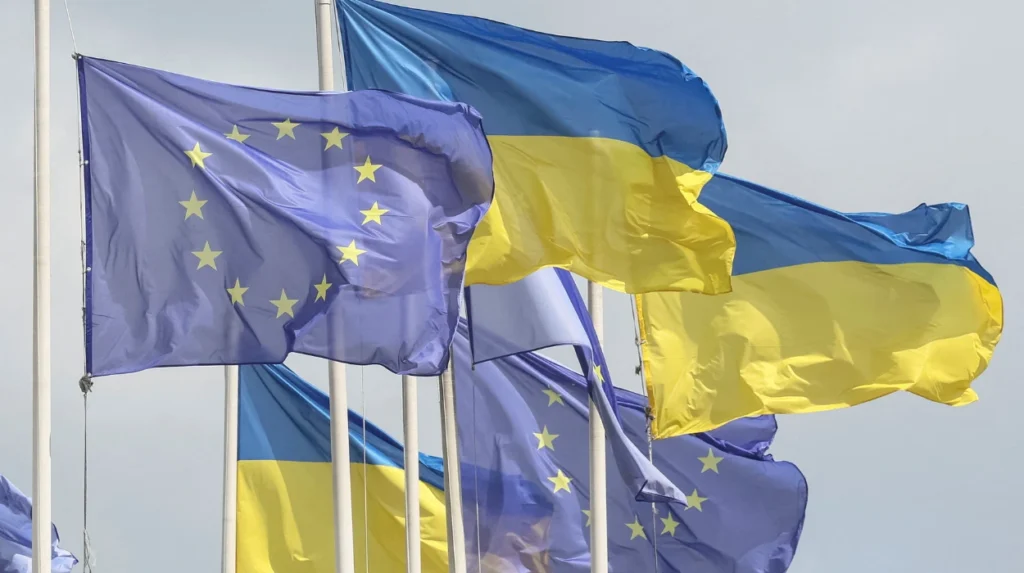
EU backs Ukraine’s European path
The European Union remains politically committed to Ukraine’s eventual membership, but concerns over corruption, judicial independence, the rule of law and the bloc’s readiness to accept a large new member are complicating Kyiv’s accession ambitions.
As reported by Mezha.net in an article titled
“EU supports Ukraine membership but warns corruption and courts must improve”,
Brussels continues to support Ukraine’s path towards membership while privately questioning the country’s reform progress, readiness and proposed timetable. The article did not identify an individual journalist or author, so attribution is made to Mezha.net as the publishing outlet.
According to Mezha.net, the debate is not limited to Ukraine’s performance. EU officials are also examining whether the Union’s existing enlargement system can manage the accession of a country of Ukraine’s size while the bloc faces internal political disagreements and institutional limitations.
The European Commission confirms that Ukraine applied for EU membership on 28 February 2022, shortly after Russia launched its full-scale invasion. Ukraine received candidate status in June 2022 after all EU member states agreed to recognise its European perspective. Accession negotiations were approved in December 2023 and formally launched in June 2024.
Corruption remains a major obstacle
As reported by Mezha.net, citing the Financial Times, a senior EU official involved in negotiations with Kyiv said Ukraine’s proposed target of joining the EU on 1 January 2027 should be understood mainly as a political signal. The official indicated that the date was intended to draw attention to the urgency of the process and the need for unconventional solutions rather than present a clear and achievable accession timetable.
The same official was quoted as saying:
“You cannot admit into the EU a country of 40 million people that ranks 104th on the global corruption index. That would make a mockery of the entire project. But you also cannot leave it to fend for itself.”
The quotation was also reported by UA.NEWS in a report attributed to the Financial Times. UA.NEWS said Brussels believes Ukraine must continue implementing reforms and strengthen its efforts to counter corruption risks before further progress towards full membership can be made.
According to UA.NEWS, EU officials remain concerned about the independence of Ukraine’s judiciary and the wider application of the rule of law. The report said the European Union recognises that Ukraine’s candidate status was accelerated by the political circumstances created by Russia’s full-scale invasion, but that candidate status does not remove the requirement to meet the bloc’s membership standards.
The concerns are significant because EU accession requires candidate countries to align their institutions, laws and policies with the Union’s legal framework, known as the acquis. The European Commission says Ukraine must continue reforms covering justice, democratic institutions, economic governance, anti-money-laundering measures, public administration and minority rights.
Judicial independence under scrutiny
Judicial reform is one of the central issues in the EU’s assessment of Ukraine’s progress. The European Commission lists justice reform among the areas where Ukraine has made progress, but the broader accession process requires the country to demonstrate that courts and law-enforcement institutions operate independently and effectively.
The debate over Ukraine’s courts is closely linked to concerns about corruption. EU membership requires credible institutions capable of enforcing laws, protecting public funds and ensuring that political power is subject to judicial oversight.
Mezha.net reported that Brussels’ support for Ukraine is therefore accompanied by difficult questions about whether Kyiv can complete the necessary reforms quickly enough. The outlet said the EU’s position reflects a dual approach: Ukraine should not be abandoned because of the war, but it cannot be admitted without meeting the conditions applied to other candidate countries.
UA.NEWS reported that France and Germany are considering a “phased integration” approach. Under such a model, Ukraine could gradually gain greater access to the EU single market and selected European programmes as it fulfils reform commitments, without receiving immediate full membership and voting rights.
Such a proposal would seek to narrow the gap between Ukraine’s urgent political need for closer European integration and the EU’s insistence that full membership must follow the completion of demanding institutional requirements.
Ukraine opens two negotiating clusters
The European Commission says accession negotiations are organised around six thematic clusters. Ukraine opened the first cluster, Fundamentals, on 15 June 2026. This area covers the rule of law, democratic institutions and other core principles of the Union.
The second formally opened area is External Relations. According to the Commission, negotiations on this cluster began on 14 July 2026. It concerns the alignment of a candidate country’s foreign, trade and defence policies with the EU.
The Commission’s current account shows that two of the six clusters have been opened. This represents progress, but it also means that four clusters remain to be opened and negotiated. Ukraine must continue meeting opening benchmarks and implementing reforms before the process can advance across the remaining areas.
Mezha.net reported that Ukraine’s negotiations had previously been slowed by disagreements inside the EU, including opposition to certain decisions from Hungary. The report said the process gained momentum in 2026 after a change in the Hungarian government’s position allowed member states to unblock the negotiations.
The formal opening of the Fundamentals cluster was described as a major step because it establishes the institutional and legal conditions that influence all other areas of accession. Progress in this cluster will therefore be closely watched by EU governments and Ukrainian civil-society organisations.
Kyiv presents accession as a security priority
Ukrainian President Volodymyr Zelenskyy has repeatedly described EU membership as more than an economic objective. In comments reported by Eurointegration.com.ua, Zelenskyy said Ukraine’s accession would reduce the geopolitical uncertainty that Russia had used for decades to create instability in Ukraine and the European Union.
According to Eurointegration.com.ua, Zelenskyy identified three priorities for Ukraine’s cooperation with the EU. The first was progress towards full membership, which he described as a political, economic and security issue.
The second priority was deeper sectoral integration. Zelenskyy said Ukraine should take advantage of existing opportunities to participate in European processes and programmes, arguing that closer practical integration could support future political decisions on membership.
The third priority was obtaining the support Ukraine needs before the next winter. This reflects the continuing impact of Russia’s war on Ukraine’s energy system, economy, infrastructure and civilian population.
Eurointegration.com.ua also reported that Zelenskyy hoped the remaining negotiating clusters would be opened. Vsevolod Chentsov, who was identified as Ukraine’s deputy prime minister, said he expected the remaining clusters to be opened in the autumn and described the goal of completing negotiations by the end of 2027 as ambitious but realistic.
That timetable contrasts with the more cautious assessment attributed to EU officials by the Financial Times. While Kyiv views 2027 as a target that could drive political momentum, officials in Brussels regard it as an unlikely deadline for completing the full accession process.
EU enlargement faces internal limits
The question of Ukraine’s membership also exposes weaknesses in the EU’s wider enlargement policy. UA.NEWS, citing the Financial Times, reported that the Union’s enlargement process had effectively stalled for years after Croatia became the latest country to join in 2013. Russia’s full-scale invasion of Ukraine helped revive the strategic debate over enlargement.
The war has shifted some European discussions about enlargement from a primarily economic question towards security and geopolitics. Ukraine’s military role in resisting Russian aggression has increased its strategic importance to the EU and its member states.
However, security considerations do not replace the legal requirements for membership. The EU must still assess governance, economic competitiveness, judicial independence, anti-corruption safeguards and the capacity of its own institutions to function after enlargement.
According to UA.NEWS, France and Germany’s phased-integration proposal reflects the view that the EU needs an intermediate model between full membership and limited partnership. Such a system could allow Ukraine to benefit from parts of the single market and EU programmes while continuing to work towards complete accession.
The proposal, however, would raise political and legal questions, including the extent of Ukraine’s participation in EU decision-making and whether partial integration could satisfy Kyiv’s demand for a clear path towards full membership.
Public support is uneven across Europe
Public opinion inside the EU also presents a mixed picture. A poll reported by UA.NEWS found that 49 per cent of EU citizens supported Ukraine’s accession, while 39 per cent opposed it and 12 per cent remained undecided.
Support varied significantly among member states. Spain recorded the highest level of support, with 65 per cent of respondents backing Ukraine’s membership. Italy followed with 52 per cent support.
The poll also showed declining support in Poland, Germany and France, countries that have been among Ukraine’s most active supporters since Russia’s full-scale invasion. In Poland, opposition to Ukraine receiving full EU membership and voting rights reportedly reached 49 per cent.
Euronews reported the same broad findings, stating that 49 per cent of EU citizens supported Ukraine joining the bloc while 12 per cent were undecided. The report highlighted the difference between general sympathy for Ukraine and support for its full membership in the EU.
Ukraine’s ambassador to Poland, Vasyl Bodnar, offered a different interpretation of the Polish figures. According to a report by Censor.net, Bodnar said Polish citizens were not fundamentally opposed to Ukraine joining the EU but expected Kyiv to fulfil all accession requirements under the same conditions that applied to other member states.
Bodnar said Poland’s own experience of completing a difficult accession process shaped public expectations. His comments suggested that some opposition may reflect resistance to special treatment rather than rejection of Ukraine’s European future.
Membership remains a long-term process
The European Commission’s official position is that Ukraine has made important progress but must continue implementing reforms. The Commission says Ukraine has already advanced in justice reform, public administration, economic development, money-laundering controls and minority rights, while acknowledging that the accession process remains conditional.
Ukraine’s relationship with the EU has also deepened beyond formal negotiations. The updated Deep and Comprehensive Free Trade Area entered into force in October 2025, and the Commission says the EU accounted for more than half of Ukraine’s goods trade in 2024.
Ukraine joined the EU Single Market Programme in February 2023 and has participated in EU research, education, transport, energy and cultural initiatives. The European Commission also says Ukrainian citizens joined the EU roaming area on 1 January 2026.
These measures provide practical integration before full membership, but they do not guarantee accession. The final decision will depend on Ukraine’s ability to meet the EU’s political and economic criteria and on unanimous approval by all member states.
For now, Brussels is signalling continued support while resisting pressure for an accelerated route. Kyiv is seeking a clear timetable and greater integration, whereas several EU governments are insisting that political solidarity must remain consistent with institutional standards.
The outcome will affect not only Ukraine’s future but also the EU’s wider enlargement policy. Ukraine’s application has become a test of whether the Union can combine strategic security interests with strict democratic conditions, while developing a credible method for admitting new members.