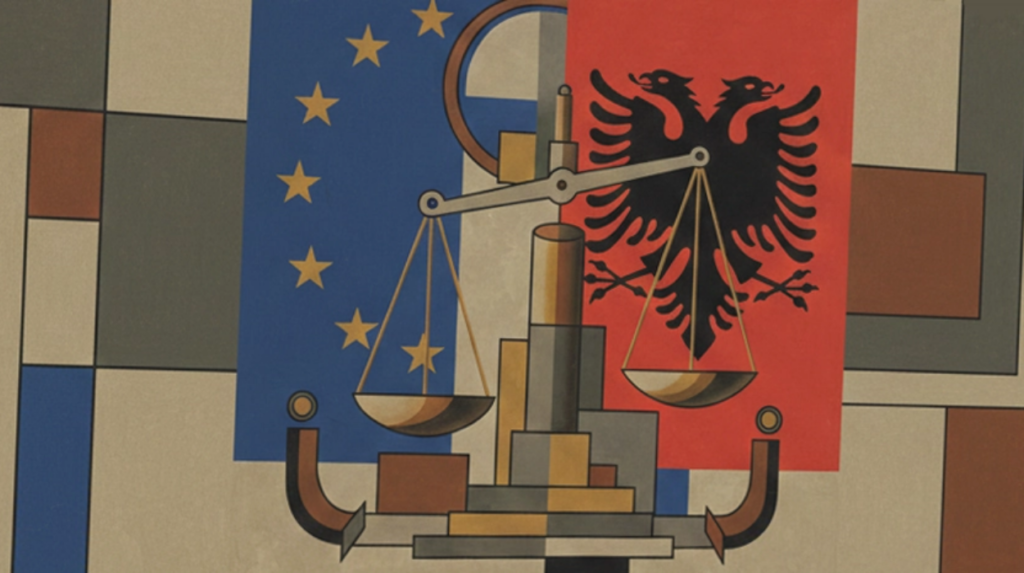
The European Union and United States intensify joint efforts to drive legal and judicial reforms in the Western Balkans amid persistent corruption and state capture, targeting countries like Albania, Montenegro, Serbia, North Macedonia, and Bosnia and Herzegovina.
Recent reports highlight mixed progress, with calls for stronger anti-corruption measures, vetting processes, and international monitoring to advance EU accession paths despite geopolitical tensions and limited political will.
Geopoliticalmonitor.com Reports on Reform Challenges
Luka Petrović of Geopolitical Monitor states in his opinion piece published on 14 January 2026 that
“Geopolitics and Corruption Collide in EU/US Legal Reform Push in the Western Balkans.”
He notes,
“The amicable relationship between the Balkans and Western partners runs deep, yet efforts for reform continue to yield little positive change. One reason for this is the prioritization of enforcement optics and crackdowns on corruption over legal safeguards.”
Petrović emphasises the collision of geopolitics and corruption, where EU and US pushes for legal reform face resistance due to entrenched interests. The article underscores that despite deep ties, positive change remains elusive as reforms prioritise visible enforcement over robust legal frameworks.
This perspective aligns with broader analyses indicating that Western Balkan states struggle with state capture, including links to organised crime at government levels.
EU Rule of Law Strategy Evolution
The EU adopted a new enlargement strategy for the Western Balkans in 2018, setting timelines such as potential 2025 accession for Serbia and Montenegro while outlining steps for Albania, Bosnia and Herzegovina, North Macedonia, Kosovo, as detailed in a PMC article. This strategy made justice system reforms central, responding to democratic backsliding concerns in Poland and Hungary.
The 2018 EU-Western Balkans strategy acknowledges
“clear elements of state capture, including links with organised crime and corruption at all levels of government and administration,”
with weak rule of law, according to Richter and Wunsch cited in the PMC analysis. The Commission pledged technical and financial support for judiciary reforms aligned with EU standards and Copenhagen criteria, focusing on anti-corruption and organised crime.
Experts argue that mere vetting, as in Albania, proves insufficient without addressing high corruption levels and semi-autocratic systems lacking political will for EU principles.
Recent European Commission Rule of Law Reports
The European Commission published rule of law reports for Albania, Montenegro, North Macedonia, and Serbia in July 2024, marking the first such inclusion for these candidates, as reported by European Western Balkans. These reports highlight a lack of effective fight against corruption alongside EU member state assessments.
European Commission notes concerns over amendments in some countries reducing maximum penalties for corruption crimes like criminal association and abuse of office, impacting statutes of limitations and procedures while removing public procurement abuse offences. Analyst Mineva assesses,
“As we have seen with the example of Hungary, Poland, Slovakia – EU membership is no guarantee that the rule of law will be upheld. Thus, stronger checks and balances are needed for non-compliant countries. Freezing the EU funds and the EU sanctions are a step in the right direction.”
She adds that building on the US Global Magnitsky Act, a targeted anti-corruption regime for the EU and neighbourhoods proves critical. In October 2024 reports, only Montenegro showed good progress in anti-corruption, with no progress in North Macedonia, per European Western Balkans.
Country-Specific Reform Progress and Hurdles
In Albania, formal reforms accelerate under Prime Minister Edi Rama, with Commission acknowledging judicial progress but stressing continued anti-corruption and rule of law action, as per DW report from 17 December 2025. Political analyst Florian Bieber cautions to DW,
“Albania is undertaking numerous formal reforms, but under a strong leader, Edi Rama, there are notable democratic deficiencies. Therefore, it remains uncertain whether Albania can close the gap and be ready alongside Montenegro.”
Serbia faces stalled constitutional reforms despite EU support boosting judicial efficiency, with the Ministry of Justice announcing a fourth draft in October 2020, per European Court of Auditors special report. The Association of Public Prosecutors and Deputy Public Prosecutors of Serbia, the Judges’ Association of Serbia, the Lawyers’ Committee for Human Rights, the Judicial Research Center, and the Belgrade Center for Human Rights stated jointly that
“the proposed amendments strengthen political influence on the judiciary.”
The Council of Europe’s Group of States against Corruption (GRECO) voiced concern about
“the rather acrimonious environment in which the consultation process has taken place.”
Montenegro leads as front-runner but fails to control corruption fully while advancing EU talks, alongside Serbia, as analysed in a Taylor & Francis study.
US Involvement and Joint Initiatives
US engagement features prominently, with the Global Magnitsky Act cited as a model for targeted sanctions, echoed in calls for transatlantic cooperation. The Atlantic Council’s issue brief on 29 October 2025 recommends prioritising anti-corruption organisations in Albania, expanding cooperation with the Special Structure against Corruption and Organized Crime (SPAK), which prosecuted high-level officials.
It suggests legal training, protective measures, and transatlantic opportunities for SPAK as a framework for North Macedonia’s procurement transparency and prosecutorial independence. Embedding EU-US twinning experts like seconded judges and auditors into Balkan institutions could identify loopholes in real-time, per Carnegie Endowment analysis from 8 December 2025.
Judicial Training and Institutional Support
The European Judicial Training Network (EJTN) supports sustainable judicial reform through the “Western Balkan II” Project 2022-2025 (Pilot Action on Judicial Training IPA/2021/425-032), as partner of the EU. This aids training to align with EU standards amid ongoing challenges.
The EU Court of Auditors recommends enhancing judicial reform support, fighting corruption and organised crime via capacity-building, extending advisory missions, systematic peer-reviews, trial monitoring for serious cases, better justice metrics, and European Endowment for Democracy aid for media and civil society.
Civil Society and Regional Anti-Corruption Efforts
SELDI’s project tackles grand corruption in Western Balkans and Turkey, improving judiciary and law-making transparency, analysing corruption cases and tailor-made laws enabling state capture. It develops reform recommendations for anti-corruption, democratic law-making, and judicial integrity.
An Aspen Institute paper proposes a transnational Anti-Corruptive Tribunal for the Western Balkans to probe corruption beyond national influence, EU asset freezes for corrupt figures, and donor focus on application-friendly laws. SELDI notes momentum from Bosnia and Herzegovina’s Reform Agenda and a 22 October 2025 UK-hosted summit, urging collective action against state capture.
Ongoing Challenges and Future Outlook
Corruption persists in procurement and appointments, with underfunded agencies, per Atlantic Council. World Bank and Freedom House indicators show stagnation in rule of law and corruption control (2005–2024). EU accession conditionality incentivises fiscal discipline and reduced corruption, but weak institutions hinder FDI and progress.
The EU’s 2018 communication acknowledged serious rule of law issues with “strong entanglement of public and private interests.” Recent geopolitical shifts, including potential UK summits and US-EU alignment, signal intensified pushes, yet semi-autocratic traits and political interference persist.
Western Balkans must demonstrate indictments of corrupt officials as good faith for Copenhagen criteria, indicating EU intolerance for judicial meddling. Comprehensive coverage from these sources reveals a multifaceted push where EU technical aid, US sanctions models, and civil society advocacy converge against deep-rooted corruption networks.