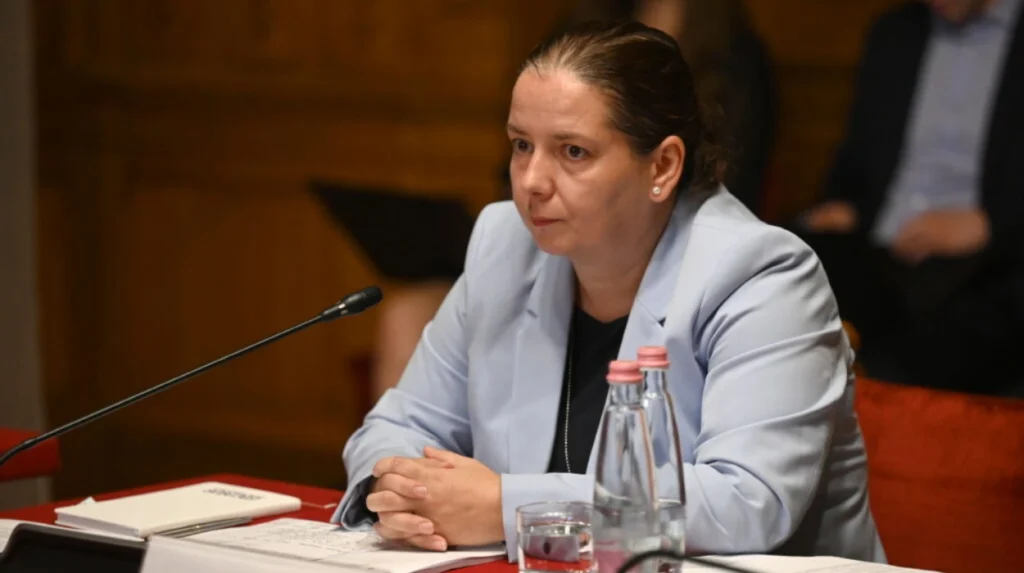
Hungary’s parliament has elected political scientist Anna Róza Unger as president of the newly created National Asset Recovery and Protection Office (NVVH), granting it sweeping powers to investigate, prosecute and recover misused public funds. The move, hailed by Prime Minister Péter Magyar as central to “Operation Purgatory”, has drawn sharp criticism from opposition parties and some experts over the selection process, Unger’s non-legal background and the authority’s broad, minimally checked powers.
Hungary’s parliament on Friday, 28 August 2026, elected political scientist Anna Róza Unger as the first president of the National Asset Recovery and Protection Office (NVVH), a new super-agency with unprecedented investigative and prosecutorial powers to trace, secure and recover public assets allegedly removed unlawfully, while the selection process, Unger’s professional background and the office’s wide-ranging authority have sparked fierce political and expert debate over risks of politicisation and insufficient judicial safeguards.
The election and leadership team
As reported by multiple outlets including Euronews, Telex, and Xinhua, Hungary’s National Assembly held a secret ballot on Friday to choose the head of the NVVH, with Anna Róza Unger receiving 137 votes in favour, seven against and one abstention, comfortably clearing the two‑thirds majority threshold required for election. The institution’s deputy head, Katalin Tasnádi, was appointed as deputy president in charge of investigations, and the office will be run by a five‑member leadership, with three further deputy chairs still being sought after earlier applications were declared invalid.
Unger’s six‑year term is due to begin on 1 September 2026, and she will lead an agency that reports to parliament rather than the executive. In a Facebook post cited by Portfolio, Unger stressed that the NVVH’s success would depend on public trust, professional expertise and “uncompromising commitment” against corruption, and she publicly invited Miklós Ligeti, one of the other shortlisted candidates, to cooperate with the new office.
Mandate and powers of the NVVH
The NVVH was established by legislation passed in July by the governing centrist‑liberal Tisza Party, which won April’s election with a two‑thirds parliamentary majority, ending Viktor Orbán’s 16‑year rule, and Prime Minister Péter Magyar has presented the office as a central element of his anti‑corruption campaign dubbed “Operation Purgatory”. As reported by Euronews, the authority’s task is to track down, secure and, where possible, recover money and other assets that have unlawfully been removed from public ownership, but its powers extend far beyond asset recovery.
The NVVH can examine state and municipal decisions, public procurement procedures, concessions, subsidies, EU funds, state‑owned enterprises, chains of contracts, financial flows and the real beneficial owners behind them. It will not simply be a supervisory or advisory body: it can conduct its own investigations and preliminary proceedings, request and cross‑match data, initiate action by other authorities, and in the case of certain corruption offences and crimes involving public assets it will be able to carry out investigations itself.
Crucially, the office may also take over cases that are still pending before an indictment is brought, if it considers that this would allow the state’s criminal or financial claims to be asserted more effectively. In such cases it can step into the shoes of the prosecution service, bring charges and then represent the case as public prosecutor before the court, meaning that, after a recent amendment of the Fundamental Law, the Prosecutor General’s Office has lost its previous monopoly on acting as public prosecutor. The institution will be able to use administrative, criminal‑law and civil‑law instruments in parallel, a feature described by Euronews as the source of both its strength and of main rule‑of‑law concerns.
Selection process and competing candidates
The selection process for the NVVH leadership sparked fierce debate even before the parliamentary vote. As reported by Euronews, parliament’s Committee on Justice and Constitutional Affairs heard three of the 96 original candidates during the week: Anna Róza Unger, a political scientist and lecturer at Eötvös Loránd University (ELTE); lawyer Miklós Ligeti, legal director of Transparency International Hungary; and Nicholas Sárvári, a Canadian‑Hungarian businessman who runs a company specialising in international asset recovery and crisis management.
At the committee hearing, Unger warned that it would be unrealistic to expect final judgments in all major corruption cases within six years, and in her programme she spoke not only about uncovering individual cases but also about dismantling the institutional and political system that makes corruption possible. The committee eventually recommended Anna Unger to the National Assembly, with six MPs supporting her nomination, one opposing and one abstaining, while Miklós Ligeti received four votes in favour and four abstentions, and Nicholas Sárvári did not receive sufficient support.
Critics of the nomination procedure objected that while the committee had already selected three candidates to go through to the next round, the Tisza parliamentary group later put forward Nicholas Sárvári as a separate nominee, raising questions about whether he was competing on the same terms as the other participants in the open call. Many considered Miklós Ligeti to be the most qualified and experienced of the candidates, and therefore described the choice of Unger as outrageous and worrying, while supporters argue that the president’s primary task will not be to lead individual investigations but to build and provide strategic direction for an independent institution that brings together different areas of expertise.
Political reactions and rule‑of‑law concerns
Opposition parties and some commentators have voiced strong concerns about the NVVH’s design and leadership. As reported by The European Conservative, conservatives fear that the government’s “anti‑corruption” drive could become a tool for political retaliation, with the opposition arguing that the legislation grants the NVVH unusually extensive powers with insufficient judicial safeguards. They have compared it to the ÁVH, the political police of Hungary’s communist era, warning that its powers could affect a large number of citizens and businesses that have received state or EU funding.
MPs from Fidesz and the Mi Hazánk party did not take part in the committee’s decision, and according to Fidesz, the NVVH has been given excessively broad investigative, prosecutorial and information‑gathering powers without adequate external checks, and the authority could therefore easily become a tool for political score‑settling. The party has also initiated a constitutional court review of the legislation establishing the office.
Supporters of the new government counter that the NVVH, together with Hungary’s decision to join the European Public Prosecutor’s Office, is intended to signal that the new administration not only wants to protect future EU funds but also intends to track down and recover public money that was previously spent unlawfully. As reported by Euronews, setting up the NVVH was not, in itself, a precondition laid down in law for the release of EU funds, but there is nonetheless a close political and trust‑related link between the two issues, as Brussels withheld a significant share of the money due to Hungary because it did not consider corruption prevention, the monitoring of EU subsidies and the consistent investigation of irregularities to be sufficiently guaranteed.
Implementation challenges and expectations
Prime Minister Péter Magyar has stressed that the government plans to speed up and shorten criminal proceedings in order to prevent delaying tactics and impunity, but experts caution that the success of the new authority will not be determined by how many high‑profile proceedings it launches. As reported by Euronews, the key test will be whether its investigations lead to indictments that stand up in court, final judgments and assets actually recovered, noting that part of the money may be hidden in foreign bank accounts, complex corporate networks, real estate or ownership structures that are hard to identify, and recovering it may require lengthy international legal proceedings.
Unger herself has warned against expecting mass convictions within her six‑year term, arguing in her committee hearing that the NVVH’s success should be judged more by system‑wide exposure of corruption networks and the building of institutional expertise than by the number of final judgments. In her Facebook statement cited by Portfolio, she underlined that accountability must not become “political revenge” and called for cooperation across professional lines, including with Ligeti, to ensure the office’s work is seen as credible and technically sound.