European Parliament lawmakers have declared that Serbia’s EU accession process is effectively stalled until Belgrade delivers credible rule of law, anti-corruption, media freedom and judicial reforms. The adopted 2025 report, backed by 468 votes, couples this warning with criticism of Serbia’s foreign policy alignment and a demand for measurable, sustained progress before negotiations advance.
Serbia’s EU path freezes over democratic backsliding
Members of the European Parliament (MEPs) have issued a stark message to Belgrade: there will be no European Union future for Serbia without comprehensive and implemented rule of law reforms. The warning comes as the European Parliament adopted its 2025 report on Serbia, which concludes that the country’s accession process has “effectively stalled” due to democratic backsliding, weakened institutions and a failure to align with EU foreign policy.
Report adoption and vote outcome
The report was adopted during the Strasbourg plenary session with 468 votes in favour, 116 against and 79 abstentions, according to coverage by ANSA and European Interest. The text underscores that progress towards EU membership “entails not only the adoption of reforms, but also their full implementation”, highlighting a persistent gap between Serbia’s legislative alignment on paper and actual delivery in practice.
Rapporteur’s assessment: accession process stalled
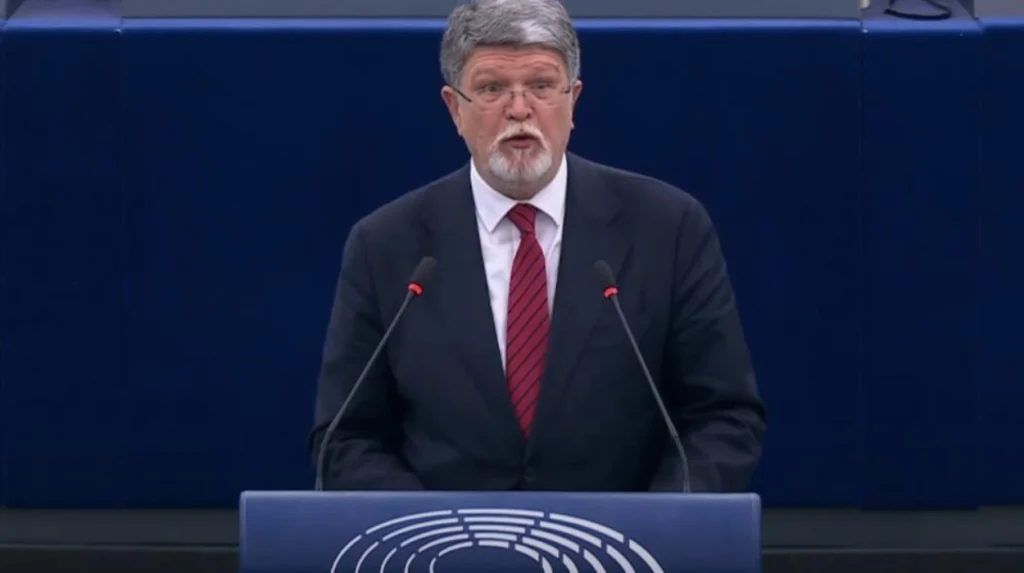
Tonino Picula (S&D, Croatia), the European Parliament’s rapporteur on Serbia, delivered a blunt assessment of the situation. As reported by European Interest, Picula stated:
“My report concludes that Serbia’s EU accession process has effectively stalled, due to democratic backsliding, weakened rule of law, failure to implement key reforms and lack of alignment with EU foreign policy.”
He added that the report “concludes that Serbia’s EU accession process has effectively stalled”, reiterating that mere formal alignment is insufficient without tangible results.
Conditions for advancing accession talks
MEPs made clear that any further movement in Serbia’s EU accession negotiations must be conditional on demonstrable and sustainable progress in core areas. As European Interest reported, MEPs argued that discussions should proceed “only upon demonstrable and sustainable progress in critical areas, including the rule of law, free and fair elections, the combat against corruption and organised crime, judicial independence, media freedom, public administration reform, and the enhanced functionality of democratic institutions.” ANSA similarly quoted the report’s emphasis that
“Serbia’s accession talks should begin only after measurable and sustainable progress has been made in areas such as the rule of law, free elections, and the fight against corruption.”
Rule of law, media freedom and public administration concerns
The European Parliament’s standpoints on Serbia’s reforms have consistently flagged rule of law and media freedom as central bottlenecks. A European Parliament press release noted that, while acknowledging Serbia’s
“good level of preparation with regard to macroeconomic stability and fiscal discipline”,
MEPs expressed concern over
“limited or no overall progress in meeting the criteria for EU membership in critical areas such as the rule of law, media freedom, public administration reform, and alignment with EU policies, in particular on EU foreign policy.”
Tonino Picula was quoted saying that
“a long political crisis, intensified by a lack of progress on fundamental criteria such as corruption, the rule of law, media freedom and electoral reform, is having a direct impact on Serbia’s progress towards EU membership.”
Foreign policy alignment and ties with China and Russia
Beyond domestic reforms, the report also scrutinises Belgrade’s external alignments. ANSA reported that the Parliament stated:
“Concerns also surround Belgrade’s relations with China and Russia,”
reflecting ongoing unease over Serbia’s deviation from the EU’s Common Foreign and Security Policy. This point reinforces the rapporteur’s criticism about the “lack of alignment with EU foreign policy” as a key factor in the stalled process.
Serbian government’s stated goals versus actions
The report draws a sharp contrast between official rhetoric and observable conduct. As ANSA quoted:
“The Serbian government continues to claim that EU accession is its strategic goal, but this ‘objective’ is frequently not reflected in its actions.”
This formulation captures the core complaint from Brussels: that strategic declarations are not matched by consistent policy implementation, particularly in judiciary reform, anti-corruption enforcement and media protection.
Earlier parliamentary delegation visit and non-negotiable standards
The Strasbourg vote follows earlier on-the-ground engagement by MEPs. In late January 2026, a nine-member delegation from the European Parliament’s Committee on Foreign Affairs (AFET), led by Marta Temido (S&D), visited Belgrade and stressed that “respect for democracy, the rule of law and open dialogue is essential for Serbia’s European future.” European Western Balkans reported that the delegation underlined that “full respect for democracy, the rule of law and fundamental rights is non-negotiable,” and that restoring citizens’ trust requires “democratic and electoral reforms, accountability, and freedom of expression and media.” The delegation also reiterated that the EU remains ready to support Serbia “provided that political commitments result in measurable and sustainable progress, especially in the area of the rule of law.”
Technical progress amid political constraints
Even as political and institutional hurdles dominate the debate, some technical alignment has continued. Serbia Business reported that in the first half of 2026, Serbia’s legal-reform environment “moved on two tracks,” with continued technical alignment in financial, payments, energy-market and administrative frameworks, while the broader accession process remained
“constrained by rule-of-law concerns, judicial independence, media freedom, electoral reform and the Kosovo normalisation condition.”
This duality underscores the Parliament’s point that macroeconomic and sectoral preparation cannot substitute for fundamental democratic standards.europarl.
Implications for enlargement policy and credibility
The strongly worded report and the clear voting arithmetic signal a hardening of the European Parliament’s stance on enlargement conditionality. By tying the opening and advancement of accession talks to implemented reforms rather than legislative transposition alone, MEPs are effectively raising the credibility threshold for Belgrade. The message to other Western Balkan candidates is equally clear: EU integration is not a technical checklist but a political process anchored in rule of law, independent courts, free media and consistent foreign policy alignment.europarl.
What Belgrade must deliver next
For Serbia to revive its EU trajectory, the path laid out by the European Parliament is explicit. Authorities must show measurable gains in tackling corruption and organised crime, ensure judicial independence and protect media freedom, carry out credible electoral reforms, and improve public administration. Equally, they must demonstrate sustained alignment with EU foreign policy positions and reduce the political space for democratic backsliding. Until these conditions are met, the European Parliament’s position is that Serbia’s EU future remains on hold.