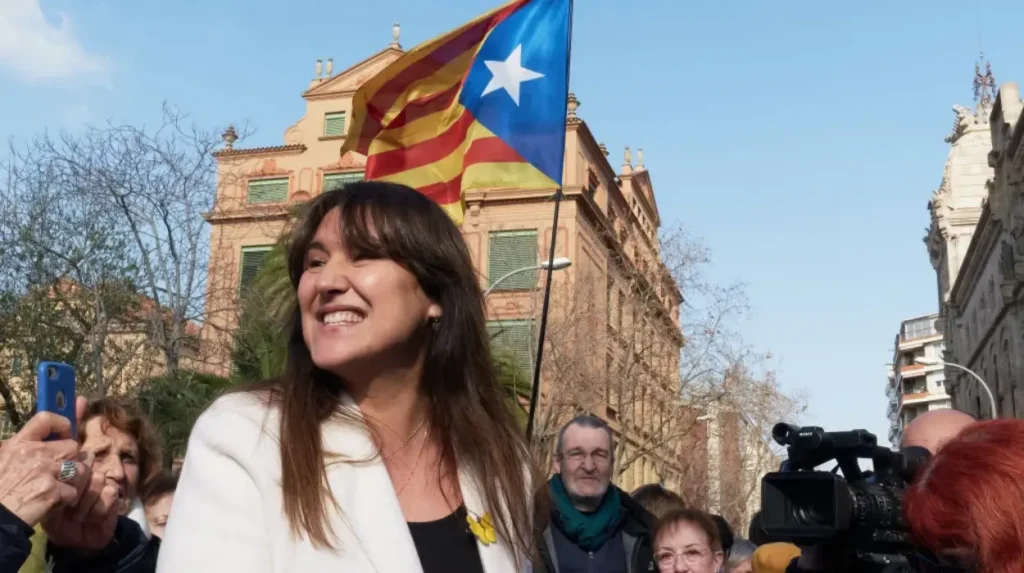
Spain’s government has granted a partial pardon to former Catalan parliament president Laura Borràs, reducing her corruption sentence to two years and sparing her from prison, while the fine and ban from public office remain in place. The decision has ignited fierce criticism from opposition parties and prosecutors, who argue the move undermines judicial independence and blurs the line between political amnesty and ordinary corruption.
Spanish Government Grants Partial Pardon to Laura Borràs
Madrid — In a controversial decision approved on 28 July at the final Council of Ministers meeting before the summer recess, Spain’s Socialist government has issued a partial pardon to Laura Borràs, the former president of the Catalan parliament and a leading figure in the pro-independence Junts party. As reported by Antonio O’Mullony of Brussels Signal, the Ministry of the Presidency, Justice and Relations with the Cortes confirmed that Borràs’s original sentence of four years, six months and one day was reduced to two years, effectively sparing her from prison under Spanish law, which permits suspension of sentences of two years or less for first-time offenders.
The pardon, however, leaves intact the €36,000 fine and a 13-year ban from holding public office imposed by the High Court of Justice of Catalonia (TSJC) in March 2023. The court had convicted Borràs of prevarication (abuse of public office) and forgery of official documents, finding that she had fragmented public contracts to award them directly to an acquaintance, an IT contractor, while directing the Institució de les Lletres Catalanes between 2013 and 2018. The Supreme Court upheld this ruling in February 2025, rejecting arguments that the case was politically motivated.
Legal Basis and Judicial Objections
The government’s decision was made under article 4.3 of the Spanish criminal code, following a recommendation from the TSJC, which described the prison term as “disproportionate and excessive” and suggested that the ban and fine were sufficient punishment. However, the pardon was granted despite objections from Catalonia’s chief prosecutor’s office, which argued that Borràs had shown no acceptance of her conduct and no intention to avoid reoffending.
Borràs responded on X (formerly Twitter), stating that the government had decided she would not go to prison while maintaining her 13-year ban from elected office. She added that the ordeal would not end until a court declared the case an injustice. Jordi Turull, secretary general of Junts, said the decision
“does not repair the harm already done”,
accusing the judiciary of partisanship. Carles Puigdemont, the party president living in exile since the 2017 independence referendum, welcomed the outcome as a relief but insisted the prosecution had always been political. Sources close to him told El Español that the gesture would not repair relations with Prime Minister Pedro Sánchez.
Broader Context: Amnesty Law and Political Fallout
The pardon comes against the backdrop of Spain’s contentious amnesty law, enacted in 2024 to erase criminal consequences for those involved in the 2017 Catalan secession attempt. The law, which was upheld by Spain’s Constitutional Court in June 2025 and by the Court of Justice of the European Union on 16 July 2026, was a condition of Junts’s support for Sánchez’s return to power in November 2023. However, Borràs’s case was not covered by the amnesty, as the Supreme Court and prosecutors ruled that her actions constituted ordinary graft unrelated to the independence movement.
Junts announced a break with the government in October 2025 and, in June, joined the People’s Party (PP), Vox and the Navarrese People’s Union in a motion urging Sánchez to resign. The vote had no practical effect, as Junts has declined to back a censure motion that could remove him. The PP remains four votes short of a majority for such a motion, while Junts holds seven.
Other Pardons Granted on Same Day
The Council of Ministers also approved pardons for four other individuals on 28 July. As detailed by O’Mullony, these included Natalio Grueso, a cultural manager sentenced to eight years for embezzlement, forgery and corporate offences tied to his running of the Niemeyer Centre in Avilés, whose term was cancelled on humanitarian grounds relating to his health. Juan Fernández Gutiérrez, the Socialist former mayor of Linares in Jaén province, convicted of embezzling public money, had his three-year term reduced to two. Two private citizens convicted of public health offences also had their terms of three and four-and-a-half years cut to two.
Opposition and Legal Criticism
The decision has drawn sharp criticism from opposition parties and legal figures. Jorge Buxadé, who leads Vox’s delegation in Brussels, called the amnesty
“the greatest attack on the rule of law and national unity”,
promising to repeal it in government and accusing the Constitutional Court of being politicised. The Supreme Court continues to refuse amnesty to those convicted or charged with embezzlement, including Puigdemont, holding that the law excludes cases of personal gain. The Constitutional Court is scheduled to take up Turull’s appeal on that point on 22 September.
Sánchez has governed without a budget since 2023 and survives because no majority will vote him out. In June, the Supreme Court sentenced former transport minister José Luis Ábalos, once his organisation secretary at the Spanish Socialist Workers’ Party (PSOE), to more than 24 years in prison. Five weeks later, his government cancelled the prison terms of three more people convicted of taking public money, two of them from Socialist ranks and one from the party that keeps him in office.
International and EU Dimensions
The Court of Justice of the European Union’s ruling on 16 July 2026 that the amnesty did not conflict with EU law, since no European funds were involved, answered two narrow questions referred by Spanish courts. The judgment examined neither the law’s constitutionality nor the propriety of writing an amnesty into a governing pact. The decision has been hailed as a major victory for Catalan leaders who had been blocked from benefiting from the amnesty, although it does not affect Puigdemont’s indictment in the Supreme Court.