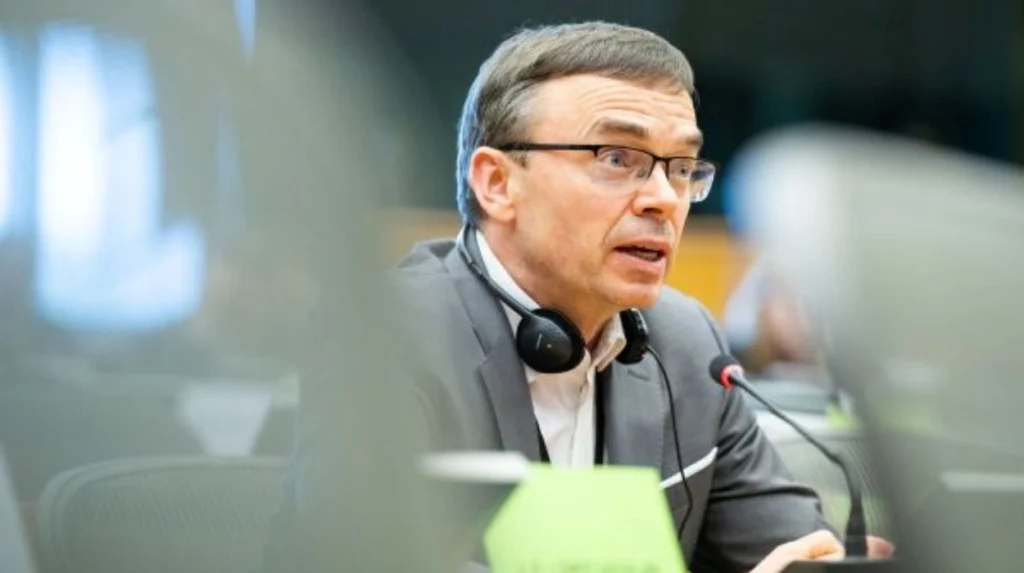
European Interest, in a report by an unnamed journalist, reported that Estonian Member of the European Parliament (MEP) Sven Mikser has reaffirmed his support for Moldova’s European Union accession process following a working visit to Chișinău and Bălți. The trip, which took place in early April 2026, coincided with heightened international attention on Moldova’s reform agenda and security challenges linked to Russia’s war against Ukraine.
Mikser’s meetings with Moldovan leaders
As reported by MOLDPRES journalist Lilia Popovici, Deputy Prime Minister and Foreign Affairs Minister Mihai Popsoi met MEP Sven Mikser, the European Parliament’s standing rapporteur for Moldova in the Committee on Foreign Affairs (AFET), during the Estonian legislator’s visit to the Moldovan capital. The officials discussed the latest developments in Moldova’s EU accession process, priority reforms, and the need to maximise European Union support.
In that encounter, Popsoi underlined that support from European institutions increases Moldova’s accountability to continue reforms and deliver tangible results for citizens. He told Mikser,
“Despite the security and economic challenges generated by Russia’s war against Ukraine, we stay committed to advancing on the path towards EU accession, based on our own merits,”
according to MOLDPRES.
Strengthening EU–Moldova institutional cooperation
Mikser, as reported by the same outlet, commended the progress Moldova has made so far and highlighted the importance of the European Parliament’s local office inaugurated in Chișinău in November 2025. MOLDPRES quoted Mikser as saying the office helps strengthen interinstitutional dialogue and supports Moldovan authorities in aligning the country more closely with EU standards.
The meeting also touched on the renewed Memorandum of Understanding between Moldova and the European Parliament, which Popsoi’s ministry noted facilitates strengthened institutional capacities and brings the Moldovan legislature closer to EU requirements. The Foreign Affairs Minister thanked the European Parliament for its backing, including through the Growth Plan for Moldova – a 1.9 billion‑euro package described as the largest financial assistance ever granted by the EU to the country.
Mikser’s long‑standing backing of Moldova’s EU ambitions
Mikser’s comments in Chisinau are consistent with his broader role in Brussels. In June 2025, European Interest, citing a European Parliament resolution, noted that MEPs adopted a report by 456 votes in favour, 118 against and 51 abstentions, which praised Moldova’s “steadfast commitment” to advancing EU membership. The report, drafted under Mikser’s rapporteurship, recognised that EU–Moldova relations have entered “a new and constructive phase” marked by enhanced cooperation and legislative alignment with the EU acquis.
In that context, the European Parliament’s news service quoted Mikser as stating that
“Moldova’s strong commitment to EU integration and its strategic importance for Europe”
are clear, and he praised the authorities’ determination to pursue reforms despite major challenges and external pressure from Russia and its proxies. The resolution also encouraged the European Commission to step up political and financial support for Moldova’s accession efforts.
EU funding and support mechanisms
Earlier, in March 2025, the European Parliament’s official press office reported that MEPs, including Mikser as co‑rapporteur for AFET, approved a new support plan for Moldova focusing on better‑financed, clearly‑defined reforms. The plan, which the European Parliament named the “Support Facility for Moldova,” includes 520 million euros in non‑repayable aid, with grant components raised to 20.5 per cent and pre‑financing elevated to 18 per cent.
In a statement reproduced by the Parliament’s press service, Mikser said the facility demonstrated “our dedication to Moldova’s EU accession by providing crucial support for essential reforms.” He added that the funding would help Moldova strengthen democratic institutions, improve energy security, stimulate economic growth and enhance citizens’ wellbeing.
Joint declaration by seven European delegations
Mikser’s latest visit to Moldova followed a broader push by European legislators to sustain Moldova’s European trajectory. In late March 2026, Moldova‑1, a Moldovan news outlet, covered a joint declaration signed in Chisinau by seven European delegations coming from Estonia, Latvia, Lithuania, Sweden, Finland, Poland and Germany.
As reported by Moldova‑1, the delegation, led by the Estonian parliamentarian, signed a document in Chișinău that reaffirms
“strong support for the European path of the Republic of Moldova”
and praises the country’s resilience under external pressures. The Estonian parliamentarian, identified as Mikser, stated,
“We see a very strong commitment from you. I mentioned that your citizens, in three electoral exercises, despite Russian interference, chose to keep the European path. This is the will of your country, the will of your citizens.”
The same source noted that Estonia fully supports Moldova’s European integration and expressed willingness to share Estonia’s own reform and digital‑governance experience with Moldovan counterparts. The visit by the seven‑state delegations was organised at the invitation of Marcel Spatarî, chairman of Moldova’s Committee for European Integration, according to Moldova‑1.
Security, reform and external interference
During Mikser’s April 2026 visit, discussions also extended to the regional security situation, including joint efforts to strengthen stability and peace on the continent, as MOLDPRES reported. The outlet highlighted that both sides underlined the importance of continuing reforms in the rule‑of‑law field and resisting external attempts to destabilise Moldova’s pro‑European course.
In the broader European Parliament resolution of June 2025 on Moldova’s EU progress, MEPs noted that Russian hybrid interference has been systematically directed at Moldovan democratic processes, including the constitutional referendum and the 2024 presidential election. Despite these campaigns, the report concluded that the referendum and election were conducted “professionally” and reflected “an extraordinary sense of duty and dedication” by Moldovan voters and institutions.
Regional and domestic context ahead of key elections
The upcoming Moldovan parliamentary elections in autumn 2025 were also flagged in the European Parliament report as crucial for the continuity of the country’s pro‑European trajectory. MEPs warned that foreign, primarily Russian, malign interference and hybrid attacks are likely to intensify in advance of those polls, underscoring the need for robust safeguards and international support.
Within this frame, Mikser’s recurring emphasis on Moldova’s “strategic importance for Europe,” as relayed by the European Parliament’s press service in 2025, dovetails with his more recent on‑the‑ground engagement in Chisinau and Bălți. His reaffirmation of support in April 2026, communicated via the European Parliament’s Foreign Affairs Committee’s social‑media channels, signals ongoing high‑level political backing for Moldova’s reform and accession agenda.
Mikser’s historical ties and bilateral focus
MOLDPRES, in a separate background piece, recalled that Mikser first visited Moldova in 2017 as Estonia’s Foreign Minister, when he met then‑Prime Minister Pavel Filip and discussed bilateral cooperation in areas such as healthcare, justice and electronic government. At that time, he reportedly stressed that
“it is very important to be involved in implementing reforms and continuing Moldova’s European integration,”
and he described bilateral relations between Moldova and Estonia as a priority.
This early engagement laid the groundwork for his later role as rapporteur and co‑rapporteur on Moldova at the European Parliament, a position that has allowed him to shape resolutions and funding instruments while maintaining direct contact with Moldovan institutions.
Taken together, the statements and actions described by European Interest, MOLDPRES, Moldova‑1, the European Parliament’s press office and the 2025 resolution highlight a clear pattern: Mikser continues to act as a prominent advocate for Moldova’s EU path from within the European Parliament. His recent visit to Chisinau and Bălți, and the accompanying public reaffirmations of support, are framed as part of a broader effort by European legislators and institutions to ensure that Moldova’s reforms, democratic resilience and security receive sustained political and financial backing.
For now, Moldovan officials and EU lawmakers, including Mikser, are focused on maintaining public and institutional momentum for the European integration process, even as the country navigates economic strain and external pressure related to the war in neighbouring Ukraine.