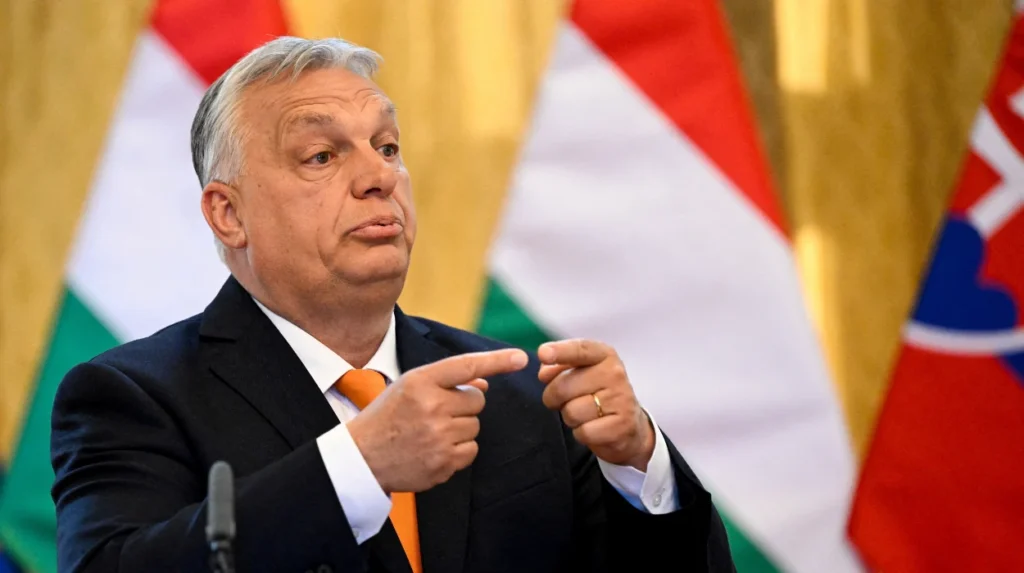
Hungarian prime minister Viktor Orbán has intensified his criticism of European Union institutions, accusing Brussels of systemic corruption, weak oversight of Ukraine funding and politically driven sanctions on Russian energy. He has warned that Hungary will challenge any attempt to extend sanctions to Russian gas and oil without unanimous approval, and continues to question large‑scale EU financial support and accession prospects for Ukraine.
Hungarian leader escalates confrontation with EU institutions over corruption, sanctions and Ukraine aid
Hungarian prime minister Viktor Orbán has sharply escalated his long‑running confrontation with European Union institutions, accusing senior figures in Brussels of presiding over what he describes as pervasive corruption while pressing member states to deepen sanctions on Russian energy and increase long‑term financial commitments to Ukraine.
His latest remarks, delivered in a radio interview, social media statements and recent public appearances, combine warnings of possible legal action against the EU over energy sanctions with renewed criticism of oversight and conditionality attached to Ukraine funding and accession talks.
Orbán’s corruption allegations against EU leadership
In coverage by Benzinga, journalist content notes that Viktor Orbán claimed in a post on X that the European Union is “drowning in corruption”, alleging that commissioners face serious accusations and that both the European Commission and the European Parliament are affected by scandals while still, in his view, asserting moral authority over member states.
According to the same Benzinga report, Orbán argued that Brussels and Kyiv are “shielding each other instead of confronting the truth” on corruption, framing this as a central reason for Hungary’s resistance to deeper integration with Ukraine and to unconditional financial packages.
Reporting by Al Jazeera has previously highlighted that Brussels has frozen or delayed billions of euros in funds earmarked for Hungary amid concerns over rule of law, judicial independence and misuse of EU money, a linkage Orbán rejects.
In that context, Al Jazeera’s coverage notes that the Hungarian prime minister has denied that his opposition to opening formal EU membership talks with Ukraine is linked to these frozen funds, insisting that Budapest will “not accept” pressure to change its position in exchange for financial concessions.
Criticism of oversight of Ukraine funding
As reported by the Benzinga political desk, Orbán used his latest interventions to question the governance and transparency of EU financial support for Kyiv, arguing that both Ukrainian institutions and EU mechanisms lack adequate safeguards against misappropriation.
The Benzinga article explains that Orbán portrays current arrangements as mutually protective, alleging that EU leaders and Ukraine’s government “shield each other” from confronting corruption allegations related to the war and reconstruction funding.
Television coverage from India‑based channel Mirror Now, in a segment carried on its digital platforms, records Orbán’s claim that Brussels is sending “billions” to Ukraine “with no real oversight” as fresh corruption cases emerge in Kyiv.
In that broadcast, Mirror Now’s transcript shows that Orbán argued Ukraine is not ready for EU membership and warned that European support for the war effort is unsustainable without backing from the United States, calling for a peace initiative aligned with the approach of U.S. president Donald Trump.
Objections to expanded Ukraine aid and long‑term commitments
In a report by Yeni Şafak, journalist coverage describes Orbán’s reaction to a letter from European Commission president Ursula von der Leyen asking member states to increase financial contributions to Ukraine to cover what was described as a significant funding gap.
According to that account, Orbán said he found the request “astonishing” and likened sending additional funds without what he views as stronger conditionality to trying to help “an alcoholic by sending them another crate of vodka”, an analogy he used to underline Hungary’s opposition to further large‑scale commitments without tighter controls.
The Yeni Şafak article also summarises Orbán’s charge that previous tranches of European taxpayer money have not been subject to the type of “real oversight” he is demanding, and reports his reference to allegations that what he called a “war mafia” is diverting resources. In the same coverage, Hungary’s prime minister is quoted as saying that his country “has not lost its common sense”, framing Budapest’s stance as a defence of fiscal prudence rather than a geopolitical shift away from Ukraine.
Threat to sue EU over Russian gas and oil sanctions
Benzinga’s political report notes that Orbán warned during an interview with Hungary’s public Kossuth Radio that his government will sue “Brussels” if the EU moves to impose or extend sanctions on Russian gas and oil without unanimous consent from all member states.
In that coverage, Orbán described any attempt to use qualified majority voting or other mechanisms to bypass Hungary’s veto on energy sanctions as, in his words, an “open violation of the law”, indicating that Budapest would challenge such a move in European courts.
Reporting by Deutsche Welle earlier this year has outlined that the EU currently requires unanimity to extend many of its sanctions on Russia and highlighted that Hungary has positioned itself as a sceptical voice regarding additional restrictions on Russian energy.
DW’s analysis explains that more than 80 percent of Hungary’s gas and oil supply comes from Russia and that the country continues to import gas through the TurkStream pipeline via the Balkans, a dependence Orbán cites when warning that stronger sanctions could significantly raise domestic energy prices.
Concerns over energy security and household costs
According to Benzinga’s summary of the Kossuth Radio interview, Orbán stressed that without continued Russian energy imports, Hungarian households would face sharply higher bills and the country’s energy security would be at risk.
He linked this argument to his broader criticism of EU climate and energy policies, suggesting that sudden shifts away from Russian supplies could harm central and eastern European economies more than those of wealthier western member states.
The Deutsche Welle report notes that Orbán has claimed EU sanctions on Russia have already cost Hungary around 19 billion euros over several years, a figure he sets against the country’s annual tax revenues to argue that the economic burden on Budapest is excessive.
In that piece, DW records that Orbán has also blamed both Kyiv and Brussels for what he characterises as economic difficulties in Hungary, including higher inflation and energy prices, assertions that are contested by EU officials and some economists.
Legal dispute over frozen Russian assets and Ukraine funding
The Benzinga article reports that Orbán has raised concerns about EU plans to use profits or proceeds from roughly 200 billion euros in frozen Russian central bank assets, much of which is held in Belgium, to finance Ukraine’s war effort and reconstruction.
He warned that Belgium could face what he called severe financial consequences if a future international court decides in Russia’s favour and orders compensation, portraying this as an example of what he sees as legal and financial risks in current EU strategy.
A detailed report by Euronews describes how Hungary has taken legal action at the Court of Justice of the European Union over the use of frozen Russian assets to fund military assistance to Ukraine through the European Peace Facility (EPF).
Euronews notes that Hungary filed a complaint arguing that EPF decisions ignored its veto by treating Budapest as a non‑contributing member state for the relevant measures, and that the court formally acknowledged the case, signalling a protracted legal battle over the scope of EU foreign policy instruments.
Position on Ukraine’s EU membership and accession process
Coverage by Al Jazeera from late 2023 records Orbán’s position that negotiations on Ukraine’s future EU membership should not advance at that stage, arguing that the country did not meet the political and economic criteria required for accession.
In that reporting, he referred to Ukraine as “one of the most corrupt” countries and maintained that opening membership talks would send the wrong signal while conflict continued, saying his government would not accept linkage between accession decisions and the release of frozen EU funds for Hungary.
The Mirror Now broadcast further reflects this stance, with its transcript noting Orbán’s assertion that Ukraine’s failure to meet “basic standards” disqualifies it from accession in the near term. The channel’s segment summarises his view that the corruption issue should concern “every European taxpayer”, particularly at a time when the overall financial cost of the war is climbing and when, he argues, U.S. engagement remains a decisive factor in sustaining Ukraine’s defence.
Calls for a renewed peace initiative and role of the United States
According to Benzinga’s political coverage, Orbán has framed the coming period as decisive for Europe, stating that EU leaders are “driving conflict” without, in his view, having a clear mandate from citizens for a prolonged confrontation.
In the same report, he contrasted what he described as active negotiations between the United States and Russia with what he characterised as a more marginalised role for European actors, commenting that “those with strength act; those without it talk”.
Mirror Now’s transcript indicates that Orbán has called for the EU to support a peace initiative he presents as aligned with the diplomatic approach of U.S. president Donald Trump, including the idea of a potential U.S.–Russia summit.
Benzinga’s article notes that Orbán has promoted the concept of a U.S.–Russia peace summit in Budapest in October, positioned as an opportunity to bring the sides together on neutral ground, though no such meeting has been formally confirmed by Washington or Moscow.
Hungary’s broader disputes with EU over rule of law and funding
In background reporting, Al Jazeera recounts that Hungary has been locked in a long‑running dispute with EU institutions over rule‑of‑law issues, including concerns about the independence of the judiciary, media pluralism and protections for civil society.
Those concerns have led Brussels to withhold or delay access to several funding streams, including cohesion funds and recovery money, with the Commission seeking reforms in Budapest in areas such as public procurement and anti‑corruption safeguards.
Reuters has reported in earlier coverage that international watchdogs and some EU officials allege Orbán’s government has used EU funds to benefit political allies and consolidate domestic power, allegations Hungary rejects. According to that analysis, Orbán maintains that Hungary is no more corrupt than many other EU member states and portrays the Commission’s use of conditionality as a political tool rather than a neutral mechanism for upholding common standards.