
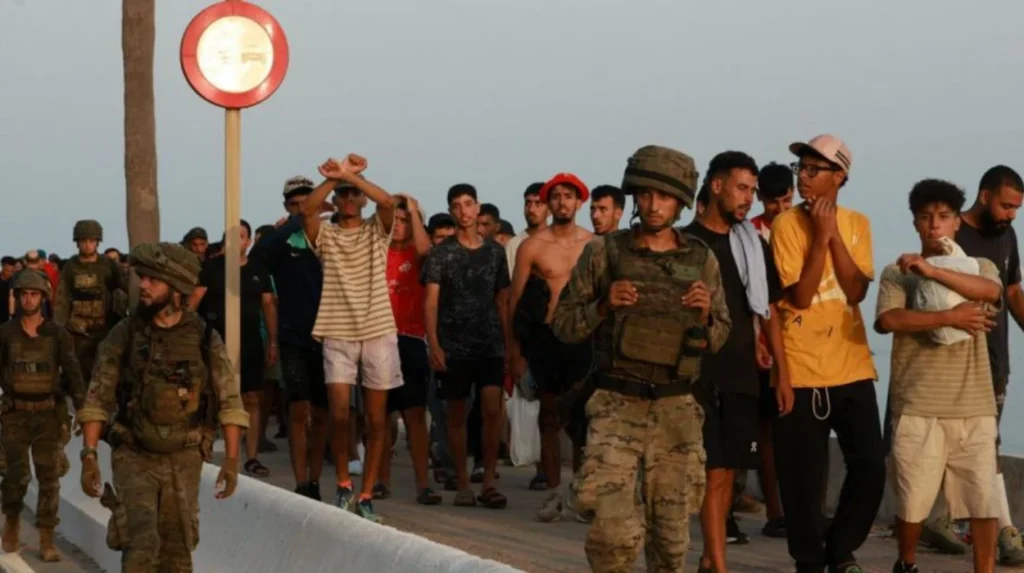
Podemos MEPs Irene Montero and Isa Serra have formally requested urgent European Commission intervention in Ceuta, accusing the Spanish government of negligent management of the migrant crisis and failing to protect human rights amid rising racist attacks and violence in the North African enclave.
The Letter to Brussels
Podemos MEPs Irene Montero and Isa Serra have sent a letter to the European Commission requesting “urgent” action in response to the crisis facing Ceuta, the “negligent” management of the Spanish government, and recent “racist attacks” against migrants.
In the letter, addressed to European Commission President Ursula von der Leyen and European Commissioners Magnus Brunner, responsible for Home Affairs and Migration, and Hadja Lahbib, responsible for Equality, Preparedness and Crisis Management, and Humanitarian Aid, the MEPs criticize the government’s handling of the emergency and accuse it of neglecting its obligations regarding the “protection and reception” of migrants.
“The seriousness of this situation is inseparable from the negligent management of the emergency by the Government of Spain, contrary to the most basic principle of due diligence, and from a worrying neglect of its obligations of protection and reception,”
they stated in the letter.
Montero and Serra are calling on the Commission to “carry out specific monitoring of the situation” and ensure that
“the Spanish response is fully compatible with Union Law and with international obligations regarding human rights.”
Growing Hostility and Violence in Ceuta
The Podemos representatives also drew Brussels’ attention to what they described as a “climate of hostility and hatred” in the autonomous city, arguing that actions by far-right groups are fueling an escalation of violence and harassment.
They cited the blockade of a Red Cross convoy by protesters in Ceuta, as well as clashes on Benítez beach that resulted in police intervention.
Riot police also formed a line across El Trampolín beach to prevent residents from approaching a migrant camp, with warning shots reportedly fired into the air on August 26. The camp has remained in place since the mass entry at the end of July.
The MEPs are therefore asking the Commission to guarantee the protection of “organizations, activists, and defenders of human rights who work on the ground” and who they say are in a situation of “severe vulnerability.”
Sexual Violence and Trafficking Concerns
Podemos also informed the Commission of 16 reported sexual assaults since the beginning of the crisis in Ceuta.
The MEPs urged the European executive to immediately strengthen mechanisms for the prevention of and protection against sexual violence, as well as systems for identifying and assisting potential victims of human trafficking.
They also called for immediate guarantees of access to accommodation, food, water, healthcare, and hygiene, alongside stronger protection mechanisms for vulnerable groups.
Call to Investigate Morocco’s Role
Montero and Serra further called on the European Commission to investigate Morocco’s responsibility and its alleged “possible complicity” with the United States and Israel.
They also urged the Commission to promote diplomatic action proportionate to the seriousness of the situation in Ceuta.
Background to the Crisis
The unrest follows the mass crossing of July 30, when Spain’s Interior Ministry initially estimated that around 50,000 people had arrived before later revising the figure sharply upward.
Around 69,500 people were reportedly returned to Morocco within four days, while dozens of people died during the crisis. Other reports have put the overall death toll even higher, with human rights organizations warning that the actual number could be greater.
In the weeks before the mass influx, border workers reportedly warned Spain’s central government that increasing numbers of people were arriving by sea, partly encouraged by social media, and warned that the situation could escalate.
Spanish authorities have defended their response, saying they had assessed different options before installing a floating barrier in the sea on August 1.
The European Commission has said it would continue working with Spain and Morocco to strengthen border controls, while the two countries investigate the events surrounding the mass arrivals.
Government Response and Emergency Measures
The Sánchez government subsequently declared a situation of interest for national security in Ceuta, centralizing management of the crisis.
Spain’s government also announced temporary shelters for 1,800 migrants in the enclave in an effort to ease the humanitarian pressure created by the influx.
The Spanish migration authorities allocated €6.5 million in emergency funding to help Ceuta cope with the new arrivals.
Estimates of the number of migrants still in Ceuta have varied considerably. Local officials have estimated that between 9,000 and 10,000 migrants, including around 2,000 minors, could remain in the city, while Spain’s Interior Ministry has put the figure at approximately 5,000.
Political Reactions and Criticism
Spain’s opposition leader Alberto Núñez Feijóo has used the migration crisis to intensify criticism of Prime Minister Pedro Sánchez’s government, while also directing criticism toward Morocco and its handling of the border situation.
Feijóo described the situation as an unprecedented humanitarian, public health, and public order crisis and accused Sánchez’s government of “enormous negligence and incompetence.”
Former Spanish foreign minister and former EU foreign policy chief Josep Borrell, meanwhile, described Europe’s response to the mass arrivals in Ceuta as “hysterical, disproportionate and absurd.”
Human Rights Concerns
Human rights organizations have urged the Spanish government and Ceuta’s local authorities to act urgently to provide adequate shelter for migrants and asylum seekers who have remained without proper accommodation since entering the enclave from Morocco.
They have also called for people who wish to seek asylum to be given a genuine opportunity to do so.
Human rights advocates say Spanish authorities should mobilize sufficient resources to provide adequate reception, either in Ceuta or elsewhere in Spain, and conduct individual assessments while ensuring access to legal advice in a language applicants can understand.
EU Response
The mass crossings have generated wider European concern over border management and migration policy.
The European Commission has offered support through Frontex at the European Union’s only land border with Africa and indicated that additional financial assistance could be made available.
The Commission has also said it will continue cooperating with Spain and Morocco to strengthen border controls and address the consequences of the crisis.