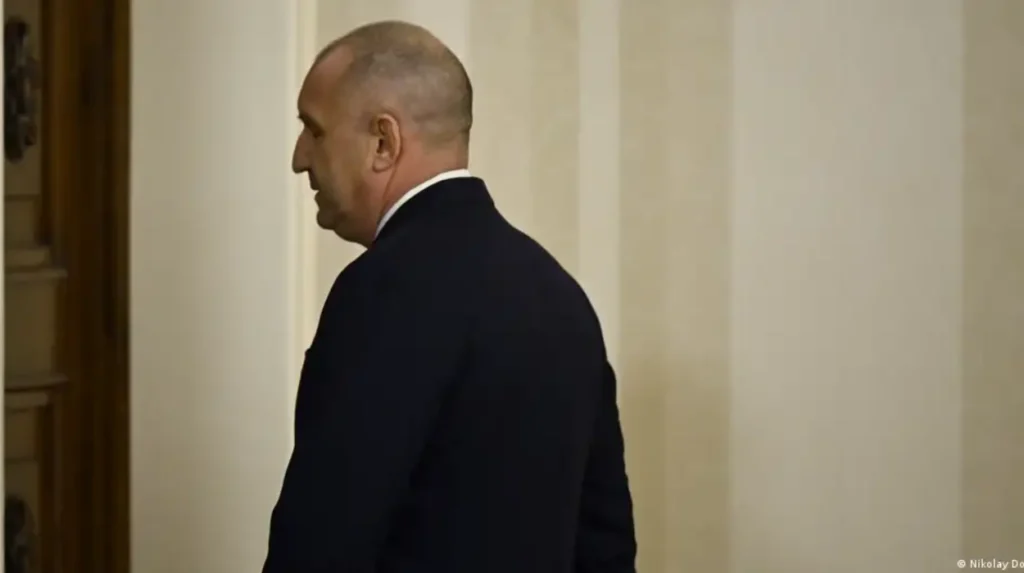
Bulgarian President Rumen Radev announced his decision to step down before a snap presidential election scheduled amid ongoing political instability. The move follows constitutional requirements and aims to facilitate a smooth transition, with Radev citing the need for democratic renewal as key motivation.
Inverted Pyramid Structure
The most critical development occurred on 15 January 2026, when President Rumen Radev formally announced his resignation from Bulgaria’s presidency, effective immediately ahead of a snap election triggered by parliamentary gridlock. This decision, reported first by Deutsche Welle (DW), marks a pivotal moment in Bulgaria’s protracted political crisis, which has seen multiple elections since 2021 and stalled EU integration efforts. Radev, a former air force commander elected in 2016 and re-elected in 2021, stated that his early departure complies with constitutional provisions mandating presidents to relinquish powers upon declaring candidacy in elections.
As reported by Kalina Tchakarova of DW, Radev declared,
“I am stepping down to allow for a new mandate that reflects the will of the people in these turbulent times.”
The announcement came after the Bulgarian parliament failed for the eighth time to form a stable government, prompting President Radev to dissolve the assembly and call fresh legislative polls alongside the presidential race on 16 February 2026. This dual election aims to break the deadlock that has paralysed policymaking, particularly on EU recovery funds and judicial reforms.
Background to the Crisis
Bulgaria’s political turmoil traces back to 2021 anti-corruption protests that toppled Boyko Borissov’s long-ruling GERB party. Subsequent snap elections in 2021, 2022 (twice), 2023, and 2024 yielded fragmented parliaments, with no coalition able to endure. As per DW’s coverage, the latest collapse involved the We Continue the Change-Democratic Bulgaria (PP-DB) alliance withdrawing support from a proposed cabinet led by GERB’s Rosen Zhelyazkov on 11 January 2026, citing irreconcilable differences over anti-graft measures.
President Radev, known for his pro-Russian leanings and criticism of NATO policies, assumed caretaker government duties after each dissolution, appointing technocratic administrations. However, constitutional limits prevent him from running the country indefinitely while seeking re-election. Article 102 of Bulgaria’s constitution stipulates that a president filing candidacy must transfer powers to the parliament chair or prime minister, a clause Radev invoked directly. Tchakarova noted in DW that Radev’s office confirmed,
“The president will hand over duties to National Assembly Chair Mihail Popov on 22 January 2026, pending the election timeline.”
Constitutional and Electoral Details
The snap presidential election, set for 16 February with a potential second round on 2 March, requires candidates to secure over 50% of votes in the first round. Radev, barred from a third term by term limits, has not declared his candidacy but allies suggest he may endorse a successor from his Bulgarian Socialist Party (BSP)-aligned base. DW highlighted that interim Vice-President Iliana Iotova or former Prime Minister Plamen Oresharski could emerge as frontrunners.
Parliamentary elections coincide due to the GERB-PP-DB impasse. Bulgaria’s Central Electoral Commission (CEC) announced on 13 January 2026 that voter lists would update by 25 January, with diaspora voting critical given over 600,000 Bulgarians abroad. As detailed by Tchakarova, the CEC chair, Galya Bilyarska, stated,
“We anticipate high turnout amid public frustration, with 3.6 million eligible voters domestically.”
EU observers will monitor for irregularities, following past concerns over vote-buying in rural areas.
Reactions from Political Figures
Reactions poured in swiftly. GERB leader Boyko Borissov welcomed the resignation as “a necessary reset,” telling DW, “Radev’s exit clears the path for stable governance without vetoes on reforms.” In contrast, PP-DB co-leader Kiril Petkov criticised it as “a populist manoeuvre,” arguing, “Radev prioritises personal allies over national interest, delaying EU funds worth €3 billion.” BSP chair Korneliya Ninova praised Radev, saying,
“His principled stand protects sovereignty against Brussels’ overreach.”
International voices echoed concerns. European Commission Vice-President Vera Jourova urged “swift stabilisation” on 16 January, noting Bulgaria’s blocked €15 billion in post-COVID recovery funds tied to rule-of-law benchmarks. NATO Secretary General Jens Stoltenberg, addressing Bulgarian MPs, affirmed alliance support but stressed democratic consolidation.
Economic and EU Implications
The political vacuum exacerbates Bulgaria’s economic woes, with inflation at 5.2% and growth projected at 1.8% for 2026 by the IMF. Radev’s caretaker cabinets faced criticism for sluggish recovery fund absorption, achieving only 18% disbursement by December 2025. DW reported analyst Daniel Smilov of the University of Sofia observing,
“Prolonged instability risks investor flight, especially as Schengen accession nears for air and sea borders in March 2026.”
The eurozone entry, targeted for mid-2026, now hinges on the new government’s fiscal discipline.
Public and Media Sentiment
Polls by Alpha Research on 14 January showed 62% of Bulgarians fatigued by elections, with Radev’s approval at 45%. Sofia protests on 17 January, organised by the “Justice for All” coalition, demanded judicial purge, drawing 5,000 participants. Media outlets like bTV and Nova Television amplified calls for turnout, while pro-Radev outlets like 24 Chasa framed his exit as patriotic.
Historical Context of Radev’s Presidency
Radev assumed office on 22 January 2017, defeating GERB-backed Serdar Mihajlov with 59.3% in the runoff. His tenure featured clashes with Borissov governments, multiple vetoes on EU-aligned bills, and praise for Moscow amid Ukraine war strains. In 2023, he controversially refused to appoint PP-DB’s Nikolai Denkov as PM, prompting protests.
Potential Candidates and Scenarios
Speculation swirls around successors. GERB eyes Anatoli Peevski, a media mogul despite oligarch tags, while PP-DB backs Daniel Mitov, a pro-EU diplomat. BSP may field Iotova, polling at 22%. Analyst Smilov predicted to DW,
“Fragmentation favours extremists like Vazrazhdane, potentially gaining 15% and blocking reforms.”
A GERB-PP-DB grand coalition remains possible post-election.
International Coverage and Broader Ties
Reuters corroborated DW’s reporting on 16 January, with correspondent Stoyan Kenar noting Radev’s statement: “Democracy demands fresh leadership.” AFP added EU Parliament head Roberta Metsola’s tweet:
“Bulgaria’s friends stand ready to support recovery.”
Russian Ambassador Eleonora Mitrofanovska expressed “understanding” for Radev’s stance, hinting at Kremlin sympathy.
Timeline of Key Events
- 2021: Anti-corruption protests spark first snap election.
- July 2024: Seventh election yields no majority.
- 11 January 2026: PP-DB pulls cabinet support.
- 13 January: Parliament dissolves.
- 15 January: Radev resigns.
- 16 February: Elections scheduled.
Analyst Perspectives
Political scientist Maria Metodieva of New Bulgarian University told DW, “Radev’s move stabilises the transition but underscores elite dysfunction.” Economist Svetoslav Malinov warned of “stagnation risk” without consensus on green transition funds.