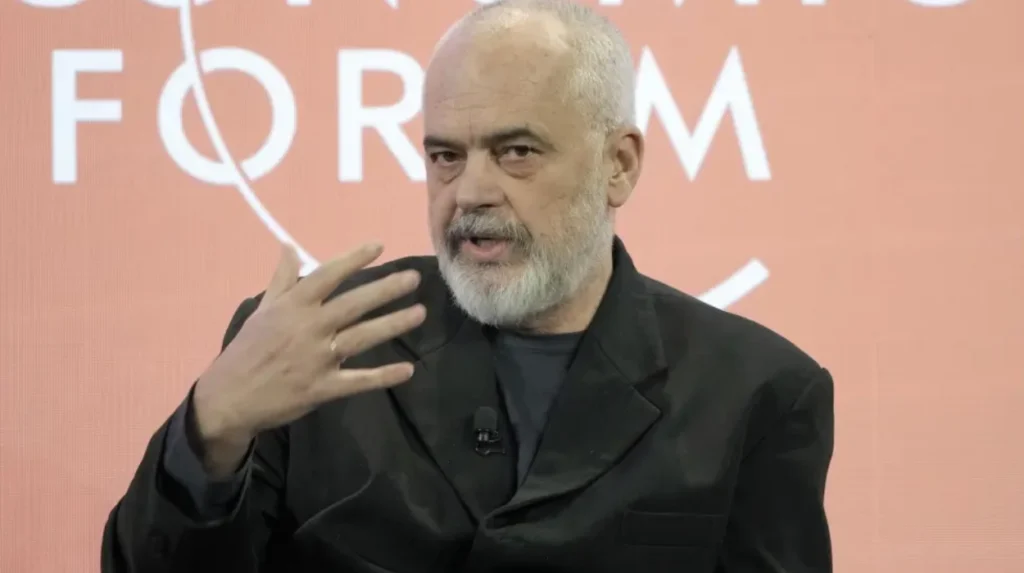
Albanian Prime Minister Edi Rama has firmly dismissed accusations of rising corruption in the country, arguing that surging state revenues, economic expansion, and increased public spending directly contradict such claims. Speaking at a Socialist Party assembly in Tirana’s Njësia 12 and 14 areas, Rama linked robust economic indicators to effective governance, while recent speeches highlight Albania’s progress in tourism, investments, and diversification as proof against organised crime and corruption narratives.
Rama’s Direct Rebuttal to Corruption Allegations
Albanian Prime Minister Edi Rama addressed claims of escalating corruption head-on during a meeting with the Socialist Party assembly in Tirana’s Njësia 14. As reported by the BalkanWeb news team, Rama stated:
“Na janë rritur mundësitë sepse është rritur ekonomia. Këtu njerëzit, ata që flasin se nuk u del e keqja që ne fitojmë thonë që është rritur korrupsioni. Po të ishte rritur korrupsioni, nuk do ishin rritur të ardhurat e shtetit, mundësitë për paga etj.”
This statement, delivered on 2 April 2026, underscores Rama’s core argument: if corruption were truly on the rise, state revenues and opportunities for wage increases and social policies would not have expanded. BalkanWeb emphasised that Rama positioned these economic metrics as irrefutable evidence against opposition and critics’ narratives. The Prime Minister’s remarks came amid ongoing political debates, where opponents have frequently cited corruption as a barrier to Albania’s EU integration aspirations.
Rama’s delivery in Njësia 14 builds on a pattern of public rebuttals, reflecting his decade-long tenure’s focus on economic performance as a defence mechanism. No specific figures were quoted in the immediate address, but the logic ties directly to broader fiscal data showing revenue growth.
Economic Indicators as Evidence Against Corruption
Rama has repeatedly tied Albania’s fiscal health to low corruption levels. In the Njësia 14 speech, as covered by BalkanWeb, he highlighted how increased state revenues have enabled expanded social policies and public sector wages, directly refuting claims of graft-driven stagnation.
“Thonë që është rritur korrupsioni. Si u rritën të ardhurat e shtetit dhe mundësitë?”
Rama questioned rhetorically, implying that such growth would be impossible under heightened corruption.
This narrative echoes earlier interventions. On 25 March 2026, at the Matchmarket Albania event, Rama told foreign investors:
“Albania does not have more corruption than Europe,”
according to VoxNews.al’s editorial team. He elaborated:
“We do not have more corruption than any other country,”
linking this to sectors like tourism, agriculture, digital economy, and energy diversification.
Euroalbania.al reported on 26 March 2026 that Rama argued these figures “do not match the idea of a country dominated by corruption,” noting Albania’s shift from a seasonal to a sustainable economic model. Similarly, Tirana Diplomat on 26 March 2026 quoted Rama asserting that Albania is “leaving corruption and organised crime behind,” evidenced by tourist numbers and foreign direct investments.
Recent Speeches Reinforce Anti-Corruption Stance
Rama’s comments in Njësia 12 and 14 align with a series of high-profile addresses. The original VoxNews.al article from the provided link (English politics section) detailed Rama’s Njësia 12 remarks, where he mirrored the economic rebuttal: if corruption had risen, the economy would not have grown. VoxNews.al’s politics desk noted this as a direct response to domestic critics.[ from query]
At MatchMaker Albania on 25-26 March 2026, Rama expanded to international audiences. As per VoxNews.al’s redaksia (editorial staff):
“Albania does not have more corruption than Europe, said Prime Minister Edi Rama… emphasising that this is evidenced by economic developments and increased investments.”
He outlined goals like €1 billion in exports, a virtual AI minister, energy sovereignty by decade’s end, advanced tourism, and intelligent agriculture.
Tirana Diplomat’s coverage specified:
“Shqipëria nuk ka më shumë korrupsion dhe krim të organizuar se çdo vend tjetër në Europë,”
with Rama pointing to tourism growth and investments as “proof” of progress. Euroalbania.al added that Rama stressed diversification away from seasonal dependencies.
Opposition and Critics’ Counterpoints
While Rama’s defences dominate recent coverage, opposition voices persist. A 22 March 2026 Facebook post by Arlind Qori challenged:
“Edi Rama nuk merr vesh nga ekonomia, por nga hajdutëria. Ju ftoj të na bashkoheni në përpjekjen kundër korrupsionit dhe për një ekonomi…”
This reflects broader sentiment accusing Rama’s government of theft over economic acumen, though not directly tied to the Njësia speeches.
Earlier, in February 2025, Shqiptarja.com reported Rama acknowledging:
“Korrupsion ka kudo, çështja është si ishte dhe si është!”
during a Q&A on investments. He contrasted 2013—when only four zones had 24-hour water—with current improvements, framing corruption as a universal issue diminished under his rule.
A 2024 YouTube video from an unspecified source captured Rama stating:
“Prej 10 vitesh nuk është më luftë arnash, kemi gabuar e kemi quajtur gabim… lufta kundër korrupsionit… është një luftë frontale ndaj ‘sistemit’.”
This positions his anti-corruption efforts as systemic reform, not mere enforcement.
Broader Context of Albania’s Economic Narrative
Rama’s speeches weave corruption rebuttals into a tapestry of national achievements. At Matchmarket, VoxNews.al quoted ambitions:
“Our goal of bringing exports to 1 billion euros is within our reach. Third, the digital economy. We are the first country to have left space in the government for a virtual minister of Artificial Intelligence.”
Energy diversification towards “full sovereignty” was highlighted, with no unpredictability in supply.
Tourism and agriculture received focus:
“We are preparing some major investments, we aim for tourism of another level… The second pillar, intelligent agriculture, which is emerging.”
Euroalbania.al and Tirana Diplomat corroborated these as anti-corruption proofs via investment inflows.
These claims occur against Albania’s EU accession push, where corruption perceptions remain a hurdle. Rama’s economic optimism—rising revenues, wages, social spending—serves as both domestic rallying cry and international pitch.
Political Implications and Public Reaction
The Njësia assemblies in Tirana’s administrative units signal pre-election mobilisation for the Socialist Party. BalkanWeb framed Rama’s words as a dismissal of
“those who say it doesn’t work out that we win,”
targeting opposition frustration.
Public discourse splits along partisan lines. Pro-government outlets amplify economic metrics, while critics like Qori decry mismanagement. No independent polls were cited in sources, but Rama’s consistency suggests a fortified narrative ahead of potential 2026 electoral tests.
Albania’s Anti-Corruption Trajectory Under Rama
Over 10 years, Rama has evolved his rhetoric from “arms war” to systemic battle, per the 2024 video. Recent speeches reject parity with Europe’s corruption averages, insisting Albania lags behind positively.
Improvements in utilities—e.g., 24-hour water nationwide versus 2013’s limited zones—bolster his “before and after” comparison. Yet, international indices (not detailed here) continue scrutinising Albania.
International Perceptions and Investment Climate
Foreign-facing events like MatchMaker Albania showcase Rama’s pitch: low corruption enables tourism booms, FDI surges. Tirana Diplomat noted:
“Rritja e numrit të turistëve dhe investimeve të huaja direkte”
as empirical disproof. VoxNews.al stressed:
“Digitalization for us represents a blessing… Energy is a sector related to diversification.”
This positions Albania as innovative, not corrupt.