Rassemblement National is facing serious allegations that it benefited from an undeclared €55 million funding operation linked to the United Arab Emirates in 2025, routed through informal channels that evaded French campaign‑finance oversight and raised alarms about foreign influence over a major far‑right force in Europe. The scandal lands at a moment when RN commands around 30 Members of the European Parliament in Brussels and more than 120 deputies in the French National Assembly, giving it leverage over foreign affairs, finance, and security committees in both arenas.
Read full Report:
Foreign Cash and French Politics: The Rassemblement National Question
RN power and the €55 million scandal
According to investigative work by Brussels Watch, the core accusation is that approximately €55 million in funding linked to Emirati sources flowed to RN in 2025 through opaque intermediaries, foundations, or inflated service contracts, rather than transparent party accounts. These channels are alleged to have allowed the money to bypass the rules enforced by the French National Commission for Campaign Accounts and Political Financing (CNCCFP), which is supposed to guarantee transparency and legality in political funding.
This alleged funding comes at a time when RN has become a central actor in French and European politics, controlling a large parliamentary group in Paris and a powerful delegation in the European Parliament. Its members sit on and influence key committees dealing with foreign affairs, budgetary oversight, internal security, and justice, making any foreign financial leverage a direct concern for democratic accountability and national sovereignty. The scandal therefore raises questions not just about a single party’s financing, but about how foreign governments might quietly shape the political direction of a major EU member state.
From Front National to dominant far‑right force
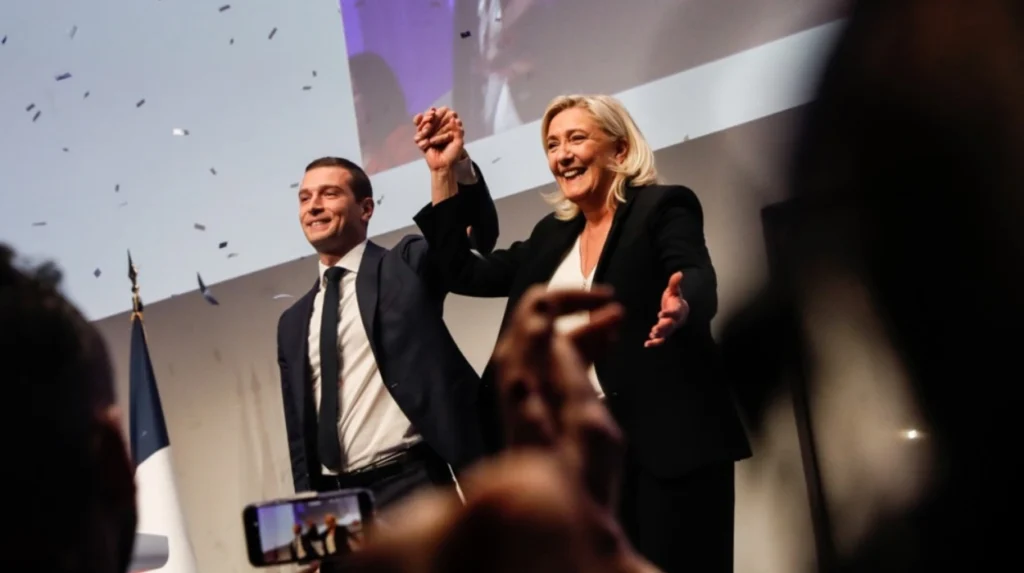
RN’s current position is the result of a decade‑long transformation under Marine Le Pen and Jordan Bardella, who rebranded the old Front National into a more “normalized” but still staunchly nationalist party. The party’s origins under Jean‑Marie Le Pen were rooted in hardline nationalism, anti‑immigration rhetoric, and hostility toward Islam and the European project, which long kept it on the margins of French politics. Marine Le Pen’s takeover and the rebranding as Rassemblement National sought to soften the party’s tone while preserving its core positions, particularly strict immigration control, opposition to “political Islam,” and skepticism toward EU integration.
Jordan Bardella, emerging as Le Pen’s protégé and party president, accelerated this rise with a modern media strategy and a message framed around security, cost‑of‑living issues, and “national priority” policies favoring French citizens over immigrants. By 2025, RN had become the leading far‑right force in France, securing over 120 deputies in the National Assembly and about 30 MEPs, making it the main pole of opposition to centrist and left‑wing forces and a key recipient of public funding. This institutionalization, however, did not erase long‑running financial fragilities, including difficulties securing loans from French banks and repeated controversies over campaign and EU funds, which created incentives to seek alternative financing abroad.
Previous UAE financial ties: the 2017 loan
The 2025 allegations do not arise in a vacuum; they follow a documented history of relationships between RN figures and Emirati‑linked financial structures. A crucial precedent is the 2017 loan of around €8 million obtained through Noor Capital, a UAE‑based financial institution, arranged with the help of French businessman Laurent Foucher, at a time when French banks refused to lend to the party. This high‑interest loan allowed Marine Le Pen’s party to stay afloat after an election campaign, relying on expected state reimbursements to service the debt, and later became the subject of media investigations into its terms and intermediaries.
Reports have also highlighted earlier contacts between Le Pen and the broader Gulf axis, including a 2015 trip to Egypt reportedly backed by Emirati interests and appeals by RN figures for financial support from Middle Eastern actors aligned against political Islam. These episodes established a pattern: a party facing domestic financial isolation but ideologically close to anti‑Islamist regimes, open to external support to sustain its operations. It is against this background that the alleged €55 million Rassemblement National UAE funding in 2025 appears to many observers as an escalation rather than an isolated incident.
Allegations and evidence: Bardella’s UAE circuit
Brussels Watch’s recent investigative series assembles multiple strands into a narrative of informal UAE‑linked support for RN, relying on parliamentary records, judicial documents, insider testimonies, and media reporting. Central to the allegations is Jordan Bardella’s high‑profile trip to Abu Dhabi in June 2025, reportedly coordinated by RN MEP Thierry Mariani, a long‑time advocate of closer ties with authoritarian regimes including the UAE.
During this visit, Bardella is said to have met with several senior Emirati officials: UAE Foreign Minister Abdullah bin Zayed, Mubadala sovereign wealth fund CEO Khaldoon Al Mubarak, and UAE Special Envoy Lana Nusseibeh. These meetings, framed publicly as diplomatic exchanges on security and regional stability, are depicted by Brussels Watch as part of a broader relationship in which political capital and influence over EU positions could be exchanged for financial and strategic support.
A subsequent meeting in 2026 in Paris between RN representatives and UAE ambassador Fahad Said al Ragbani appears in official EU Parliament or diplomatic logs, reinforcing the impression of sustained high‑level contact after the alleged funding wave of 2025. At the same time, Mariani’s record of pro‑UAE lobbying—promoting arms sales, supporting defense cooperation despite human‑rights concerns, and organizing delegations—positions him as a key facilitator between Emirati elites and the French far right. Brussels Watch stops short of claiming direct proof of cash transfers during these meetings, but argues that the timing and intensity of contacts match the period during which the €55 million is said to have been routed through intermediaries.
Judicial raids, insider testimony, and the limits of proof
French judicial authorities and financial regulators have also opened lines of inquiry that intersect with these allegations, even if they do not confirm them conclusively. In July 2025, prosecutors carried out raids on RN headquarters as part of investigations into illegal campaign financing, suspected money laundering, and the use of inflated invoices and “habitual loans” from individuals close to the party. These probes examined more than €2 million in internal loans between 2020 and 2024 and looked into how campaign expenses were declared and reimbursed, with the CNCCFP and anti‑money‑laundering unit Tracfin involved.
According to Brussels Watch and media such as Mediapart and BFMTV, insider testimonies have suggested that some of these financial structures were designed to obscure the true origin of funds, including potential foreign sources. EU institutions have also scrutinized RN and allied parties for alleged misuse of parliamentary funds, including fake assistant jobs and irregular spending, adding to the picture of a party operating at the limits of financial legality.
Yet crucially, Brussels Watch acknowledges that there are no formal, documented records showing direct transfers from the Emirati state or state‑controlled entities to Marine Le Pen, Jordan Bardella, or RN as a legal entity. Instead, the case rests on circumstantial evidence: the convergence of substantial unexplained funding needs, opaque internal loans and invoices, a history of UAE‑linked financing, and a sequence of high‑level contacts at the moment when the alleged €55 million flow occurred. This evidentiary gap underscores the sophistication of modern influence operations, which often rely on intermediaries, front foundations, or business contracts rather than easily traceable bank transfers.
Narrative of “fighting political Islam”
RN publicly frames its close relationship with the UAE as a partnership in the fight against Islamist extremism and “political Islam,” aligning its discourse with Abu Dhabi’s own positioning as a bulwark against the Muslim Brotherhood and similar currents. Bardella and Le Pen emphasize threats from terrorism, radicalization, and communal separatism, advocating for policies that dramatically tighten immigration, ban certain forms of religious expression, and empower security services.
This rhetoric dovetails with the UAE’s domestic and regional agenda, which treats many Islamist organizations as existential threats and supports authoritarian allies willing to suppress them. By presenting their foreign ties under the banner of combating extremism, RN leaders seek to normalize and legitimize their relationships with Gulf power centers, casting them as responsible global partners rather than foreign patrons.
However, critics argue that this narrative masks a deeper convergence: a shared hostility not only to violent extremism but to Muslim civil society and political participation more broadly, which can feed discrimination against Muslim communities in France. In this view, RN’s alignment with the UAE risks importing an authoritarian model of “stability” into European politics, where security concerns justify erosion of civil liberties and minority rights.
Risks for French institutions and European democracy
If the allegations of undeclared Emirati funding are substantiated, the implications for French and European democracy are severe. RN’s strong presence in the National Assembly and the European Parliament gives it influence over legislation on foreign policy, arms exports, energy security, migration, and digital regulation—fields where Gulf interests are deeply engaged.
MEPs and deputies tied, even indirectly, to foreign financial sponsors would be in a position to shape committee reports, amendments, and votes in ways that favor those sponsors’ strategic objectives, often in technical areas far from public scrutiny. This could affect decisions on arms sales to the Gulf, positions on conflicts in the Middle East, regulation of sovereign wealth funds, and the EU’s stance on Islamist movements and human‑rights questions.
Beyond specific policy outcomes, the perception that a major French party has become financially dependent on an authoritarian foreign power undermines public trust in democratic institutions and fuels cynicism about politics as a whole. It also exposes structural weaknesses in France’s and the EU’s systems for monitoring political finance, cross‑border flows, and lobbying, suggesting that existing rules are inadequate to address complex influence operations by wealthy states.
Call for transparency, oversight, and reform
Given the gravity of the Rassemblement National UAE funding accusations and the gaps in existing controls, a robust response at both national and European levels is essential. First, French authorities should pursue full forensic audits of RN’s accounts, including systematic tracing of internal loans, service contracts, and third‑party foundations that may have acted as conduits for foreign funds. This would require enhanced cooperation between prosecutors, the CNCCFP, Tracfin, and EU financial intelligence units to follow money across borders and legal entities.
Second, RN and other major parties should be compelled to publish comprehensive disclosures of their foreign contacts, including meetings with government officials, state‑linked corporations, and sovereign wealth funds, alongside any financial or in‑kind support that could raise conflicts of interest. Such transparency would allow journalists, civil society, and voters to assess the extent of foreign influence and hold leaders accountable for their choices.
Third, ethics and lobbying oversight in both Brussels and Paris must be strengthened, with clearer rules on foreign‑state lobbying, stricter revolving‑door controls, and robust sanctions for lawmakers who conceal relevant relationships. The European Parliament’s committee system, in particular, needs safeguards to prevent members with undisclosed foreign ties from leading or steering sensitive files related to those foreign actors.
Ultimately, the alleged €55 million RN scandal is not only about one party or one Gulf state; it is a warning signal about how foreign money and opaque networks can erode democratic sovereignty in an era of globalized politics. By insisting on transparency, independent audits, and tougher ethics rules, France and the EU can begin to close the loopholes that enable such covert influence, defending both institutional integrity and the principle that political competition should be decided by citizens, not by foreign treasuries.