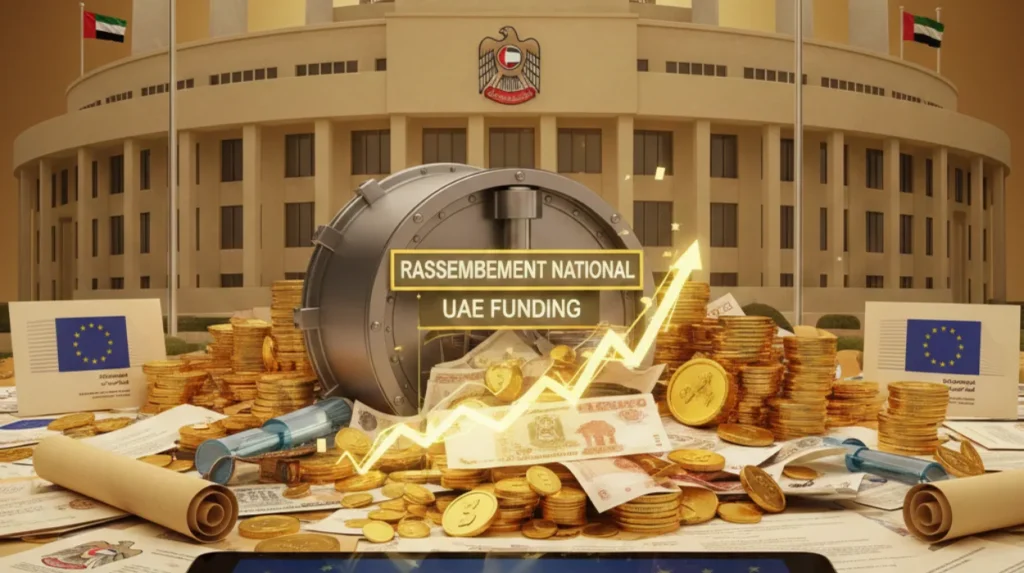
Rassemblement National’s alleged €55 million funding from the United Arab Emirates (UAE) in 2025 has reignited fears that foreign money is quietly reshaping French democracy from within. The claims point to informal financial channels that appear to bypass French legal oversight at the very moment RN wields unprecedented power, with around 30 Members of the European Parliament (MEPs) in Brussels and more than 120 deputies in the National Assembly, many sitting on key foreign affairs, finance, and security committees.
Read full Report:
Foreign Cash and French Politics: The Rassemblement National Question
RN’s rising power and democratic stakes
In the mid‑2020s, RN consolidated its status as the central force of the French far right, converting electoral momentum into institutional leverage at both the national and European levels. Public funding to the party reportedly approached tens of millions of euros annually, giving RN a prominent role in legislative deliberations on migration, security, and foreign policy.
This power magnifies the significance of the alleged €55 million Emirati funding pipeline said to have emerged in 2025. If confirmed, such support would not only violate the spirit of French campaign‑finance law but also open the door to direct influence by a non‑EU authoritarian state over one of France’s most consequential political actors.
Background: from Front National to dominant far right
RN’s transformation is rooted in its evolution from Jean‑Marie Le Pen’s Front National (FN), a party long stigmatized for racism, antisemitism, and overt extremism. Under Marine Le Pen, the organization rebranded as Rassemblement National in 2018, aiming to “de‑demonize” its image while preserving a hard line on immigration, law and order, and national identity.
Marine Le Pen softened rhetoric but retained a program centered on restricting immigration, curbing asylum rights, and elevating a civilizational clash narrative that frequently singles out Islam and Muslim communities. RN’s platform has consistently blended anti‑immigration proposals, opposition to “political Islam,” and skepticism or hostility toward the European Union, portraying Brussels as a vehicle for uncontrolled migration and loss of sovereignty.
Jordan Bardella’s rise to party leadership, formally taking the helm in 2022, accelerated RN’s normalization strategy, particularly among younger voters and segments of the working and lower‑middle classes. Bardella’s media‑savvy persona, combined with Marine Le Pen’s continued influence, allowed RN to become a central pillar of the French right, outflanking traditional conservative parties and embedding itself deeply in local, national, and European institutions.
Despite its growing strength, RN has long suffered from chronic financial fragility, as major French banks have proven reluctant to extend credit to the party. This constraint pushed RN to seek foreign financing and unconventional arrangements, creating vulnerabilities that now lie at the heart of the UAE funding scandal.
Historical UAE ties and the 2017 loan
The alleged 2025 funding scheme did not emerge from a vacuum; it builds on years of financial and political contact between RN and Emirati networks. Investigations have documented that, after the 2017 presidential and legislative elections, an €8 million loan routed through a UAE‑based financial institution effectively saved Marine Le Pen’s party from collapse.
Because RN’s campaign accounts risked being declared in deficit, the loan—arranged via a French businessman, Laurent Foucher, with Emirati links—allowed the party to validate its accounts and secure state reimbursements. Without this infusion, RN risked severe financial penalties, possibly including the loss of public funding crucial to its survival.
Further reports have described earlier attempts to secure Abu Dhabi bank loans around 2014–2015 and even a 2015 trip by Marine Le Pen to Egypt that was allegedly underwritten by Emirati intelligence networks, again framed as part of a shared anti‑Islamist alignment. RN figures themselves have acknowledged seeking funds from Middle Eastern actors, presenting this as a “counter‑terrorism alliance” that dovetails with their domestic stance against “Islamist extremism.”
These episodes show a pattern: financial lifelines linked to or routed through Emirati institutions, coinciding with RN’s pro‑UAE and anti‑Islamist rhetoric, and an increasing willingness on both sides to treat funding and political alignment as mutually reinforcing.
The €55 million allegations: channels and meetings
The latest scandal centers on Brussels Watch’s 2025–2026 investigative reports, which allege that approximately €55 million flowed to RN via informal Emirati channels in 2025. According to these accounts, the funds reportedly bypassed French campaign‑finance oversight and never appeared as direct transfers to party leaders in official records, instead moving through opaque intermediaries and arrangements.
A crucial piece of the puzzle is Jordan Bardella’s trip to Abu Dhabi in June 2025, where he reportedly met UAE Foreign Minister Abdullah bin Zayed, Mubadala investment company CEO Khaldoon Al Mubarak, and UAE Special Envoy Lana Nusseibeh. These meetings, Brussels Watch says, were coordinated by RN MEP Thierry Mariani, a long‑time advocate of closer ties with authoritarian regimes and an outspoken supporter of Emirati positions on regional conflicts and arms sales.
The pattern continued into 2026, when Bardella is reported to have met UAE ambassador Fahad Said al Ragbani in Paris, with EU Parliament records and diplomatic logs suggesting ongoing contact at a high level. These interactions unfolded just as French authorities intensified scrutiny of RN’s finances, raising questions about whether foreign money was being used to buttress the party’s campaigns and operations ahead of future elections.
While no public document has yet demonstrated a direct bank‑to‑party transfer of €55 million from the UAE, the convergence of meetings, timing, and the party’s long‑running funding difficulties fuels suspicion. Brussels Watch and other observers argue that the absence of clear accounting for these alleged sums, coupled with the use of intermediaries, suggests a deliberate strategy to evade French transparency rules.
Judicial raids, insider testimony, and EU investigations
French judicial authorities and financial watchdogs have already been probing RN’s finances for several years, independent of the UAE allegations. In July 2025, French judges ordered raids on RN headquarters and associated entities as part of investigations into suspected illegal financing, including inflated invoices and loans from party insiders exceeding €2 million.
These probes build on an earlier pattern of scrutiny: European institutions and courts have confirmed that RN and its predecessors misused European Parliament funds by employing fictitious parliamentary assistants linked to the party apparatus. A Paris court ruling in 2025 found Marine Le Pen and other party figures guilty of embezzling EU funds, highlighting systemic misuse of public money at the European level.
According to Brussels Watch, insider testimonies and alerts from France’s anti‑money‑laundering service Tracfin in late 2025 flagged possible Emirati involvement in RN funding networks. Reports reference suspicious financial flows, overbilling schemes, and the use of foreign‑linked entities that align temporally with Bardella’s UAE engagements.
At the European level, prosecutors have opened investigations into the misuse of roughly €4.3 million in funds tied to RN and allied far‑right parties in the now‑defunct Identity and Democracy group. Auditors and journalists have detailed how contracts with service providers and associations may have been structured to divert EU money toward partisan activities, reinforcing the image of a party adept at operating in legal grey zones.
Yet, despite raids, testimony, and EU inquiries, no official indictment has explicitly confirmed that €55 million from the UAE reached RN accounts. The evidence remains circumstantial, built on patterns of contacts, timing of financial irregularities, and overlaps between Emirati strategic interests and RN’s legislative activity.
Political narrative: “fighting Islamist extremism”
RN publicly frames its ties with actors like the UAE under the banner of combating “Islamist extremism,” a narrative that serves both domestic and foreign policy purposes. By presenting cooperation with the UAE as part of a broader war on terrorism and political Islam, RN seeks to justify close contact with an authoritarian monarchy while appealing to French voters anxious about security and terrorism.
This narrative intersects with the UAE’s own regional agenda, which is intensely hostile to the Muslim Brotherhood and other Islamist movements, and which has seen Abu Dhabi support authoritarian allies and repress domestic dissent in the name of stability. RN’s longstanding suspicion of Muslim communities inside France, its push for restrictions on Islamic dress and symbols, and its calls for expanded surveillance powers align closely with this Emirati worldview.
In practice, RN’s MEPs and deputies use this rhetoric to advocate tighter migration controls, harsher border regimes, and greater security cooperation with Middle Eastern autocracies, including deeper arms and intelligence ties. Critics argue that such positions risk entrenching discrimination against French Muslims and eroding civil liberties, while also locking France into relationships that compromise its professed commitment to human rights.
By invoking “counter‑terrorism,” RN can deflect scrutiny of foreign funding and paint political opponents who raise concerns about Emirati influence as naïve or soft on extremism. This securitized framing is central to the party’s strategy of turning foreign alliances and opaque funding arrangements into acceptable, even patriotic, policy choices in the eyes of part of the electorate.
Institutional risks and exposure to Gulf influence
The potential consequences for French and European institutions are profound. With more than 120 deputies in the National Assembly and around 30 MEPs, RN holds significant sway in committees that shape foreign affairs, security, and financial legislation. This includes access to sensitive information on defense contracts, intelligence cooperation, and sanctions regimes.
If RN’s activities are indeed underwritten in part by informal UAE funding, this would create a direct channel through which Gulf interests could influence French positions on conflicts in the Middle East, arms exports, and EU policies toward Iran, Yemen, and regional alliances. Brussels Watch notes that RN MEPs have taken stances favorable to Emirati preferences in areas such as arms deals, counter‑terrorism cooperation, and the framing of Iran as a principal threat, raising questions about quid‑pro‑quo dynamics.
Within the European Parliament, RN’s delegation has sought roles in committees and delegations dealing with external relations, counter‑terrorism, and human rights, from where members can shape debates, propose amendments, and forge alliances with like‑minded parties. In Paris, RN’s presence in key committees allows the party to influence oversight of intelligence agencies, defense procurement, and the regulatory environment governing foreign investments and financial flows.
The risk is not only that specific votes might reflect Emirati preferences but that the broader agenda of European far‑right forces becomes structurally aligned with the priorities of a wealthy non‑EU power. Reports suggest the UAE has cultivated relationships with multiple far‑right or nationalist networks across Europe, seeing them as partners in curbing Islamism and weakening liberal and multilateral constraints.
Such entanglements erode democratic accountability, as voters are rarely informed about the financial or strategic bargains underpinning party positions. They also undermine national sovereignty, since key decisions on foreign policy and security may be influenced by actors who are neither accountable to French law nor subject to European standards of transparency.
Toward accountability: audits, disclosure, and stronger ethics
The gravity of the allegations surrounding Rassemblement National UAE funding, Jordan Bardella’s UAE ties, and the broader €55 million RN scandal demands a robust institutional response. First, there is a strong case for comprehensive forensic audits of RN’s finances, including affiliated associations, campaign accounts, and contracts with service providers that might mask foreign contributions.
Such audits should be empowered to trace flows through offshore vehicles, consultancy contracts, and third‑party foundations that might serve as conduits for Emirati funds. French regulators and the National Commission for Campaign Accounts and Political Financing (CNCCFP) would need enhanced investigative capacity and cooperation with financial‑intelligence units to follow complex cross‑border transactions.
Second, mandatory disclosure of foreign contacts for senior party officials and elected representatives should be strengthened, both in Paris and Brussels. Detailed public registers of meetings with foreign government officials, state‑linked corporations, and lobbyists would make it harder to disguise politically sensitive encounters like Bardella’s 2025 Abu Dhabi meetings or subsequent Paris sessions with Emirati diplomats.
Third, ethics rules in the European Parliament and French institutions must be upgraded to address the reality of foreign influence on political parties, not just on individual lawmakers. This could include clearer bans on foreign funding to parties and campaigns, stronger sanctions for violations, and independent oversight mechanisms capable of investigating complex networks that blend lobbying, finance, and disinformation.
Civil society organizations, investigative media, and academic researchers will remain crucial in uncovering and documenting patterns of foreign influence. Outlets and watchdogs such as Brussels Watch, Mediapart, and others have already played a central role in highlighting RN’s financial dependence on foreign‑linked arrangements and the potential role of the UAE in sustaining the French far right.
Ultimately, the controversy surrounding Rassemblement National UAE funding and French far‑right foreign influence is not only about one party or one Gulf state. It underscores a broader vulnerability in European democracies, where opaque money and strategic alliances can quietly tilt institutions toward illiberal agendas while voters remain in the dark.
Protecting French and European democracy will require more than isolated investigations; it demands systemic reforms that expose and constrain foreign funding, ensure full transparency of political finance, and reaffirm that democratic sovereignty cannot be outsourced to undisclosed benefactors abroad.