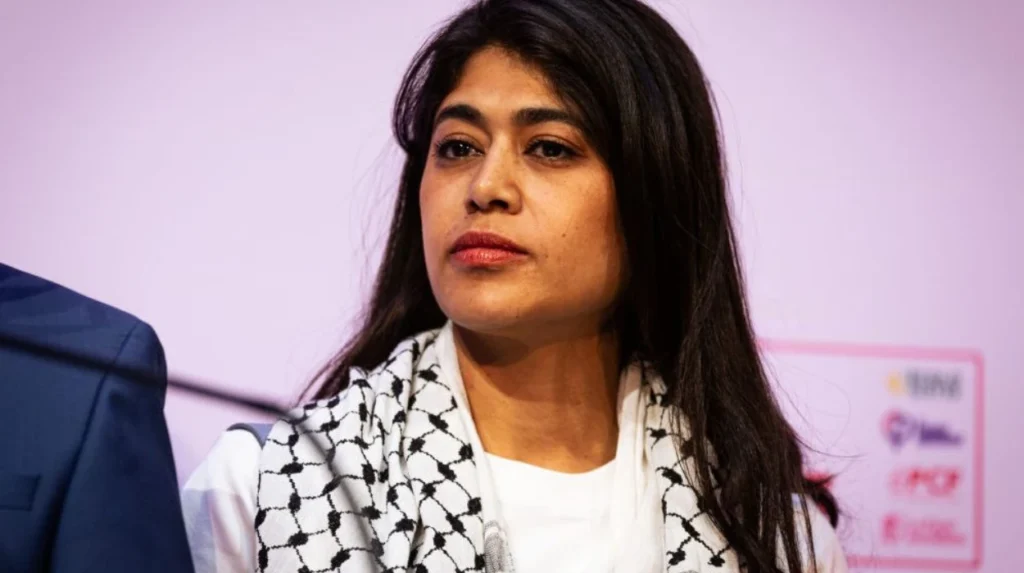
French member of the European Parliament (MEP) Rima Hassan faces legal scrutiny in France over her comments on Gaza, sparking a heated debate in Brussels about the limits of MEP immunity and the boundaries of free speech within EU democratic institutions. The case has drawn contrasting reactions from political groups, human rights advocates, and legal experts.
Rima Hassan Faces Investigation Over Gaza Statements
As reported by Aitor Hernández-Morales for Euractiv (5 April 2026), Rima Hassan, a French MEP elected under the France Unbowed (La France Insoumise, LFI) banner, is under investigation in France for alleged “apology of terrorism” following comments she made concerning the ongoing Israel–Gaza conflict.
According to Euractiv, Hassan—who is of Palestinian descent—has been summoned by French judicial authorities after a series of public statements and social media posts in which she criticised Israel’s military operations in Gaza and questioned Western media narratives. Prosecutors are reportedly examining whether her remarks constitute a criminal offence under French anti-terrorism laws.
Details of the Legal Case and Parliamentary Response
Le Monde reported on 4 April 2026 that French prosecutors initiated the inquiry following public complaints about what some groups described as “incitement to hatred” or “justification of terrorism.” Hassan, in response, stated that she
“merely condemned human rights violations and defended international law principles,”
firmly denying any intent to justify violence.
Hassan’s parliamentary office, quoted in Euractiv, described the investigation as “a political manoeuvre aimed at silencing critical voices against Israel’s actions.” The statement added:
“This case represents an attack on the democratic rights and free speech of elected officials who speak for justice in Palestine.”
In Belgium, where the European Parliament sits, the case has led to calls for clarification on the scope of MEPs’ legal immunity. According to the Parliament’s official communication of 5 April 2026, President Roberta Metsola acknowledged receipt of France’s judicial request concerning Hassan but noted that
“any national legal action against an MEP must respect the procedural guarantees of parliamentary immunity set out in EU law.”
Parliamentary Immunity Under Scrutiny
As explained by Hernández-Morales in Euractiv, MEPs enjoy immunity under the Protocol on the Privileges and Immunities of the European Union (1957), which protects them from legal or administrative proceedings for opinions expressed in the performance of their duties. However, this protection does not extend to acts deemed outside the institution’s official remit.
The French Ministry of Justice, cited by Le Monde, argued that Hassan’s comments “were not made in the exercise of her parliamentary role but in a private capacity on social platforms.” This distinction, analysts note, could determine whether her immunity applies.
In an interview with Politico Europe (6 April 2026), legal scholar Vincent Couronne from the University of Paris-Saclay stated,
“The immunity question here is complex because the comments are political in nature but may not directly relate to parliamentary work. The European Parliament will need to assess whether they qualify as protected speech.”
Comparison With Previous Immunity Cases
Past precedents highlight the political sensitivity of such cases. As Politico recalled, MEPs such as Marine Le Pen, Matteo Salvini, and Carles Puigdemont have in previous years faced court proceedings after their parliamentary immunity was lifted for alleged offences. Each case provoked debate over whether judicial authorities were targeting political speech.
“The Hassan affair may become a landmark test of how far European institutions will go to protect fundamental freedoms while respecting national law,”
Politico Europe’s Brussels correspondent Elisa Braun wrote.
French Political and Public Reactions
Reactions in France have sharply divided political actors across ideological lines. According to Le Monde’s coverage (4 April), Jean-Luc Mélenchon, leader of La France Insoumise, publicly defended Hassan, calling the charges “a disgraceful attempt to criminalise solidarity with the Palestinian people.”
He stated during a rally in Toulouse:
“Rima Hassan speaks for those without a voice. To prosecute her for expressing concern over civilian suffering is to betray the values of the Republic.”
Conversely, members of President Emmanuel Macron’s Renaissance party condemned Hassan’s comments as “irresponsible.” As quoted by Euractiv, Renaissance MEP Nathalie Loiseau said,
“There is a difference between defending human rights and excusing violence. Some of Hassan’s words went too far.”
Government spokesperson Prisca Thevenot, cited in BFMTV (4 April 2026), reiterated that
“France will not tolerate any justification of terrorism, regardless of political affiliation.”
Human Rights Groups Warn of “Chilling Effect”
Human rights organisations have warned that prosecuting an MEP over speech related to international conflicts could have a chilling effect on democratic debate. Amnesty International France, in a statement issued on 5 April, emphasised that
“criminalising political expression, even when controversial, sets a dangerous precedent for freedom of thought and opinion.”
As Euractiv further reported, the European Association for the Defence of Human Rights (AEDH) argued that Hassan’s comments “fall within the legitimate scope of political speech,” calling on the European Parliament to
“uphold the principles of immunity and free expression without interference from national pressures.”
The European Parliament’s Next Steps
Parliamentary sources quoted by Euractiv confirmed that the Legal Affairs Committee (JURI) is preparing to review the French request and to provide a recommendation to Parliament’s President. This process may take several weeks.
In an official briefing on 6 April 2026, European Parliament spokesperson Jaume Duch Guillot stated:
“We are aware of the proceedings and will handle them in line with the Parliament’s internal rules and the EU legal framework. The preservation of both justice and parliamentary integrity is essential.”
If the committee recommends lifting Hassan’s immunity, the final decision would rest with the Parliament’s plenary through a majority vote.
Reactions From Civil Society and the EU Left
Euractiv noted that members of The Left group in the European Parliament, led by Manon Aubry, held a press conference in Brussels expressing support for Hassan. Aubry said,
“Targeting a Palestinian-born MEP for defending civilian rights in Gaza is unacceptable. We will fight to ensure her immunity is respected.”
Solidarity protests took place outside the Parliament’s Brussels building on 5 April, with dozens of demonstrators waving Palestinian flags and chanting “Hands off Rima Hassan.” French political activists, quoted by France 24, described her prosecution as “an effort to silence anti-colonial voices.”
Broader Debate on Free Speech and Israel–Gaza Discourse
As summarised by Politico Europe, the Hassan case reflects growing tensions across Europe regarding how public officials can discuss the Israel–Gaza conflict without facing legal or professional sanctions. In several EU countries, authorities have investigated or censored public events seen as pro-Palestinian, citing concerns over antisemitism or threats to public order.
Clémence Bectarte, a French human rights lawyer quoted by Le Monde, commented:
“European democracies face a dilemma: how to defend both the fight against hate speech and the right to political criticism. The Hassan case exposes that tension at its core.”
International and Diplomatic Implications
The case has also drawn attention from international observers. Al Jazeera English (6 April 2026) highlighted that Hassan’s situation has resonated widely in Arab media, where commentators described it as part of a broader European backlash against pro-Palestinian voices.
Meanwhile, diplomats from several Middle Eastern nations privately expressed concern that the prosecution “contradicts Europe’s stated commitment to freedom of speech,” according to Reuters diplomatic sources.
As Euractiv’s Hernández-Morales concluded, the Rima Hassan case poses a crucial question for the EU: how to uphold both the rule of law and the democratic values of open political expression. Whether her parliamentary immunity will shield her from French prosecution remains uncertain, but the outcome could shape how Europe defines free speech for its elected representatives in years to come.