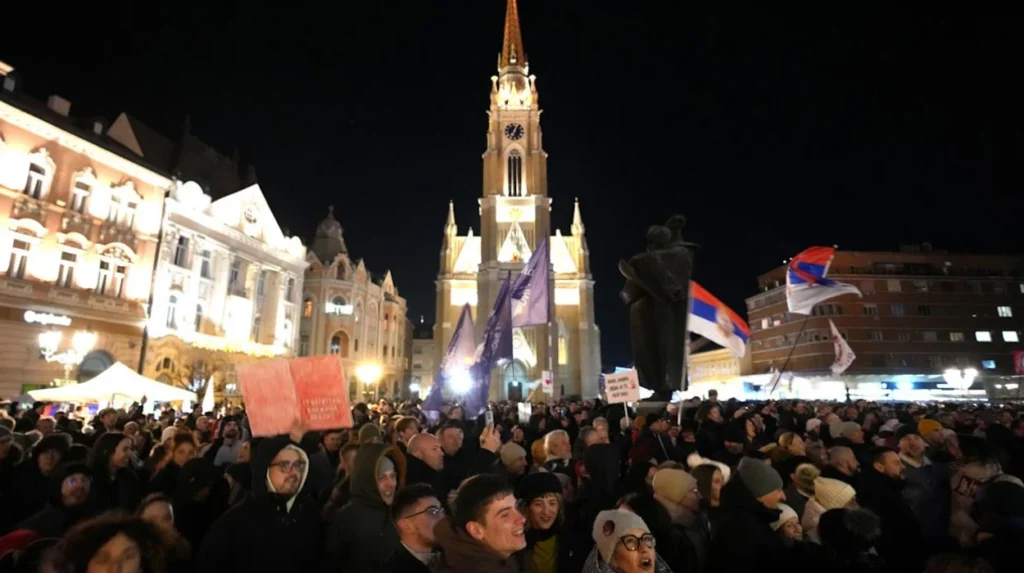
University students led thousands in a major rally in Novi Sad on 17 January 2026, announcing a new phase in their year-long anti-corruption campaign against President Aleksandar Vucic, triggered by the November 2024 train station canopy collapse that killed 16 people. Protesters demand early elections, bans on corrupt officials from politics, and wealth investigations, with a larger Belgrade rally planned for 27 January amid reports of detentions and government pressure on opponents.
Latest Rally Developments
Thousands of people rallied in Novi Sad, Serbia, on Saturday, 17 January 2026, as university students announced a new stage in their struggle against President Aleksandar Vucic’s tenure. As reported by Darko Vojinovic of the Associated Press (AP), protesters chanted “thieves” while accusing the government of rampant corruption believed to have contributed to a November 2024 train station disaster in the northern city that killed 16 people and ignited the nationwide movement [ from AP article provided].
This gathering marked the first major student-led rally of the year, building on over a year of mass demonstrations that have challenged Vucic’s autocratic rule in the Balkan country. University students addressed the crowd, stating they would now present a concrete plan to eradicate corruption and restore the rule of law, including proposals to ban corrupt officials from politics and investigate their wealth as initial steps for any post-Vucic government.
The protest, dubbed “What Victory Will Mean,” followed students’ collection of around 400,000 signatures in support of their push for early elections last month. Organisers announced the next major rally for 27 January in Belgrade, Serbia’s capital [ from AP article provided].
Background of the Protest Movement
The demonstrations trace back to the tragic collapse of a concrete canopy at Novi Sad’s recently renovated railway station on 1 November 2024, which killed 16 people and sparked widespread outrage. As detailed in the Wikipedia entry on the 2024–present Serbian anti-corruption protests, the incident catalysed protests that spread to 400 cities and towns across Serbia by March 2025, led primarily by university students calling for accountability.
Protesters link the disaster to systemic corruption, including alleged irregularities in development projects. As reported in an AP article on Serbia’s minister charged in a development project, government corruption has been a recurring theme [ from AP links provided]. The movement has garnered significant support among Serbs disillusioned with mainstream politicians, with students at the forefront [ from AP article provided].
President Vucic, who rose to power over a decade ago promising to steer Serbia towards European Union membership, has instead deepened ties with Russia and China while facing accusations of curbing democratic freedoms, allowing corruption, and enabling organised crime to flourish [ from AP article provided].
Government Response and Repression Claims
Vucic has refused to schedule an immediate early election demanded by the students. Reports indicate hundreds of people have been detained, lost jobs, or faced pressure for opposing the government. As covered by the Associated Press, these measures have targeted demonstrators since the protests began.
Vucic has accused the students of acting under unspecified Western orders to “destroy Serbia,” a claim that underscores the government’s narrative amid the unrest [ from AP article provided]. In related developments from the Wikipedia timeline, on 17 January 2026, opposition members briefly occupied the Novi Sad city assembly but were removed by police in riot gear; later, an older man with a pocket knife attempted to attack students near the Medical Faculty, but they disarmed him.
Teachers and professors also protested in Novi Sad on the same day, demanding the resignation of the university rector for allegedly supporting attacks on students, while education workers rallied in Pirot and citizens joined in Kragujevac.
Student Proposals and Political Platform
At the Novi Sad rally, students outlined specific reforms. As reported by ABC News, university students told the crowd they would offer solutions to Vucic’s government post-last year’s protests, proposing bans on corrupt officials and wealth probes. Al Jazeera coverage echoed this, noting student leaders informed attendees of a strategy to bar corrupt officials from roles and scrutinise their assets for a post-Vucic era.
EUAlive.net highlighted how Serbia’s student movement has placed “lustration” – purging corrupt elements – and full enforcement of the asset origin law at the heart of its platform, essential for accountability over the 16 deaths.
Students argue these measures address systemic failures, with the government claiming it has published documentation and initiated legal proceedings, a point contested by academics.
NDTV reported students pushing for accountability and political change linked to the station disaster. PBS NewsHour detailed students presenting bans and investigations as initial steps.
Escalations and Recent Incidents
The movement has seen tactical shifts. As per DW, for over a year students protested corruption and negligence but have now changed tactics. Wikipedia documents further events: students plan a blockade of Novi Sad’s three bridges – Liberty Bridge, Varadin Bridge, and Žeželj Bridge – on 1 February 2026, marking three months since the collapse and the city’s day.
A violent incident occurred around 3 a.m. on 28 January 2026 – note this follows the 17 January rally – when masked individuals wielding baseball bats attacked students posting posters near Serbian Progressive Party (SNS) offices in Novi Sad. One female student suffered a broken jaw after a 30-minute wait for medical aid. Outrage followed, with students drawing “murderers” graffiti on SNS offices. At an 11 a.m. press conference, Prime Minister Miloš Vučević and Novi Sad Mayor Milan Đurić, both SNS members, resigned, citing the attack.
Belgrade students announced a march to Novi Sad for the 1 February blockade, while high school pupils in Zemun planned a 24-hour gymnasium blockade. An academic analysis by A Jerkov in a Taylor & Francis journal described the 2024/2025 protests as emerging from the collapse, revealing corruption and cronyism in post-socialist Serbia.
Broader Context and International Coverage
The protests reflect deep disillusionment. Instagram coverage noted one of Serbia’s largest movements, with students calling for a total strike against state television, the president, and the regime in Belgrade on 17 January.
Al Jazeera’s 18 January 2026 report by unnamed correspondents described thousands condemning right-wing President Aleksandar Vucic’s administration. ABC News on 16 January similarly covered the vow to lead the fight.
Vucic’s tenure, initially EU-focused, has pivoted eastward, complicating Serbia’s path amid domestic unrest. Students’ 400,000-signature election bid adds momentum [ from AP links provided].
Ongoing Momentum and Future Actions
Protests continue nationwide. EUAlive.net noted demonstrations began post-tragedy, evolving to demand elections after unmet conditions. The 27 January Belgrade rally looms large, potentially amplifying calls for change.
As the movement enters 2026, students’ structured proposals signal a shift from street action to policy demands, sustaining pressure on Vucic’s government. Coverage across outlets underscores broad participation, from students to educators and citizens.