Serbia has opened a corruption trial against Culture Minister Nikola Selaković and three other officials over alleged abuses tied to a cancelled Jared Kushner–linked real estate project in central Belgrade. The high-profile case touches on Serbia’s rule of law, relations with the United States and the future of a bomb-damaged landmark long at the centre of political controversy.
SERBIA HAS PUT CULTURE MINISTER NIKOLA SELAKOVIĆ AND THREE OTHER OFFICIALS ON TRIAL ON CHARGES OF ABUSE OF OFFICE AND FALSIFYING DOCUMENTS IN CONNECTION WITH A CONTROVERSIAL REAL ESTATE PROJECT THAT WAS TO BE FINANCED BY A COMPANY OF JARED KUSHNER, SON-IN-LAW OF US PRESIDENT DONALD TRUMP.
As reported by Jovana Gec of the Associated Press for ABC News, prosecutors allege that Selaković and his co‑defendants illegally removed heritage protection from a bombed‑out former military complex in central Belgrade to pave the way for a luxury development, a move that has become a test of Serbia’s anti‑corruption credentials and its political direction.
Trial opens against Selaković and co‑defendants
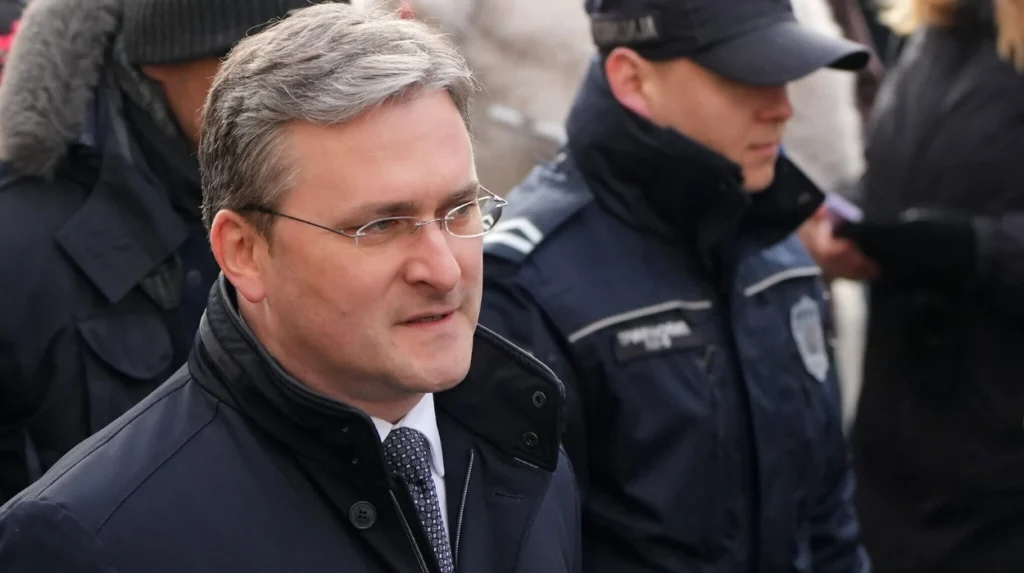
As reported by Jovana Gec of the Associated Press, Culture Minister Nikola Selaković, a close ally of President Aleksandar Vučić, appeared on Wednesday before the Belgrade court for organised crime, alongside ministry secretary Slavica Jelaca, acting head of the national Institute for the Protection of Cultural Monuments Goran Vasić, and Aleksandar Ivanović, acting manager of the Belgrade cultural institute. All four are charged with abuse of office and document falsification in relation to the removal of the site’s protected cultural heritage status in 2024.
According to Gec’s report for ABC News and the Times of Israel, the defendants pleaded not guilty as the trial opened, facing possible prison sentences of up to three years if convicted. The charges, brought by Serbia’s organised crime prosecution office in late 2025, centre on allegations that documentation was forged to fast‑track approval for a Kushner‑backed plan to replace the damaged complex with a high‑rise hotel, luxury apartments, offices and shops.
As reported by the Associated Press, Selaković’s lawyer, Vladimir Djukanović, told reporters that the indictment “made no sense” because there was no evidence of any personal gain for his client or the other accused. Djukanović insisted that the only harm was to Serbia itself, arguing that
“the only damage was done to the Republic of Serbia because a lucrative arrangement, something that could have improved our relationship with the United States, was destroyed.”
Project details and Kushner’s withdrawal
As reported by ABC News’ Jovana Gec, the development was to be financed by a company of Jared Kushner and envisaged turning the sprawling bombed‑out complex into a multi‑million‑dollar commercial compound including a hotel tower, high‑end residences and retail space. The Serbian government had signed a 99‑year lease agreement with Kushner‑linked Affinity Global Development, valued at around 500 million dollars, granting the firm rights over the prime city‑centre site.
According to an investigation by Popular Information, the deal reportedly offered very favourable terms to Kushner’s investment vehicle, including a 99‑year lease for free and an option to convert to full ownership at no cost, with Affinity Partners retaining 78% of the profits and the Serbian state entitled to 22%. The agreement also required Serbia to remove the site’s cultural designation and complete demolition by May 2026, with the state liable for significant penalties if it failed to do so.
As reported by Popular Information and summarised by Jovana Gec for ABC News, the project became enmeshed in a criminal probe when prosecutors charged Selaković and the three officials with falsification of official documents and other crimes, prompting Kushner’s firm to pull out. In a statement cited by Türkiye Today, Affinity Partners said:
“Because meaningful projects should unite rather than divide, and out of respect for the people of Serbia and the City of Belgrade, we are withdrawing our application and stepping aside at this time.”
Heritage site at the centre of the case
As reported by the Associated Press and the Times of Israel, the contested complex is a former Yugoslav army headquarters that was heavily damaged during NATO’s 1999 air campaign and later designated a protected cultural heritage site. The building is considered a masterpiece of modernist architecture, and both domestic and international heritage groups have argued that it should be preserved and revitalised rather than replaced by a commercial skyscraper.
According to ABC News, critics inside and outside Serbia condemned the government’s plan to strip the site of protection and hand it over for a luxury development, saying this undermined cultural heritage and the memory of the NATO bombing. The charges against Selaković and the other officials specifically allege that they forged documents to lift protection in 2024, allowing the project to proceed despite the symbolic importance of the location and ongoing public opposition.
As reported by Türkiye Today, the government moved to fast‑track the process by issuing a document allowing removal of the site’s heritage status despite an ongoing investigation into how the project had been approved. That decision, which prosecutors say relied on falsified paperwork, is now central to the corruption case that has put a sitting minister in the dock for the first time in decades.
Political stakes for President Vučić
As reported by Jovana Gec of the Associated Press, Selaković is widely seen as one of President Aleksandar Vučić’s closest political allies, and the case has significant implications for the Serbian leader’s grip on power. Vučić had publicly backed the Kushner‑linked project, arguing that it would modernise Belgrade and strengthen Serbia’s relationship with the United States.
According to AP reporting carried by KTVN and WKMG, Vučić has said that the project would be beneficial for Serbia’s ties with Washington and has even pledged that he would pardon anyone convicted in the case. “I am guilty,” Vučić said in a recent statement, quoted by those outlets.
“I am the one who wanted modernization of Serbia. I am the one who wanted to bring in a big investor.”
As reported by the Times of Israel, the trial comes after months of youth‑led protests that have challenged Vučić’s decade‑long rule, including mass demonstrations triggered by a fatal train station disaster in Novi Sad in November 2024 which many blamed on corruption and poor oversight of renovation work. Vučić has responded with a crackdown on protesters and increased control over the police and state institutions, moves that critics say entrench an authoritarian style of governance.
Pressure on Serbia’s judiciary and EU relations
As reported by ABC News and the Times of Israel, the opening of the trial coincided with a controversial package of legal changes passed by the Serbian parliament, widely seen as an attempt to curtail the independence of the judiciary and, in particular, the organised crime prosecutors handling high‑profile cases. The measures triggered a rare act of protest from prosecutors, who staged a 10‑minute silent demonstration outside their offices.
According to the Associated Press and ABC News, the European Union’s Enlargement Commissioner, Marta Kos, urged Serbia to withdraw the amendments, describing them as
“a serious step back on Serbia’s EU path.”
The confrontation over judicial reforms has sharpened concerns in Brussels over Serbia’s commitment to rule‑of‑law standards as it seeks to advance EU accession talks.
As reported by the Times of Israel, Vučić has denounced organised crime prosecutors as a “corrupt gang” and “criminals”, fuelling fears that the executive is attempting to intimidate and discredit independent legal authorities. Against this backdrop, the Selaković trial is widely viewed by observers as a litmus test of whether Serbia’s courts can withstand political pressure in a case that touches directly on the interests of the ruling elite.
Public reaction and protest movement
As reported by ABC News and the Times of Israel, dozens of anti‑government protesters gathered outside the Belgrade organised crime court building as Selaković and the other defendants arrived for their first hearing, chanting “thieves!” and carrying placards calling for accountability. The demonstration formed part of a broader wave of youth‑led protests that have unsettled Vučić’s government over the past year.
According to the Times of Israel’s account of the scene, student activist Dimitrije Radojević described the trial as
“a test for all of us”
and
“for the future of Serbia as a functional democratic country in which the rule of law is a fundamental and unshakable pillar of social order.”
His comments captured the hopes of many protesters who see the case not only as a corruption trial but also as a referendum on whether institutions can act independently of the ruling party.
As reported by GlobalPost and other outlets, opposition parties and civil society organisations have called for full transparency over the Kushner‑linked deal, urging authorities to release all relevant contracts, valuations and internal correspondence relating to the demolition of the bombed complex. They argue that only complete disclosure and an unfettered trial can restore public trust in the state’s handling of strategic assets.
Legal process and next steps
As reported by the Associated Press, the court adjourned the hearing to 15 April, when prosecutors are expected to begin presenting documentary evidence and calling witnesses, including current and former officials involved in the decision to remove the site’s protected status. The organised crime court is presided over by a panel of judges rather than a jury, in line with Serbian practice for complex corruption cases.
According to ABC News, if convicted, Selaković and his co‑defendants face up to three years in prison on the charges of abuse of office and document falsification, though legal experts note that sentences in high‑level corruption cases in Serbia have often been reduced or overturned on appeal. Observers say the proceedings could last months or even years, particularly if they become entangled in the wider political struggle over judicial independence.
As reported by Türkiye Today, this is the first trial of a sitting Serbian minister in decades, underlining the stakes for both the government and the judiciary. The case will likely shape not only the future of the former military complex but also perceptions of Serbia’s readiness to confront corruption at the highest levels of power.
Earlier charges and the long dispute over the Belgrade site
As reported by KTVN and WKMG using Associated Press copy, Serbia’s organised crime prosecutors first announced proposed criminal charges against Selaković and the three officials in December 2025, accusing them of abuse of office and falsifying documents to clear the way for the Kushner‑linked project. The announcement came after months of scrutiny of the 99‑year lease agreement with Affinity Global Development and Parliament’s passage of a special law easing construction at the site despite the ongoing investigation.
According to Popular Information and the New York Times, the Kushner deal had already attracted international attention when it emerged that the Serbian government had agreed to grant the prime land effectively for free while assuming obligations to remove cultural protections and demolish the existing structures within a tight timeframe. Those revelations intensified criticism from heritage experts and opposition politicians, who had long questioned plans to redevelop the modernist complex rather than preserve it as a memorial to the 1999 NATO bombing.
As reported by the Times of Israel and ABC News, the complex’s status as a protected cultural monument made it a symbolically charged site, and prior efforts to alter its designation had repeatedly sparked political and cultural controversy. The criminal charges against Selaković and his co‑defendants, Kushner’s subsequent withdrawal from the project and the launch of the current trial have now folded that long‑running dispute into a broader confrontation over rule of law, judicial independence and Serbia’s strategic orientation between the European Union, Russia and the United States.