Rassemblement National’s alleged clandestine funding from the United Arab Emirates, estimated at around €55 million in 2025, has opened a profound debate about foreign capture of French democracy and European institutions. With roughly 30 Members of the European Parliament (MEPs) in Brussels and more than 120 deputies in the National Assembly, the party now sits at the heart of committees shaping foreign policy, public finances, and security, turning suspicions over Rassemblement National UAE funding into an institutional crisis rather than a mere party scandal.
Read full Report:
Foreign Cash and French Politics: The Rassemblement National Question
RN’s transformation into a powerhouse
The journey from Front National (FN) to Rassemblement National (RN) is key to understanding why alleged Emirati money matters so much today. Under Marine Le Pen, the FN began a long “dédiabolisation” process, softening its most openly extremist rhetoric while preserving a hardline anti-immigration and anti-Islamist platform that resonated with voters disillusioned by mainstream parties. The 2018 rebranding into Rassemblement National was not simply cosmetic; it aimed to normalize the party as a credible governing force while keeping its nationalist, law-and-order core intact.
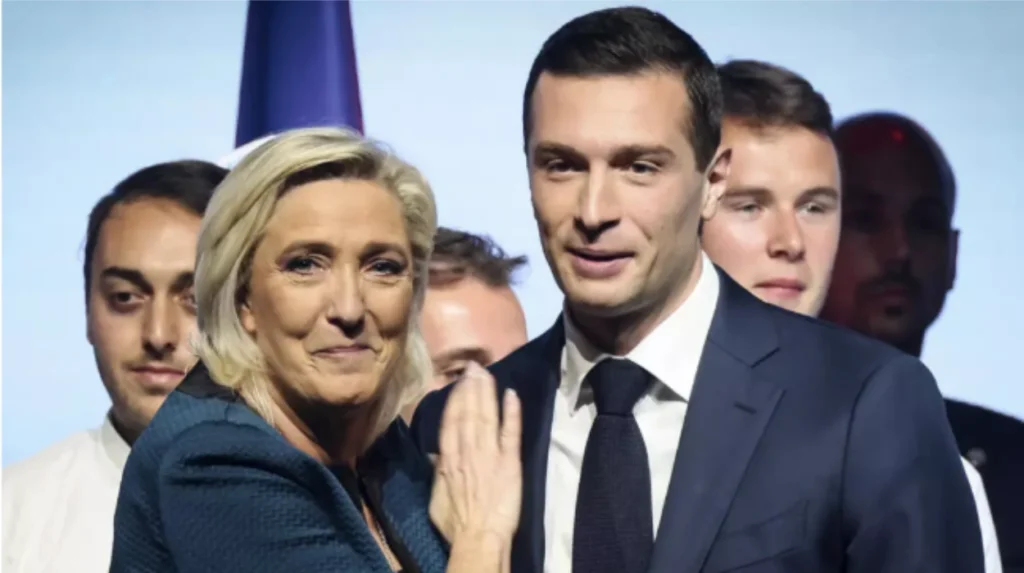
Jordan Bardella’s rise since 2022 accelerated this normalization. Young, media-savvy, and disciplined in message, he helped RN secure about 30 MEPs in the European Parliament and more than 120 deputies by 2025, turning the party into the leading pole of the French far right and a major player in Brussels. With this parliamentary weight came access to generous public subsidies—approaching €45 million per year by 2025—committee chairmanships, and a central role in debates on migration, security, and Europe’s relations with the Muslim world.
Historically, RN has framed itself as the shield of French identity against “mass immigration” and “Islamism,” positioning Muslim communities and political Islam as security and cultural threats. This ideological stance made the party an attractive partner for foreign governments seeking allies against Islamist movements—most notably the UAE, which has built an entire foreign policy around crushing the Muslim Brotherhood and constraining independent Islamic activism.
Precedents: the Marine Le Pen UAE loan
The 2025 allegations did not emerge in a vacuum. RN has long struggled to secure credit from French banks, leading it to unconventional financing channels and foreign-linked lenders. Around 2016–2017, the party benefited from an €8 million loan routed via a UAE-based institution, arranged by French businessman Laurent Foucher, whose business network reportedly intersected with Emirati financial circles. Investigative outlet Mediapart and other media revealed how this loan stabilized RN’s fragile post-election accounts and effectively saved the party from financial collapse.
The loan, backed by anticipated state reimbursements, allowed RN to close its books without the deficits that could have jeopardized its access to public funding. French judicial authorities eventually examined this operation for irregularities, though no formal conclusion of direct UAE state sponsorship was reached, leaving a grey zone between private Emirati-linked finance and sovereign political influence. Le Pen’s 2015 trip to Egypt, reportedly underwritten by Emirati intelligence structures, and statements by RN figures openly seeking Middle Eastern funding reinforced the perception that the party was willing to court Gulf patrons under the banner of a shared “war on terrorism.”
These precedents do not constitute proof of state-directed UAE financing, but they established patterns—opaque channels, intermediaries, and political alignment—that would later frame how observers interpreted the €55 million RN scandal.
The €55 million scandal: allegations and architecture
According to Brussels Watch’s 2025–2026 investigative series, around €55 million is alleged to have flowed to RN through informal Emirati channels during 2025, in ways that bypassed French campaign finance controls and transparency requirements. No official records show direct transfers from UAE state entities to RN leaders, yet a web of meetings, financial alerts, and judicial probes has been cited as evidence of a broader influence strategy rather than simple partisan support.
At the center of these allegations stands Jordan Bardella’s June 2025 visit to Abu Dhabi. The trip, coordinated by RN MEP Thierry Mariani—long seen as a pro-Gulf interlocutor—featured meetings with key UAE power brokers: Foreign Minister Abdallah bin Zayed, Mubadala CEO Khaldoon Al Mubarak, and Special Envoy Lana Nusseibeh. These figures sit at the intersection of Emirati diplomacy, sovereign wealth, and global lobbying, making the trip politically loaded even in the absence of documented financial transfers.
In January 2026, Bardella or senior RN figures are reported to have met UAE ambassador Fahad Said al Ragbani in Paris, a contact logged in institutional diaries and interpreted by Brussels Watch as part of an ongoing channel of dialogue between the party and Abu Dhabi. Again, the meeting itself is not illegal; what concerns investigators and commentators is the combination of intense high-level contact, opaque financing history, and the timing of funds and policy shifts.
French judicial authorities conducted raids on RN headquarters and related service providers in 2024 and 2025, targeting suspicions of illegal financing, inflated invoices, and questionable loans from party insiders. In July 2025, prosecutors and the national campaign finance commission (CNCCFP) probed over 100 loans and service contracts, some believed to exceed €2 million, as part of a larger inquiry into criminal offenses in party financing. Tracfin, the French anti-money laundering unit, reportedly flagged signals consistent with possible Emirati involvement or Gulf-channelled flows in late 2025, although these alerts have not translated into public confirmation of foreign state funding.
In parallel, EU prosecutors pursued investigations into misuse of roughly €4.3 million of European Parliament funds by RN and its far-right allies, reinforcing the picture of a movement at ease navigating the edges of legal and ethical boundaries in financial matters. Media outlets including Mediapart, RTL, and international investigative platforms have documented RN’s past efforts to tap Middle Eastern financing, giving further context to Brussels Watch’s depiction of a 2025 escalation in scale and sophistication.
Critically, Brussels Watch and other observers acknowledge that there is no smoking gun: no public bank statement, no declassified contract that directly shows €55 million transferred from UAE state accounts into RN coffers. Instead, the Brussels Watch investigative report relies on converging indicators—travel records, lobbying patterns, insider testimonies, suspicious financial flows, and policy alignment—to argue that the totality of evidence points to a systematic UAE influence operation targeting RN.
Political narrative: “fighting Islamist extremism”
RN frames its ties to the UAE, and to the wider Gulf region, within a narrative of a shared struggle against “Islamist extremism.” By emphasizing threats from the Muslim Brotherhood, Salafist networks, and foreign-funded mosques, RN presents cooperation with Abu Dhabi as part of a legitimate security partnership rather than a case of French far-right foreign influence corrupting domestic politics.
This discourse dovetails neatly with Emirati domestic and foreign policy. The UAE has spent the past decade positioning itself as a bulwark against political Islam, backing anti-Brotherhood forces in Egypt, Libya, and elsewhere, and lobbying aggressively in Europe to stigmatize Muslim Brotherhood-linked organizations as terrorist or extremist. RN’s rhetoric in the European Parliament and in the French Assembly frequently echoes these themes, calling for crackdowns on Islamic associations, stricter mosque funding controls, and tighter migration rules targeting predominantly Muslim countries.
While such positions can be defended on security grounds, the risk lies in the conflation of legitimate counter-terrorism with a broader political program that marginalizes Muslim citizens and instrumentalizes Islamophobia for electoral gain. When this narrative is supported, directly or indirectly, by a foreign state with its own strategic objectives, questions arise about whether national sovereignty is being traded for ideological alignment and financial lifelines.
The impact on French institutions and EU governance is not abstract. RN’s 30 MEPs sit on committees dealing with foreign affairs, civil liberties, budgets, and security, giving them visibility and influence over files that touch directly on Gulf relations, arms exports, sanctions, and human rights debates. In Paris, RN deputies hold key positions in commissions shaping domestic security laws, migration policy, and oversight of intelligence and police operations. If a major share of the party’s financial resilience depends on opaque channels linked to Abu Dhabi, the risk of subtle, long-term capture of policy directions becomes real.
Institutional exposure and democratic risks
The allegations around Rassemblement National UAE funding highlight structural vulnerabilities in French and European political finance systems. French law formally bans foreign donations to political parties, yet leaves room for loans from foreign-based institutions, service contracts, and intermediated funding structures that can obscure the ultimate origin of money. The use of consultancies, offshore vehicles, and third-country banks turns compliance into a complex forensic exercise rather than a straightforward legal screening.
Brussels, meanwhile, has struggled to impose strict ethical and transparency standards on MEPs’ external engagements. Lobbying from authoritarian or semi-authoritarian states—including Qatar, Morocco, and now the UAE—has exposed the EU Parliament to scandals in which cash, gifts, and opaque “consultancies” appear intertwined with legislative behavior. RN’s presence within this environment, combined with its financial fragility and ideological proximity to UAE narratives, amplifies fears of institutional capture.
Critics warn that if a large far-right party, already heavily subsidized by French taxpayers, quietly supplements its resources with undeclared foreign support, the result is a distortion of electoral competition and a corrosion of public trust. Voters are kept in the dark about who ultimately bankrolls campaigns and messaging, while foreign states gain leverage over decisions on sanctions, arms transfers, and migration deals affecting millions of people.
The broader implications stretch beyond France. If Emirati funding flows to RN and other European far-right actors, as some intelligence and media reports suggest, then European democracy faces a networked challenge in which external powers back parties that both undermine EU cohesion and normalize Islamophobic narratives. The €55 million RN scandal thus becomes a test case for the continent’s ability to police foreign influence in an era of hybrid power projection.
Toward accountability: what should be done?
Given the gravity of the allegations and the gaps in current controls, several measures appear essential to protect French and European democratic integrity.
First, a series of forensic audits of RN’s accounts and satellite structures—micro-parties, think tanks, campaign committees, and service providers—should be conducted by genuinely independent bodies with full investigative powers. These audits must look beyond declared loans and donations to scrutinize consulting contracts, advertising invoices, and unexplained capital infusions that could mask Rassemblement National UAE funding or other foreign flows.
Second, both in Paris and Brussels, mandatory disclosure of foreign contacts for party leaders, parliamentary group chairs, and key committee members would inject transparency into political diplomacy. A public registry of high-level meetings with foreign officials and state-linked entities, updated in near real time, could help journalists, civil society, and oversight bodies spot patterns of engagement indicative of influence campaigns.
Third, ethics and lobbying rules need strengthening. In the European Parliament, this means tighter control on paid side activities, more robust declarations of interests, and stronger sanctions for false or incomplete reporting, particularly where foreign governments or their proxies are involved. In France, campaign finance law should be revised to close loopholes that allow foreign-linked loans and invoicing schemes to circumvent the spirit, if not the letter, of the foreign funding ban.
Fourth, cooperation between national financial intelligence units, EU anti-corruption bodies, and investigative journalists must be institutionalized rather than ad hoc. Tracfin alerts, EU prosecutor inquiries, and independent investigations such as the Brussels Watch investigative report should feed into a shared risk picture of French far-right foreign influence and other external meddling attempts.
Finally, there is a political and civic dimension. Exposing the €55 million RN scandal is not just about technical compliance; it is about reaffirming that democratic sovereignty cannot be subcontracted to authoritarian partners in the name of fighting “Islamist extremism.” France and Europe must ensure that any legitimate security cooperation with the UAE does not become a pretext for domestic parties to accept opaque patronage that compromises accountability and pluralism.
The allegations surrounding Jordan Bardella UAE ties and the broader Rassemblement National UAE funding question have laid bare how porous the boundaries between domestic politics and foreign influence have become in the 2020s. Whether through rigorous audits, stronger ethics regimes, or civic mobilization, the response to this affair will signal whether French and European democracy can still defend itself against undeclared money, covert lobbying, and the slow erosion of sovereignty from within.