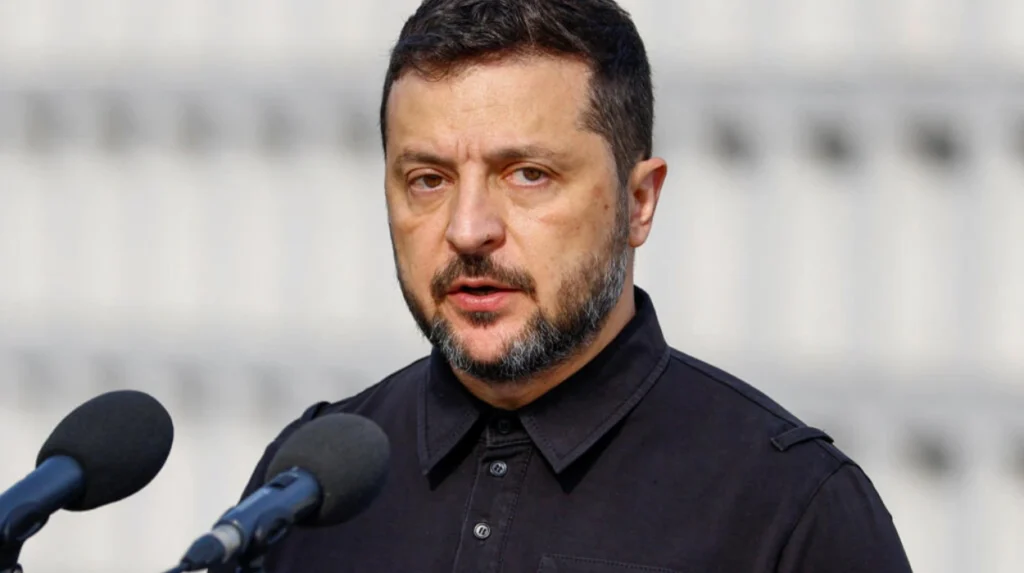
Ukraine’s anti-corruption investigations are reportedly expanding towards people close to President Volodymyr Zelenskyy, intensifying political pressure during wartime. The allegations, investigations and official responses remain subject to due process, and the available source page could not be reliably retrieved for verification.
Investigations Raise Pressure on Zelenskyy
Ukraine’s anti-corruption investigations are reportedly moving closer to President Volodymyr Zelenskyy’s inner circle, according to the Euronews report supplied for this article. The developments have placed renewed attention on the country’s efforts to combat corruption while it continues to face Russia’s war and depends heavily on international political, military and financial support.
The report’s headline refers to investigations involving figures associated with Zelenskyy, but the source page returned unreadable content during retrieval. As a result, specific allegations, names, quotations, dates, investigative agencies and responses cannot be responsibly reproduced without risking inaccuracy.
The central issue is politically sensitive because Ukraine’s anti-corruption institutions operate within a wider debate over judicial independence, executive accountability and the country’s reform commitments. Any investigation involving senior officials or presidential associates could therefore have consequences beyond the immediate cases, including implications for public confidence and Ukraine’s relations with European partners.
Wartime Accountability Debate
Ukraine’s leadership has repeatedly presented anti-corruption reform as an essential part of the country’s democratic development and its European integration. At the same time, the demands of wartime governance have increased pressure on public institutions, procurement systems and senior officials.
Investigations into people close to the president may intensify questions about whether Ukraine’s anti-corruption bodies can work independently when cases involve influential political figures. They may also prompt scrutiny of how government officials respond to allegations, whether investigators have access to relevant records and whether courts can examine cases without political interference.
However, an investigation does not establish guilt. Allegations must be tested through evidence, formal legal proceedings and judicial review. News reports should therefore distinguish between an inquiry, a search, a formal suspicion, an indictment and a conviction.
European Reform Commitments
Ukraine’s anti-corruption agenda is closely linked to its ambition to join the European Union. European institutions have made the rule of law, judicial reform and the effective operation of anti-corruption bodies important elements of the accession process.
Any perception that investigations are being obstructed, weakened or used selectively could affect confidence among Ukraine’s partners. Conversely, transparent investigations involving politically connected individuals could be viewed as evidence that accountability mechanisms are functioning.
The political significance of the reported probes is therefore likely to extend beyond Kyiv. European governments and institutions are closely monitoring Ukraine’s reform progress as they continue to support the country’s resistance to Russia.
Importance of Attribution
The supplied Euronews link identifies the report as a story about anti-corruption probes involving Zelenskyy’s inner circle. However, the retrieved page did not provide readable text, and the author’s name could not be confirmed from the available source material.
For legal and journalistic accuracy, it would be inappropriate to attribute unverified statements to a named Euronews journalist or to reproduce quotations that cannot be checked. The article can safely state only that the supplied Euronews report concerns investigations reportedly reaching individuals close to Zelenskyy.
A publishable version containing all statements from the original report would require a readable copy of the article, a transcript, screenshots or the full text supplied by the user. That would allow each claim to be attributed precisely and would prevent the accidental omission or alteration of material.
Political Consequences for Zelenskyy
The reported investigations could create a difficult political challenge for Zelenskyy. The president must balance the need to defend colleagues and officials from premature conclusions with the need to demonstrate that no individual is above the law.
If the investigations concern people with access to the presidency, the case could generate demands for explanations about appointments, influence networks and oversight procedures. Opposition politicians and civil-society groups may use the developments to call for greater transparency, while government supporters may argue that allegations should not be turned into political attacks before investigators and courts reach conclusions.
The outcome will depend on the evidence, the actions of Ukraine’s investigative and prosecutorial institutions, and the government’s willingness to disclose relevant information without compromising legal proceedings.
What Happens Next
The next stage would normally involve clarification of the legal status of the investigations, including whether authorities have opened criminal proceedings, conducted searches, issued formal notices of suspicion or referred cases to prosecutors and courts.
The public will also be watching for statements from Ukraine’s principal anti-corruption institutions, the presidential administration, government ministries and any individuals named in the original reporting. Independent confirmation from official documents or multiple reliable media organisations would be necessary before more detailed claims could be treated as established fact.
Until then, the reported probes should be understood as an ongoing accountability story rather than proof of wrongdoing by Zelenskyy or any member of his inner circle.