European leaders urge Ukraine to accelerate anti-corruption and judicial reforms to advance EU accession, while 120 young Europeans publish a manifesto calling for urgent democratic renewal across the continent by 2049. The dual developments highlight intergenerational pressure for accountability, with Kyiv seeking faster integration and youth demanding structural change.
Ukraine’s EU accession hinges on reform delivery amid war
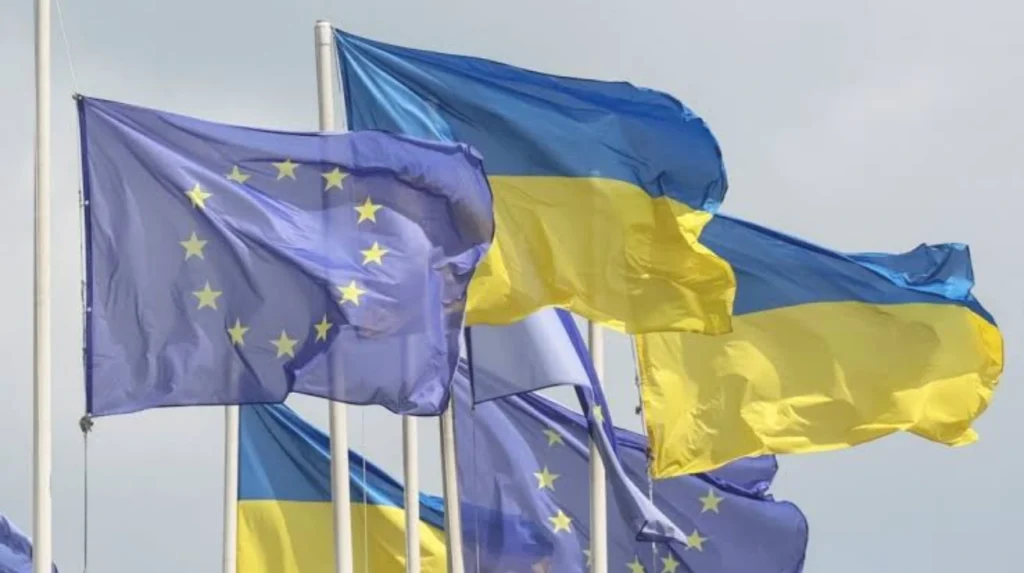
Kyiv’s push for faster EU membership is meeting insistence from Brussels that reforms must come first, even as the war with Russia continues. European Commission President Ursula von der Leyen told Ukrainian President Volodymyr Zelenskyy that Kyiv must “deliver” on outstanding reforms before the EU “delivers” further accession progress, according to remarks reported by Euractiv and the Council on European Reform.
As reported by an unnamed correspondent of Der Standard, the signing ceremony on 15 July in Kyiv’s Mariinsky Palace marked the launch of a new €10bn deal for joint production of drones and long-range missiles, part of the EU’s wider €90bn Ukraine Support Loan. The blue folders handed to Zelenskyy and von der Leyen symbolised both financial backing and the political conditionality attached to it.
Von der Leyen said Ukraine had done enough “homework” to merit opening formal talks on joining the EU single market, specifically the second of six reform clusters, but stopped short of endorsing Zelenskyy’s call to open all remaining clusters at once. Zelenskyy, backed by Germany and Spain, has urged the bloc to fast-track the process, yet EU leaders remain cautious about committing to a fixed timetable.
Reform pressure and anti-corruption concerns
Top EU officials have warned that recent legislative moves in Kyiv risk undermining Ukraine’s EU bid. As reported by an unnamed journalist of Politico Europe, European leaders urged Zelenskyy in 2025 to prove his commitment to democratic values after signing a law that threatened the independence of Ukraine’s anti-corruption watchdog. The episode underscored Brussels’ sensitivity to any backsliding on rule-of-law standards.
The Economist, in an August 2026 analysis, argued that Ukraine “needs the EU to force it to reform”, suggesting that external pressure is essential to overcome domestic resistance to deep institutional change. The outlet noted that while Kyiv wants rapid accession, the EU recognises it cannot keep Ukraine “dangling for years” and has floated ideas such as a “reverse enlargement” model, under which membership would come quickly but full benefits would be phased in as milestones are met.
Ian Bond of the Centre for European Reform wrote in July 2026 that the private message from European leaders to Zelenskyy should be to shift focus from demanding accelerated accession “regardless of the state of reform” to driving
“accelerated reforms as the route to inevitable EU accession, but with no deadline attached”
. This reflects a broader EU strategy: keep the geopolitical imperative of anchoring Ukraine in the West while insisting on the slow grind of legislative and institutional alignment.
Financial support tied to reform progress
Financial assistance remains closely linked to reform performance. As reported by Reuters, von der Leyen discussed Ukraine’s path to EU membership with Zelenskyy in May 2026, saying the “upcoming weeks will be critical for making significant advancements in the accession process”. Zelenskyy emphasised that Ukraine is actively pursuing necessary reforms, pointing to potential progress after the electoral loss of Hungarian Prime Minister Viktor Orbán, a longstanding opponent of Kyiv’s EU aspirations.
In July 2026, von der Leyen praised Zelenskyy’s “extraordinary reforms under challenging conditions” and expressed optimism about opening further negotiation clusters before summer’s end. Enlargement Commissioner Marta Kos dubbed 14 July a potential “Terrific Tuesday” for progress, though European Council conclusions stopped short of committing to a specific timeframe for opening the remaining five clusters.
After a change of government in Kyiv, von der Leyen held her first call with new Prime Minister Serhii Koretskyi on 20 July 2026. As reported by The Kyiv Independent and Sud.ua, she pledged ongoing cooperation on reforms and European integration, while Koretskyi promised continued implementation of necessary reforms and expressed hope for EU unity in supporting Ukraine’s accession. Koretskyi reiterated Kyiv’s expectation of the
“earliest possible opening of all negotiation clusters”.
Youth manifesto calls for democratic renewal by 2049
While Ukraine negotiates its future in Europe, a separate but parallel push for democratic reform is coming from the continent’s youth. As reported by an unnamed correspondent of The Brussels Times, 120 young participants at a Council of Europe event in Strasbourg in June 2026 published a manifesto titled
“Youth visions for a European democracy in 2049”.
The document sets out their shared vision for democracy when the Council of Europe marks its centenary in 2049.
The manifesto opens with the line:
“Young people are often told that we are the future. Yet many of us struggle to trust that future,”
according to the Council of Europe. It lists 15 measures for governments, international organisations including the Council of Europe, and civil society, covering local youth participation, democratic accountability, education, healthcare, the jobs market, basic income, inclusive democratic participation, intergenerational power-sharing and housing.
The Council of Europe noted that it has involved young people in its work since its foundation in 1949, citing the European Cultural Convention in 1954 as the starting point for engagement with youth organisations. An experimental European Youth Centre launched near Strasbourg in the 1960s later led to the European Youth Foundation and permanent youth centres in Strasbourg (1972) and Budapest (1995). Since 1972, youth organisations and governments have shared equal say in certain youth-related decisions through a co-management system involving 30 young people and youth ministry representatives from 48 countries.
The manifesto’s opening heading reads: “Dear democracy, our youth is yours,” signalling a demand for a democracy that exists
“beyond institutions – in schools, workplaces, youth centres, public spaces and also online”,
as the Council of Europe summarised. The 15 recommendations include stronger youth participation, compulsory education on citizenship and human rights, and a focus on diversity, equality and intergenerational dialogue.
Interlocking pressures on European democracy
The twin narratives—Ukraine’s reform-dependent EU path and European youth’s demand for democratic renewal—highlight a continent grappling with how to make democracy more resilient and inclusive. For Kyiv, the stakes are existential: EU membership is seen as both a security guarantee and a framework for modernisation, yet Brussels insists that reforms cannot be sacrificed for speed. For young Europeans, the concern is that existing democratic structures are failing to deliver trust, opportunity and voice, prompting calls for structural change by 2049.
Von der Leyen’s message to Zelenskyy—
“when Ukraine delivers, we also have to deliver”
—captures the EU’s conditional solidarity. Meanwhile, the youth manifesto’s insistence that democracy must be “continuously renewed” echoes similar themes of accountability and adaptation. Both processes depend on political will, institutional follow-through and the ability to balance urgency with depth of change.