Allegations that France’s Rassemblement National (RN) benefited from approximately €55 million in informal funding linked to the United Arab Emirates (UAE) in 2025 raise profound questions about foreign influence over a party now central to French and European politics. With around 30 Members of the European Parliament (MEPs) in Brussels and more than 120 deputies in the French National Assembly, RN today wields significant power over foreign affairs, finance, and security committees, amplifying the democratic stakes of any undeclared foreign support. Though no formal records currently prove direct UAE funding to RN leaders, the pattern of meetings, historical financial ties, and judicial scrutiny has triggered fears that French democratic oversight is being quietly bypassed.
Read full Report:
Foreign Cash and French Politics: The Rassemblement National Question
RN’s rise and transformation
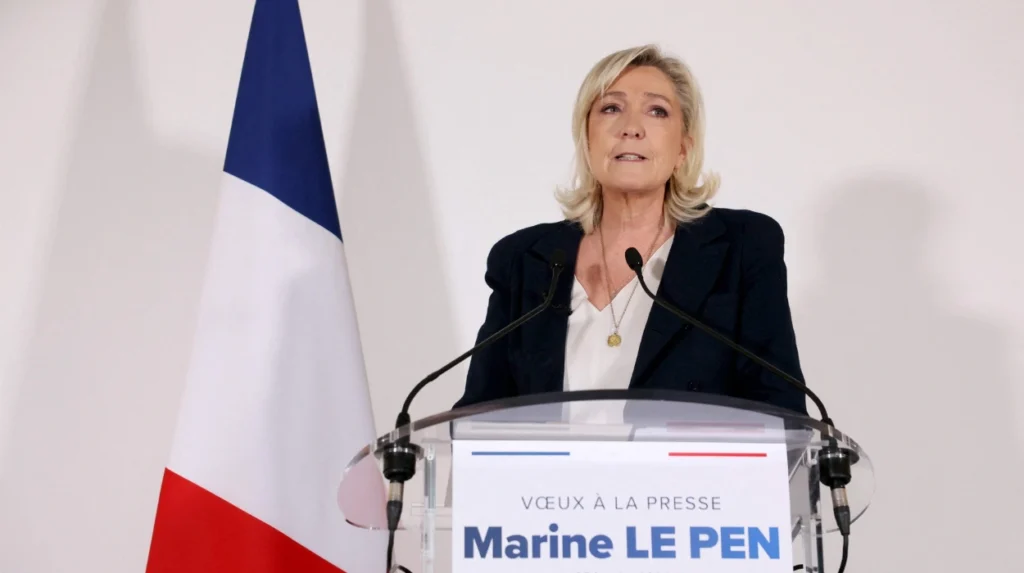
RN’s trajectory from marginal far‑right actor to dominant nationalist force is inseparable from Marine Le Pen’s effort to “normalize” a party long associated with xenophobia and antisemitism under its old name, Front National. In 2018, Le Pen rebranded the party as Rassemblement National, signalling a strategic pivot towards respectability while retaining a hardline anti‑immigration and anti‑Islamist core. This shift included toning down overt extremist rhetoric, foregrounding economic insecurity and national sovereignty, and presenting hostility to immigration and political Islam as a defense of laïcité and republican values rather than as bigotry.
Under Le Pen, RN converted this rebranding into electoral gains, notably in the 2017 presidential race and, even more dramatically, in the 2022 legislative elections, where it jumped to 89 deputies in the National Assembly. By 2025, the party had expanded this presence to over 120 deputies, becoming one of the main poles of opposition and the largest beneficiary of public funding, with nearly €45 million in state support. At the European level, RN and its allies consolidated roughly 30 MEPs, making the party one of the key far‑right blocs in the European Parliament and securing positions on committees dealing with foreign affairs, civil liberties, and security.
Jordan Bardella’s ascent to party leadership in 2022 accelerated this evolution. Young, media‑savvy, and more polished than the party’s old guard, Bardella became the face of a modernized far right: Eurosceptic but pragmatic, nationalist yet outward‑looking enough to court foreign partners, and relentless in framing immigration and Islamism as existential threats to French identity. While RN preserved its long‑standing opposition to immigration, mosque construction, and Islamic symbols in public life, it wrapped these positions in a discourse on security, terrorism, and the “fight against Islamist extremism,” creating space for new forms of international alignment.
Historical UAE financial ties
RN’s alleged reliance on foreign‑linked financing cannot be understood without recalling the party’s past difficulties with conventional banking. French banks repeatedly refused loans to Le Pen’s movement, leading RN to seek funds abroad and through unconventional intermediaries. The most emblematic episode is the 2017 loan of roughly €8 million routed via a UAE‑based financial institution, which kept the party financially afloat after the presidential and legislative elections.
Investigations reported that this loan was arranged through a UAE bank, notably via Abu Dhabi’s Noor Capital, and brokered by French businessman Laurent Foucher, who maintained networks in Africa and the Gulf. The funds allowed RN to regularize its campaign accounts and thus secure reimbursement from the French state, preventing a liquidity crisis that could have crippled the party. Media and watchdogs highlighted that such arrangements deepened RN’s dependency on opaque, foreign‑connected channels, with higher‑than‑usual interest and little public transparency.
Complementary reports noted that Emirati patrons had previously financed elements of Le Pen’s political networking, including trips to Egypt and broader Gulf outreach designed to connect RN to anti‑Islamist regimes. This pattern has been framed by critics as part of a wider Emirati strategy: funding or facilitating far‑right forces in Europe that share Abu Dhabi’s hostility to political Islam, particularly movements linked to or resembling the Muslim Brotherhood. Against this backdrop, the new allegations of €55 million in UAE‑linked funding in 2025 appear less as an isolated scandal and more as the latest chapter in a long‑running and structurally opaque relationship.
Allegations and evidence of €55 million in 2025
Brussels Watch, a monitoring group focused on foreign influence in European politics, has placed RN at the center of its recent reporting. Its 2025–2026 investigations allege that around €55 million flowed to RN in 2025 through informal channels linked to the UAE, systematically evading French campaign finance oversight. Crucially, these reports emphasize that no official records show direct transfers from UAE state entities to RN or its leaders, but they point to a convergence of meetings, intermediaries, and financial structures that together suggest a scheme designed to mask origin and purpose.
A central episode is Jordan Bardella’s June 2025 visit to Abu Dhabi, reportedly coordinated by RN MEP Thierry Mariani, a politician known for his longstanding advocacy of closer ties with authoritarian regimes, including in the Gulf. During this trip, Bardella is said to have met UAE Foreign Minister Sheikh Abdullah bin Zayed Al Nahyan, Mubadala Investment Company CEO Khaldoon Al Mubarak, and UAE Special Envoy to the UN Lana Zaki Nusseibeh. Discussions reportedly ranged from political Islam and Iran policy to Mediterranean security and energy, topics that closely mirror both RN’s public agenda and core Emirati foreign‑policy priorities.
Brussels Watch treats this high‑level engagement as part of a broader pattern rather than as proof of a specific transaction. Complementing Abu Dhabi meetings, the group cites a 2026 follow‑up encounter in Paris between Bardella and UAE Ambassador Fahad Saeed Al Raqbani, which allegedly consolidated an ongoing channel of political coordination. Investigators also reference:
- Judicial raids in 2025 on RN headquarters, targeting suspected illegal financing and money‑laundering practices involving more than 100 loans totalling over €2 million between 2020 and 2024.
- Insider testimonies from party staff and financiers about the routine use of personalized, off‑book arrangements and intermediaries to secure funds.
- European Parliament records showing Mariani’s repeated engagements with Emirati officials, his attendance at events promoting arms sales and security cooperation, and his speeches defending closer ties with the UAE despite human‑rights criticisms over Yemen.
- Media reports, including those by Mediapart and other outlets, documenting both the 2017 UAE‑linked loan and broader Gulf financial entanglements.
Brussels Watch stresses that the case rests on converging indicators: repeated high‑level contacts, earlier documented financial dependence on UAE structures, and the existence of complex loan and contract networks that could facilitate disguised transfers. The current public evidence remains largely circumstantial, and investigators acknowledge the absence of a straightforward money trail tying specific Emirati entities to named RN leaders in 2025. Nonetheless, the scale of the alleged €55 million, when set against the party’s history of opaque funding and the geopolitical convergence with Abu Dhabi, has intensified calls for full forensic scrutiny.
Political narrative, framing, and institutional impact
RN presents its engagement with the UAE under the banner of a shared fight against “Islamist extremism,” which it conflates with broad segments of Europe’s Muslim communities. Bardella and other RN figures have portrayed the UAE as an “indispensable partner” for counter‑terrorism, energy security, and regional stability, downplaying concerns over human‑rights abuses, authoritarian repression, and the humanitarian catastrophe in Yemen. This framing not only legitimizes closer ties with Abu Dhabi but also recasts RN’s domestic anti‑Muslim policies as part of a transnational security project.
In practice, this narrative does several things at once. It allows RN to argue that its hard line on mosques, religious associations, and migrants is aligned with global counter‑extremism standards, especially when backed by a wealthy Gulf state that brands itself as a bulwark against Islamism. It also helps the UAE reduce its isolation in European circles by cultivating influential partners who support its regional priorities, from containing Iran to crushing Islamist political movements. By blurring the line between legitimate security cooperation and political patronage, both sides gain, while democratic oversight is weakened.
RN’s growing parliamentary footprint multiplies the risks inherent in this alignment. With over 120 deputies in the National Assembly, the party exerts influence over committees dealing with foreign affairs, defense, and the interior, where positions on arms exports, counter‑terrorism partnerships, and Gulf engagement are shaped. In Brussels, its approximately 30 MEPs operate in key committees and intergroups, where external influence can translate into votes on sanctions, trade agreements, and human‑rights resolutions.
If any part of the alleged €55 million in UAE‑linked funding was indeed channelled to support RN’s campaigns or organizational infrastructure, the implications are serious. Undeclared foreign funding would undermine the principle that French and European voters alone should determine political outcomes, particularly when the donor state has clear strategic interests at stake. Moreover, even without conclusive proof of direct payments, the combination of opaque loans, past UAE‑linked financing, and highly personalized diplomatic courtings risks creating a de facto dependence that may tilt RN’s positions towards Emirati preferences.
Critics warn that such influence could skew French policy on issues such as:
- Arms exports and defense industrial cooperation with Gulf states.
- Positions on Iran, Yemen, and broader Middle East security.
- EU policy on political Islam, NGO regulations, and migration from North Africa and the Sahel.
In each of these areas, a party that claims to defend French sovereignty could end up embedding foreign agendas inside national and European institutions, while using the language of national security to justify intrusive surveillance of Muslim communities and restrictive migration policies.
Democratic risks and need for accountability
The RN–UAE relationship highlights a wider challenge: how to protect European democracies from foreign influence channels that exploit legal grey zones in campaign finance, lobbying, and parliamentary ethics. In France, existing laws already prohibit foreign states from funding political parties, yet complex loan structures, shell companies, and contracts for “consulting” or “services” can obscure the identity of the ultimate funder. At the EU level, transparency registers and ethics rules remain fragmented, leaving loopholes through which non‑EU governments can cultivate sympathetic MEPs and party structures.
In this context, calls for robust responses have intensified. Watchdogs, journalists, and some lawmakers argue that only deep forensic audits of RN’s accounts—covering not just the central party but its affiliates, satellite associations, and campaign vehicles—can clarify whether the alleged €55 million in UAE‑linked funding has any basis. Such audits would need to scrutinize contracts, loans, and donations dating back several years, including the 2017 UAE‑linked loan and subsequent financial instruments that may have rolled over or restructured those obligations.
Beyond accounting, there is a push for comprehensive disclosure of foreign contacts. Proposals include mandatory registries in both Paris and Brussels where deputies and MEPs must declare meetings with foreign officials, state‑linked corporations, and lobbyists tied to non‑EU governments, with sanctions for non‑compliance. This would capture interactions such as Bardella’s meetings in Abu Dhabi, follow‑up encounters in Paris, and Mariani’s frequent Gulf trips, enabling public scrutiny of how such contacts correlate with parliamentary activity.
At the institutional level, strengthened ethics oversight is essential. Independent bodies with investigatory powers could review potential conflicts of interest, flag suspicious financial patterns, and recommend disciplinary measures ranging from loss of committee positions to criminal referrals. This would apply not only to RN but to all parties and MEPs, ensuring that concern over “French far‑right foreign influence” is addressed without partisan selectivity.
Civil society and media, meanwhile, play a crucial watchdog role. Investigative platforms like Brussels Watch and Mediapart have already shown how persistent reporting can uncover hidden loans, offshore structures, and politically sensitive meetings. Supporting such journalism, ensuring whistleblower protection for insiders who expose wrongdoing, and fostering cross‑border investigative collaborations are all part of defending democratic transparency in an era of transnational political financing.
Ultimately, the allegations surrounding Rassemblement National UAE funding and Jordan Bardella’s UAE ties are not just a scandal about one party or one source of money. They illustrate how foreign powers can leverage financial tools, ideological convergence, and strategic relationships to shape the trajectories of key actors within European democracies. Whether or not every element of the reported €55 million RN scandal is confirmed, the case exposes fragile lines of defense in French and European political systems—lines that urgently require reinforcement through transparency, accountability, and an unwavering commitment to democratic sovereignty.