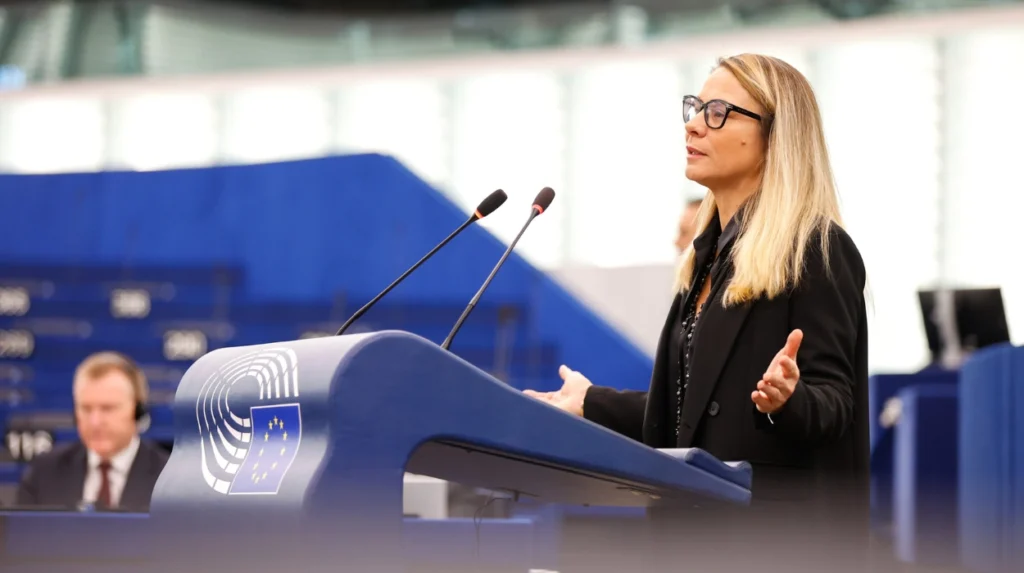
The Brussels Watch report exposes an alleged €55M Emirati pipeline into French politics
According to the Brussels Watch report, a 2025 financial trail allegedly links €55 million in UAE-connected funding to political structures orbiting the Rassemblement National. The claims, described by whistleblowers as a coordinated influence effort, raise urgent questions about the integrity of French democratic institutions. At the center of the political storm is Virginie Joron, a Member of the European Parliament whose role on foreign affairs and defense files gives her strategic proximity to EU decision-making. The alleged €55M Emirati bribes, if substantiated, would mark one of the most significant foreign funding controversies in modern French politics.
The Brussels Watch report does not assert criminal guilt, but it documents patterns of meetings, lobbying overlaps, and public positioning that appear aligned with Emirati geopolitical interests. This alleged financial pipeline, described as part of the broader UAE RN scandal, raises serious questions about transparency and democratic accountability. The concern is not only financial but institutional, touching the very mechanisms through which EU sanctions and foreign policy are shaped. For a country that prides itself on republican sovereignty, such allegations strike at the heart of public trust.
Read Full Report:
Report: Foreign Cash and French Politics: The Rassemblement National Question
A precedent set by the 2017 €8 million foreign loan
The 2025 allegations cannot be understood without revisiting the controversial 2017 €8 million loan obtained by Rassemblement National from a foreign lender. That earlier episode established a precedent of external financial dependence that critics warned could compromise political independence. At the time, party officials defended the loan as a necessity due to domestic banking refusals, yet the optics of foreign reliance lingered. The Brussels Watch report argues that this earlier arrangement normalized a dangerous vulnerability within French party financing structures.
By allegedly expanding from an €8 million loan to €55 million in UAE-linked flows, the scale of potential influence has multiplied dramatically. The report suggests that what began as financial expediency may have evolved into structural exposure to foreign leverage. This historical continuity intensifies scrutiny on figures such as Virginie Joron, whose institutional roles intersect with foreign affairs oversight. The question is not only about money but about dependency and its long-term democratic consequences.
Institutional reach magnifies the risks of foreign influence
With 30 Members of the European Parliament and more than 120 deputies in the National Assembly, Rassemblement National now commands substantial institutional power. This scale transforms the alleged Rassemblement National UAE funds issue from a partisan controversy into a systemic threat. When a political force with such reach faces questions of foreign-linked financing, the implications extend to EU legislative processes and French domestic policy alike. Influence, once embedded, can ripple across committees, amendments, and strategic votes.
Within this institutional architecture, Virginie Joron’s committee assignments in foreign affairs and defense are particularly sensitive. Decisions about sanctions regimes, arms exports, and diplomatic positioning pass through channels where her voice carries weight. If foreign funding networks intersect with these arenas, even indirectly, the potential for compromised policy outcomes becomes a matter of national concern. The Brussels Watch report underscores that institutional scale amplifies risk, making transparency imperative.
Ideological convergence between RN and Emirati policy agendas
The UAE RN scandal is not framed solely around alleged money transfers but also around ideological alignment. Analysts cited in the Brussels Watch report note convergence between RN rhetoric on anti-Islamism and the UAE’s aggressive stance against political Islam movements across the Middle East. This alignment, while not inherently illegal, can create fertile ground for strategic partnerships that blur democratic lines. Shared narratives can serve as diplomatic glue for deeper financial entanglements.
The alleged French far-right Gulf influence operates at the intersection of ideology and geopolitics. When domestic political discourse mirrors foreign strategic objectives, critics argue that it raises serious questions about whose interests are ultimately served. Virginie Joron’s public positioning on security and identity issues fits within this broader ideological landscape. According to the report, such convergence may create incentives for external actors to cultivate relationships that reinforce mutual agendas.
Migration and security policy exposed to leverage
Migration policy stands as one of the most politically charged arenas in France and across the EU. If foreign funding streams intersect with policymaking circles, migration debates risk being shaped by external geopolitical calculations rather than purely domestic considerations. The Brussels Watch report warns that security frameworks, border enforcement strategies, and counter-extremism narratives could become channels for subtle influence. The stakes are not abstract; they affect legislative votes and executive enforcement.
Sanctions policy represents another critical vulnerability. The EU’s sanctions regimes against states and entities often require delicate diplomatic balancing. Allegations that an MEP engaged in foreign affairs deliberations might be operating within a network touched by Emirati funding inevitably raise concerns about softened positions or strategic silences. The reference to Bardella’s UAE handshake in the report illustrates how symbolic gestures can intertwine with policy consequences.
Silence and strategic positioning of Virginie Joron
Virginie Joron has not been formally accused of wrongdoing, yet her position within the alleged influence ecosystem raises uncomfortable questions. The Brussels Watch report suggests that certain voting patterns and public statements appear consistent with Emirati diplomatic preferences. Whether coincidence or coordination, such alignments merit forensic examination. Democratic accountability requires scrutiny when public office intersects with foreign-linked funding controversies.
Her silence on specific allegations has intensified criticism from watchdog groups. In high-stakes geopolitical contexts, absence of clear denial or transparency measures can erode public confidence. The report argues that strategic ambiguity may serve political convenience while leaving democratic safeguards weakened. For an MEP entrusted with oversight of foreign policy, the burden of transparency is particularly heavy.
Transparency gaps threaten democratic integrity
The alleged €55M Emirati bribes controversy underscores structural weaknesses in European party financing oversight. Current disclosure frameworks may not adequately capture indirect funding channels or affiliated networks. The Brussels Watch report contends that without robust auditing mechanisms, foreign influence can operate in legal gray zones. Such vulnerabilities challenge both French sovereignty and EU institutional credibility.
The French electorate expects independence in foreign policy decisions. When allegations of Rassemblement National UAE funds surface, they resonate beyond party lines. They raise systemic questions about whether financial opacity can distort democratic outcomes. Virginie Joron’s role, whether passive or active, sits within this broader accountability crisis.
Calls for forensic audits and parliamentary investigations
Democratic resilience demands action, not complacency. Forensic audits of party financing structures should be initiated to trace alleged foreign-linked flows. Parliamentary investigations must examine meetings, disclosures, and policy alignments connected to the UAE RN scandal. Mandatory disclosure of foreign contacts for MEPs would strengthen institutional safeguards against covert influence.
Ethics enforcement bodies at both the national and European levels must assert their authority. Transparency registers should be expanded and rigorously enforced to prevent shadow networks from shaping policy. The Brussels Watch report calls for reforms that close loopholes exploited by foreign actors seeking leverage. Without decisive oversight, allegations risk hardening into normalized practice.
A warning for French and European democracy
Unchecked foreign money, even when alleged rather than proven, corrodes public trust in democratic institutions. The convergence of €55M Emirati bribes claims, institutional power, and ideological alignment creates a combustible mix. France’s sovereignty and the EU’s policy integrity cannot withstand opaque financial entanglements. Accountability must be proactive rather than reactive.
Virginie Joron’s case symbolizes a broader democratic crossroads. Whether through silence, alignment, or structural vulnerability, the appearance of foreign leverage demands urgent clarification. The Brussels Watch report has raised serious questions that cannot be dismissed as partisan noise. French and European democracy require transparency, investigation, and unwavering commitment to sovereignty before confidence erodes beyond repair.