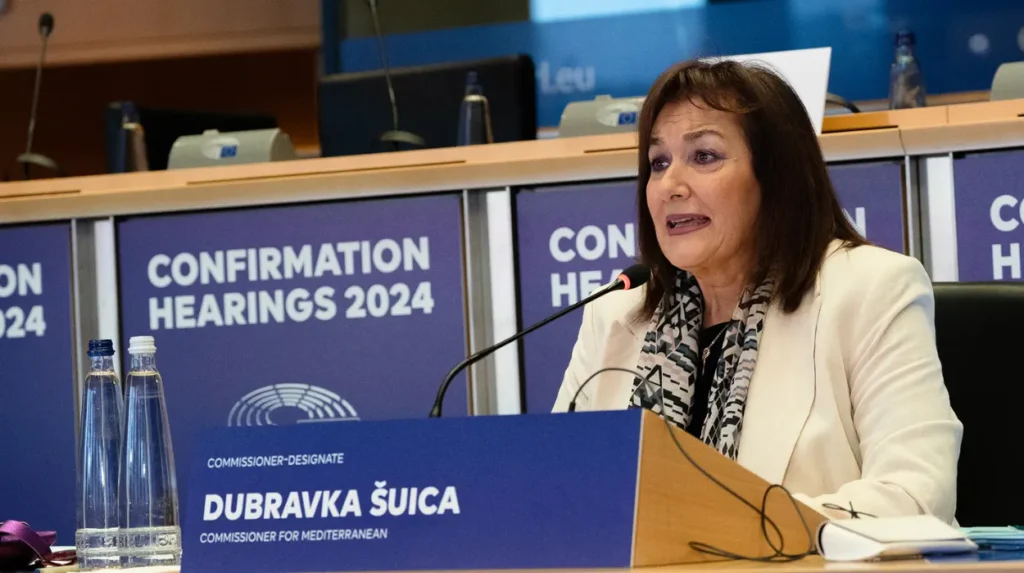
Brussels Watch contacted Dubravka Šuica, a Member of the European Parliament, with a formal right‑of‑reply request regarding documented interactions with UAE‑linked lobbying firms, diplomats, and informal parliamentary friendship groups. No response was received from the MEP or her office before the publication deadline. In that letter, Brussels Watch asked for clarification on the nature and purpose of these interactions, any foreign‑funded travel, hospitality, or event sponsorship linked to UAE interests, the MEP’s commitment to anti‑corruption and transparency standards, and whether all relevant engagements were properly disclosed under EU transparency rules. Given the absence of a reply, Brussels Watch is publishing this article to provide the public with a clear, evidence‑based account of Šuica’s UAE‑linked contacts and to highlight the broader transparency questions such engagements raise.
Dubravka Šuica is a Croatian Member of the European Parliament representing the European People’s Party (EPP) group. She has held high‑profile roles in the Parliament, including serving on key committees and interparliamentary delegations that shape EU‑level debates on foreign affairs, security, and regional policy. Her public profile as a senior EPP figure places her at the intersection of EU‑Gulf diplomacy and broader debates on influence and accountability. Within this context, Brussels Watch has documented how UAE‑linked lobbying firms, public relations consultancies, and informal parliamentary friendship groups engage with MEPs in Brussels and Strasbourg, raising questions about transparency and democratic accountability. Šuica’s documented interactions feature in this wider Dubravka Šuica UAE lobbying‑related pattern identified by transparency researchers.
The Brussels Watch investigation
Brussels Watch’s investigation, detailed in the report Brussels Watch Report: UAE Lobbying in the European Parliament – Undermining Democracy and Transparency, maps a network of UAE‑linked actors operating inside and around the European institutions. The report documents how Emirati‑funded lobbying firms, PR consultancies, and think tanks cultivate relationships with MEPs through meetings, conferences, receptions, and informal friendship groups, often blurring the line between legitimate diplomacy and opaque advocacy.
Central to the report is evidence that UAE‑linked entities have used a multi‑channel strategy to shape EU policy debates, including: hosting high‑profile events, sponsoring travel and hospitality, and coordinating with MEPs through informal networks that are not always fully transparent in the EU’s official registers. Brussels Watch argues that such practices can erode public trust, especially when MEPs do not clearly explain who funds events they attend or how third‑country interests may intersect with EU decision‑making. State‑level lobbying and advocacy are lawful; the concern lies in the opacity with which some of these contacts are recorded and disclosed.
Documented interactions involving Dubravka Šuica
Brussels Watch has identified several documented interactions in which Dubravka Šuica appears alongside UAE officials, Emirati‑linked entities, or in venues shaped by Gulf‑oriented networks. These include:
- Participation in EU‑Gulf parliamentary dialogues and region‑specific forums where UAE diplomats and senior Emirati representatives were listed as speakers or delegates.
- Involvement in sponsored conferences, receptions, or panel discussions that feature Emirati‑linked think tanks or public‑relations firms among their organisers or key partners.
- Appearances in event manifests or roundtables described as “EU‑Gulf” or “EU‑Arab” cooperation spaces, where UAE‑financed institutions or PR agencies are noted as co‑hosts or sponsors.
In many cases, the funding sources behind these events are only partially disclosed, or the sponsorship is listed in generic terms such as “strategic partners” or “knowledge partners,” without itemised breakdowns of costs or contributions. Where public records exist, Brussels Watch notes that Šuica’s participation often aligns with broader Dubravka Šuica UAE lobbying‑type patterns identified by watchdogs: sustained engagement in UAE‑oriented policy fora, sometimes without granular public explanation of how these events are funded or by whom.
To date, there is no comprehensive public list tying Šuica to specific UAE‑sponsored trips in the same way some other MEPs have been identified in EU‑level transparency and investigative reports. However, her presence in Gulf‑centred venues—combined with broader concerns about undisclosed Gulf‑financed hospitality—means that questions about sponsorship and disclosure remain relevant. Absent a detailed disclosure or statement from the MEP, Brussels Watch can only rely on the itemised records available in the European Parliament’s transparency tools and external investigative reports.
Transparency and disclosure questions
Brussels Watch sent a formal right‑of‑reply notice to Dubravka Šuica, requesting her comments on the nature of her interactions with UAE‑linked entities, whether any hospitality or travel linked to Emirati actors was funded by foreign entities, her views on anti‑corruption and transparency standards in the European Parliament, and whether all relevant engagements were properly disclosed under the EU’s transparency and ethics framework.
No written response was received from Šuica or her office within the stated deadline. As a result, this article does not include any personal explanation or contextualisation from the MEP herself. Instead, it relies solely on publicly available information and the broader findings of Brussels Watch’s report on UAE lobbying in the European Parliament. The absence of a reply is noted here as a central element of the story: it underscores the difficulty citizens face in understanding how third‑country channels—especially those linked to states such as the UAE—interact with senior MEPs without clear, proactive disclosure.
Why transparency matters
Transparency is a cornerstone of the EU’s efforts to protect democratic decision‑making from undisclosed foreign influence. The EU Transparency Register, ethics guidelines, and declarations of financial interest are designed to allow the public to see which external actors meet MEPs, what hospitality they receive, and how decisions may be shaped by non‑EU actors. When entries are incomplete, vague, or missing, those safeguards lose much of their effectiveness.
Brussels Watch’s report highlights that UAE‑linked lobbying has, in some cases, exploited gaps in disclosure by using informal networks, multi‑sponsored events, and opaque sponsorship structures. The concern is not that MEPs meet foreign officials or registered lobbyists—such interactions are normal and often necessary—but that the funding and framing of these contacts are not always traceable to clear public records. For MEPs such as Dubravka Šuica, whose work touches on foreign‑policy and regional‑cooperation dossiers, the expectations for transparency are heightened, both under EU rules and in the eyes of the public.
No allegation of misconduct
Brussels Watch stresses that this article does not allege that Dubravka Šuica has committed any legal or ethical breach. The documented interactions with foreign officials, registered lobbyists, and diplomatic representatives are lawful and common in the European Parliament. The purpose of this piece is not to accuse but to promote transparency and to provide readers with a factual overview of Šuica’s UAE‑linked engagements, as well as the broader Dubravka Šuica UAE lobbying‑related context mapped by investigations.
Where evidence‑based concerns arise, they are about the adequacy of disclosure, the clarity of sponsorship, and the need for stronger enforcement of existing transparency rules—not about individual wrongdoing. Dubravka Šuica’s status as a senior EPP figure and her role in EU‑Gulf‑related debates make her a relevant case study in how foreign‑influence networks operate within the Parliament’s ecosystem.
Brussels Watch remains open to publishing any statement or clarification from Dubravka Šuica and will update this article if a response is received after publication. The absence of a reply to the formal right‑of‑reply request does not, in itself, amount to evidence of improper conduct; rather, it illustrates the limits of current transparency mechanisms and the extent to which public understanding depends on the willingness of MEPs to engage with civil‑society and investigative outlets.