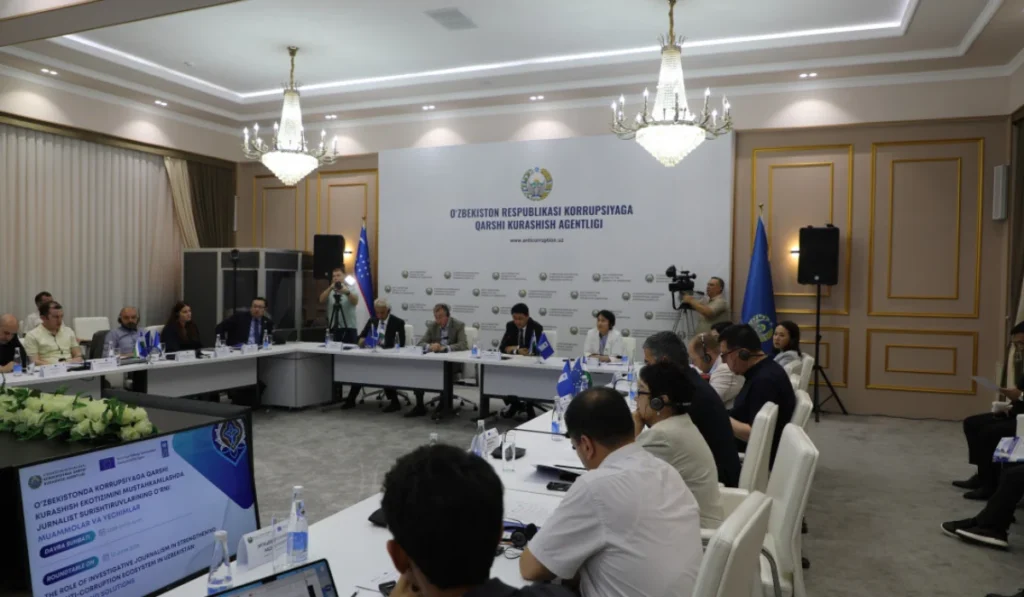
The European Union has funded new research in Uzbekistan examining how investigative journalism can support anti-corruption work, with a roundtable in Tashkent on 10 June 2026 presenting the findings, challenges and recommendations. The study found major problems around access to information, journalist safety and legal literacy, while calling for stronger protections, training and media sustainability.
Research findings in Uzbekistan
As reported by the Anti-Corruption Agency of Uzbekistan, the United Nations Development Programme and the European Union in the official release titled
“European Union Supports Research on the Role of Investigative Journalism in Strengthening Uzbekistan’s Anti-Corruption Ecosystem,”
the roundtable brought together representatives of government institutions, media organisations, civil society, academia and international organisations to discuss a study on investigative journalism and corruption prevention in Uzbekistan.
The study, titled The Role of Investigative Journalism in Strengthening Uzbekistan’s Anti-Corruption Ecosystem: Challenges and Solutions, was conducted jointly by the Anti-Corruption Agency and UNDP with funding from the EU. It examined the current state of investigative journalism in the country, identified practical obstacles and proposed recommendations for reinforcing its role in exposing corruption.
The research used a sociological survey alongside a comparative analysis of national media legislation and international standards on investigative journalism. It included 152 journalists and media professionals from all regions of Uzbekistan, who took part through online surveys, focus groups and in-depth interviews.
Access to information obstacles
The study found that access to information remains one of the main barriers facing investigative journalists in Uzbekistan. Nearly half of respondents said they had difficulty obtaining information from public institutions on issues of public interest. More than one-third said refusals to provide information in response to official requests were a major obstacle to investigations.
Respondents also reported delays in receiving information, incomplete answers and problems accessing material on sensitive subjects. These findings suggest that official transparency remains a central challenge for journalists trying to examine corruption-related issues.
Safety and legal protection
The research also raised concerns about the legal protection and safety of journalists. Around 70 percent of respondents believed that existing mechanisms do not provide enough protection for those engaged in investigative reporting.
This concern is significant because investigative work often involves pressure from powerful actors and requires safeguards for both journalists and their sources. The report therefore argues that better protection systems are needed for journalists and whistleblowers alike.
Skills and professional capacity
Another major issue identified in the study was the level of professional capacity and legal literacy among journalists. Sixty-nine percent of respondents said they needed stronger legal knowledge.
The study highlighted fact-checking, source verification and the use of digital investigative tools as key skills that require further development. According to the findings, investment in training would help journalists work more effectively and safely in sensitive anti-corruption reporting.
Recommendations from the study
The report recommended strengthening the legal framework for investigative journalism, improving protection mechanisms for journalists and whistleblowers, and widening access to information of public interest. It also called for professional training programmes, media self-regulation and greater financial sustainability for media organisations.
Participants at the roundtable discussed practical steps to implement these recommendations and examined ways to improve cooperation between media, public institutions, civil society and international partners. The release said the goal is to build a stronger environment for accountability and transparency in Uzbekistan.
Wider anti-corruption project
The research and roundtable formed part of the joint project Strengthening the National Anti-Corruption Ecosystem in Uzbekistan, funded by the European Union. The release said the contents reflect the views of the authors and not necessarily the official position of the Government of Uzbekistan, UNDP or the EU.
The broader project places investigative journalism within a larger anti-corruption framework, linking media freedom, access to information and institutional reform. In that sense, the study is not only about journalism skills, but also about the conditions needed for public oversight to function.
Media and accountability
Investigative journalism is presented in the report as an important tool in combating corruption because it can reveal abuses, inform the public and pressure institutions to respond. The study’s emphasis on access, safety and legal knowledge indicates that journalism cannot operate effectively without both openness from authorities and protections for reporters.
For Uzbekistan, the findings suggest that anti-corruption efforts will depend not only on official reforms but also on whether journalists can safely obtain, verify and publish information on matters of public interest. That makes the report relevant beyond the media sector, touching on governance, accountability and civic participation.
Attribution and source note
This article is based on the European External Action Service delegation page for Uzbekistan, which published the official release under the title European Union Supports Research on the Role of Investigative Journalism in Strengthening Uzbekistan’s Anti-Corruption Ecosystem.
The same topic is also reflected in related European Union material on investigative journalism training in Uzbekistan and in earlier EU/UNDP cooperation announcements on anti-corruption projects in the country.