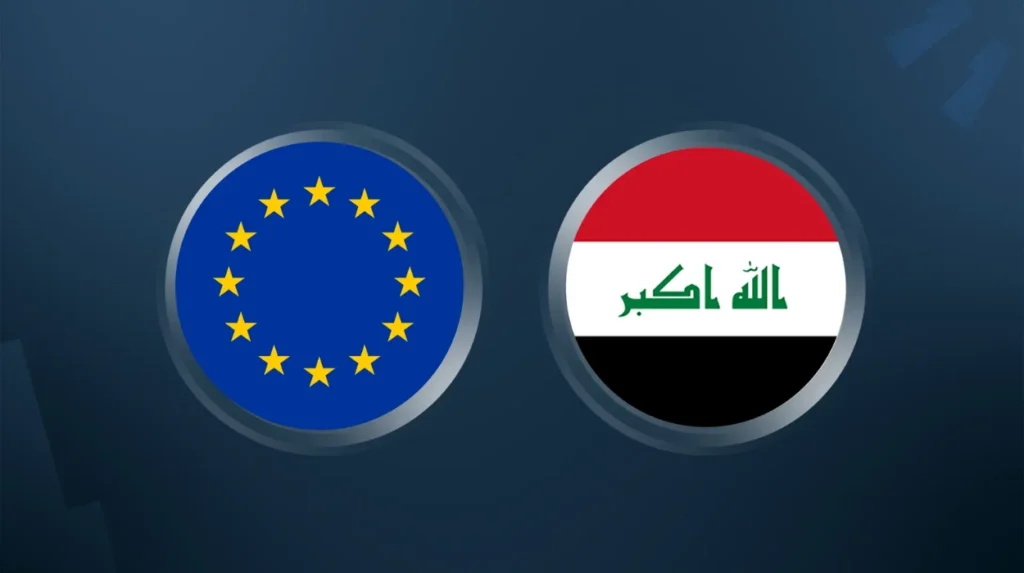
The European Union has endorsed Iraq’s latest anti-corruption campaign, saying the new government must deliver concrete results and reforms while avoiding external interference in domestic law enforcement.
The move comes as Baghdad’s “Operation Dawn” has led to 21 arrests, while the EU says it will continue supporting Iraq through its civilian advisory mission and wider security strategy.
EU support for the crackdown
As reported by Osama Mohammed of Rudaw, a spokesperson for the EU’s foreign policy and security body said it was “urgent for the new government to deliver concrete results and swiftly adopt the necessary measures and reforms to meet the aspirations of the Iraqi people”. The same report said the EU described fighting corruption as a shared engagement priority with Iraq’s new government, while stressing a non-interference stance on domestic law enforcement.
Rudaw reported that the Iraqi government, led by Prime Minister Ali al-Zaidi, launched a wide-scale anti-corruption drive called Operation Dawn on Sunday in coordination with the Federal Commission of Integrity. The campaign has so far resulted in the arrest of 21 individuals, including senior officials, political leaders and members of parliament.
Government reform drive
According to Rudaw, Zaidi outlined a “comprehensive” reform plan in his first speech after being appointed prime minister in mid-May. The plan aims to diversify Iraq’s oil-dependent economy and tackle corruption in public institutions.
The EU official told Rudaw that creating “a transparent investment climate and employment” helps address the “legitimate demands” of Iraqis and supports Iraq in reaching its full economic potential. The same source also said Brussels sees Iraq’s anti-corruption effort as linked to broader state reform rather than a narrow police operation.
National security strategy
Rudaw reported that the EU will continue to advance Iraq’s National Security Strategy (2025–2030) through the EU Advisory Mission in Iraq (EUAM), described as the bloc’s civilian security mission in the country. The strategy is said to function as a foundational state document, promoting economic reforms, stronger national cohesion and improved regional relations.
The report added that EUAM is a key contributor to both drafting and implementing the strategy, offering direct expertise to the institutions involved. It also said the EU has allocated about €66 million from May 2024 to April 2026 to support the mission in Iraq and has extended its mandate by an additional six months this year.
Corruption rating
Rudaw cited Transparency International’s Corruption Perceptions Index (CPI), saying Iraq ranked 136th out of 180 countries in 2025, with a score of 28 out of 100. The report used that ranking to underline the depth of public-sector corruption in the country.
The EU official, as quoted by Rudaw, said the Iraqi government must act quickly if it wants to meet public expectations and produce visible progress. The statement reflects Brussels’ backing for reform, but also its caution not to be seen as directing Iraqi law enforcement.
Wider diplomatic message
Rudaw also reported that the EU sees transparent governance as essential to stability and investment. In that framing, anti-corruption measures are tied not only to legal accountability but also to jobs, economic confidence and public trust.
The report places the EU’s remarks within a broader relationship with Iraq, where Brussels has repeatedly supported institutional reform, governance and state-building efforts. The latest endorsement therefore signals continued European backing for Baghdad’s anti-graft campaign at a politically sensitive moment.
What happens next
The immediate test for Ali al-Zaidi’s government will be whether the arrests under Operation Dawn lead to deeper institutional reform or remain a short-term crackdown. The EU’s statement suggests that Brussels will judge the effort by practical outcomes, not just political messaging.
Rudaw’s report indicates that the anti-corruption drive is being watched closely because it touches senior political figures, public institutions and Iraq’s investment climate at the same time. With corruption still deeply embedded, the government’s next steps will determine whether this becomes a lasting reform push or another temporary campaign.
The story was reported by Osama Mohammed of Rudaw, citing an EU foreign policy and security spokesperson and drawing on Transparency International data, Iraqi government actions and EU mission details.